

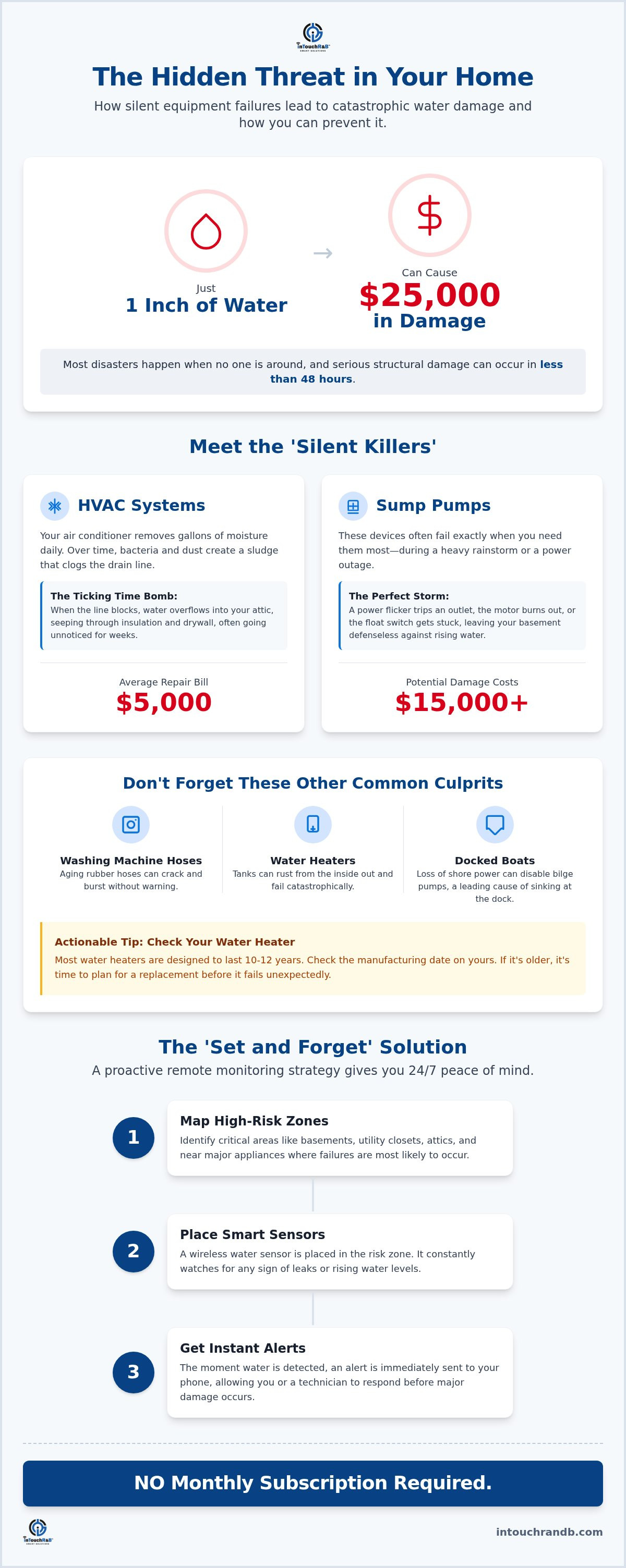
Did you know that just one inch of water can cause approximately $25,000 in damage to your home? It’s a sobering thought, especially since most disasters happen when no one is there to notice the leak. When you’re focused on preventing water damage from equipment failure, you’re really fighting a battle against time. Whether it's a sump pump failing during a midnight storm or an HVAC condensate line (the pipe that carries away excess moisture) slowly backing up, these silent killers can turn a peaceful property or vessel into a construction zone in less than 48 hours.
It’s normal to feel anxiety when you’re away from your property, wondering if you'll return to a flooded mess and a high insurance deductible. We believe you deserve to feel secure without checking your equipment every day. This guide explains how to set up a "set and forget" monitoring system that acts as a watchful guardian. For instance, if a pump fails, a sensor detects the water and immediately sends an alert to your phone. You’ll learn simple maintenance steps to keep machinery running and how proactive monitoring provides peace of mind while traveling. By the end, you will have a clear, actionable plan to protect your assets from the stress of unattended failures.
For property owners who prefer a professional system design, UTD Technology Corp provides comprehensive technology systems for residential and commercial properties to ensure every vulnerability is covered.
NO Monthly Subscription Required.
Key Takeaways
- Understand how to identify hidden mechanical risks in your home, such as HVAC (heating and cooling) drain clogs and sump pump failures, before they lead to costly repairs.
- Discover why many boats are most vulnerable while docked and how monitoring your shore power connection ensures your bilge pumps stay active and ready.
- Master the essential steps for preventing water damage from equipment failure by mapping out high-risk zones and selecting the right remote connectivity for your property.
- See how browser-based monitoring tools can notify both you and your repair technician instantly, ensuring a fast response to any water intrusion.
- Protect your property and gain total peace of mind with a reliable, "set and forget" monitoring system that features NO Monthly Subscription Required.
What is Equipment-Driven Water Damage?
While many property owners worry about heavy rain or rising rivers, a significant threat lives inside your utility closet. Equipment-driven water damage is caused by internal mechanical failures rather than external forces like storms. It is the difference between a roof leak and a washing machine hose that finally gives up. For a deeper dive into the broader context, understanding water damage helps clarify how these internal issues often lead to the most expensive restoration projects. These incidents are uniquely frustrating because they are entirely preventable with the right oversight.
This type of failure is treacherous because it often starts where you can't see it. A slow drip inside a wall or a cracked condensate pan (the tray that catches moisture from your AC) in a dark attic can go unnoticed for weeks. By the time you see a damp spot on the ceiling, the structural damage is already well underway. Successfully preventing water damage from equipment failure requires looking beyond the obvious signs and focusing on the hidden mechanics of your home or business.
There is often a predictable "chain reaction" that leads to disaster. Imagine a summer storm causes a brief power flicker. This might trip a GFCI outlet, which is a safety device that shuts off power when it detects an electrical imbalance. If your sump pump is plugged into that outlet, the pump is now dead. The storm continues, but the pump cannot clear the rising water. Because this happens while you are asleep or away, the failure goes unnoticed until the basement is submerged. The cost of this silence is high, as undetected leaks allow mold to take hold within 24 to 48 hours.
Common Culprits in Home and Business
HVAC systems are a leading cause of trouble. Bacteria and algae can build up in drain lines, creating a "time bomb" of sludge that eventually causes the system to overflow. Using a specialized tool like the HVAC Minder can catch these overflows before they ruin your drywall. Sump pumps are another frequent point of failure. These rely on a float switch, which is a small ball that rises with water to turn the pump on. If that switch gets stuck or the motor burns out during a heavy surge, the Sump Pump Minder provides the necessary alert to save your basement. Finally, aging washing machine hoses and water heaters are constant risks that deserve regular inspection.
The Reality of Unattended Properties
If you own a vacation home or a rental property, the risk is even higher. While "Home Watch" services provide a visual check once a week, they don't offer the 24/7 protection needed for a sudden burst. If a leak starts on Monday and the check isn't until Friday, the damage will be catastrophic. Proactive monitoring bridges this gap, acting as a watchful guardian even when the property is empty. Actionable Tip: Check the manufacturing date on your water heater. Most units are designed to last about 10 to 12 years. If yours is older, it's time to consider a replacement before it fails.
NO Monthly Subscription Required.
The 'Silent Killers': HVAC and Sump Pump Failures
While a burst pipe is loud and obvious, the most destructive leaks often happen in total silence. HVAC systems and sump pumps are the primary culprits behind this invisible flooding. In your attic, your air conditioner removes gallons of moisture from the air every day. This water usually travels through a small plastic drain line, but over time, bacteria and dust create a thick sludge, often called bio-slime, that clogs the pipe. This turns your attic into a ticking time bomb. When the line blocks, water has nowhere to go but down through your insulation and drywall, leading to an average repair bill of $5,000.
Sump pumps face a different kind of stress. These devices often fail exactly when you need them most: during a heavy rainstorm accompanied by a power outage. If the pump loses power or the motor burns out from overwork, your basement can quickly fill with water. Since a failed pump can lead to damages upwards of $15,000, preventing water damage from equipment failure requires more than just hoping the machinery works. You need a way to know the second the water level rises beyond a safe point, especially if you are away from home.
In warm, humid climates, the danger isn't just the water itself. If your AC unit fails, the indoor humidity spikes almost immediately. This creates a perfect breeding ground for mold, which can begin to grow in as little as 24 to 48 hours. Actionable Tip: To keep your drain lines clear, pour one cup of distilled white vinegar down your HVAC condensate drain line every three to four months. This simple step kills the algae and bacteria that cause most clogs.
HVAC Monitoring Essentials
Most modern systems have a secondary drip pan designed to catch overflows from the primary line. However, if you aren't checking that pan daily, you won't know it's full until the water leaks through the floor. Integrating a remote notification system allows you to receive an alert the moment moisture hits that secondary pan. By using an HVAC Minder, you can track both water intrusion and environmental factors like temperature and humidity, giving your technician time to fix the issue before your ceiling sags. If you want to see how these sensors fit into your home setup, you can explore our monitoring solutions today.
Sump Pump Best Practices
Many homeowners rely on a battery backup, but these aren't foolproof. Batteries can die, and backup pumps can fail just as easily as the primary one. You need to know if your backup system has been triggered or if the water is still rising. A quick, five-minute test of your float switch, the ball that triggers the pump, can prevent a catastrophic flood. Simply lift the float manually to ensure the pump kicks on. For 24/7 vigilance, a Sump Pump Minder provides real-time alerts to your phone, ensuring you’re never left in the dark when the water starts to rise.
NO Monthly Subscription Required.
Protecting Your Boat and Mobile Assets from Water Intrusion
While we often focus on the foundations of our homes, boat owners face a unique set of challenges. It's a startling reality that 69% of boat sinkings happen right at the dock, not out on the open sea. These incidents are rarely the result of a massive storm; instead, they usually stem from a slow, mechanical breakdown that goes unnoticed. Preventing water damage from equipment failure on a vessel isn't just about fighting the ocean. You're managing a delicate balance between your bilge pumps and your electrical supply.
A common disaster begins with a simple shore power failure. If a breaker trips on the marina pedestal or your power cable is accidentally disconnected, your onboard battery charger stops functioning. Your bilge pumps, which are the last line of defense against packing gland leaks or through-hull failures, begin to draw directly from the batteries. Eventually, the batteries drain completely. Without power, the pumps stop, and the boat begins to take on water. This isn't just a concern for boats in "wet slips," which are slips where the boat remains in the water. Trailered boats and RVs are also vulnerable to internal plumbing leaks or heavy rain accumulation that can ruin an interior during the off-season.
Actionable Tip: Take five minutes to reach into your bilge and manually lift the float switch on your pump. Check for any debris like loose zip ties, fishing line, or stray wires that could jam the float in the "down" position. A jammed float prevents the pump from ever turning on, regardless of how much water is in the boat.
Bilge Pump Monitoring for Vessel Security
Standard high water alarms are helpful, but they only trigger once the situation is already an emergency. A more effective strategy is to monitor your pump "cycles," which refers to how often the pump actually turns on. If your pump usually runs once a week but suddenly starts cycling every hour, you have a developing leak that needs immediate attention. You can see how the Bilge Minder protects against dockside sinking by tracking these cycles and sending an alert to your phone before the water level becomes critical.
Shore Power and Battery Health
Monitoring your battery voltage is the first line of defense for any boater. If your voltage drops below a healthy level, it's a clear sign that your shore power has failed or your charger is malfunctioning. By receiving an alert the moment your power is lost, you can reach the dock and reset the breaker before your batteries die. For those who keep their vessels at remote slips or storage lots where internet is spotty, you can learn about monitoring systems without WiFi that use cellular connections to keep you informed.
NO Monthly Subscription Required.
Building a Proactive Remote Monitoring Strategy
Creating a reliable defense plan doesn't have to be complicated, but it does require a structured approach. A clear strategy is the most effective way of preventing water damage from equipment failure, especially when you can't be on-site to witness a leak. Instead of relying on luck, you can follow five simple steps to build a monitoring system that acts as a watchful guardian for your property. First, identify your high-risk zones. These are typically areas like the attic (HVAC), basement (sump pump), or the bilge of a boat. Once you know where the risks are, you can move through the implementation process with confidence.
The second step involves choosing your connectivity. WiFi is usually the best choice for a primary residence, while cellular options are ideal for remote docks or RV storage lots. Third, place your sensors at the "first point of contact." This means the sensor should be exactly where water will first accumulate, such as the very bottom of a drip pan. Fourth, configure multi-recipient alerts. You can set the system to notify you, a trusted neighbor, or even your preferred service technician simultaneously. Finally, always perform a "wet test." Simply touch a damp cloth to the sensor to ensure the alert reaches your phone immediately. This verification gives you the peace of mind that the system is ready to respond when it counts.
Smart Sensor Placement Tips
Where you put a sensor is just as important as having one. For washing machines and dishwashers, a "presence" sensor (a device that detects liquid on a flat surface) should be placed on the floor directly behind or under the appliance. This is different from a "high water" sensor, which is designed to monitor rising levels in a tank or bilge. If you're ready to secure your property, browse our full line of Minder sensors to find the right fit for your high-risk zones.
Actionable Tip: When installing an HVAC sensor, place it about 1/4 inch from the bottom of the secondary drain pan. This small gap prevents "nuisance" alerts caused by normal, minor condensation while still catching a genuine overflow before it reaches your ceiling.
Managing Alerts and Notifications
Your monitoring system should work for you, not create extra stress. You can configure different urgency levels, such as receiving a quiet email for a low-battery warning and a loud text message for a water intrusion event. Because these systems use cloud-based reporting, no alert is ever lost. If your home loses power, the cloud detects the "heartbeat" failure and notifies you that the system is offline. For those managing seasonal homes, check out our guide to remote monitoring for vacant properties to see how these tools handle long-term absences.
NO Monthly Subscription Required.
The inTouch R&B Advantage: Smart Security Solutions
Most property owners only think about their equipment when it stops working. This reactive approach is why water damage remains one of the most expensive insurance claims today. At inTouch R&B, we focus on a proactive philosophy. Instead of waiting for a flood to announce a failure, our technology acts as an ever-present guardian that identifies trouble the moment it starts. Successfully preventing water damage from equipment failure means catching a slow drip in an attic pan before it becomes a collapsed ceiling—a principle of resilience that also applies to enterprise environments where you can discover Bio-Cognitive Solutions for protecting mission-critical data centers.
Our setup process is designed to be straightforward and accessible. You won't need to navigate a complicated app store or worry about constant software updates. We use a browser-based setup, sometimes called a Captive Portal, that lets you connect your device to your local network in just a few minutes using any smartphone or tablet. Once your device is online, you have customizable control over your alerts. You can name your specific locations, such as "Guest Bath Sump" or "Main Deck Bilge," so you know exactly where the issue is located the second an alert hits your phone.
Reliability is at the core of everything we build. We understand that sensors often live in harsh environments. Whether it's the intense heat of a summer attic or the damp, corrosive atmosphere of a boat bilge, our hardware is rugged enough to maintain protective vigilance 24/7. This durability ensures that your monitoring system is just as tough as the machinery it's watching over.
Why Choose inTouch R&B Minders?
The "Minder" lineup offers specialized solutions tailored to your specific needs. From the HVAC Minder that tracks attic overflows to the Bilge Minder designed for vessel security, we provide targeted protection for your most vulnerable assets. If you're unsure which model fits your situation, you can view our Comparison Matrix of all Minders to see the features of each system side-by-side. This clarity helps you build a defense strategy that covers every high-risk zone on your property.
Getting Started with Your Protection
If you're ready to move from worry to peace of mind, our introductory offers provide everything you need to secure your home or boat immediately. Actionable Tip: When you configure your notification settings, set up a secondary alert for a trusted neighbor or your preferred HVAC technician. If a leak occurs while you're traveling or out of cell range, having a second pair of eyes on the situation ensures a faster response and less damage. Don't wait for a flood to realize you need a monitor; proactive protection is the only way to ensure your property stays dry and your deductibles stay in your pocket.
NO Monthly Subscription Required.
Take Control of Your Property's Safety
Protecting your home or boat isn't about constant worry; it's about having the right information at the right time. By shifting from a reactive mindset to one of proactive vigilance, you can avoid the $5,000 average cost of an HVAC flood or the heartbreak of a sunken vessel. Since 69% of boat sinkings happen right at the dock, these events are almost entirely preventable with reliable sensors that monitor your bilge and shore power. Successfully preventing water damage from equipment failure is simply a matter of placing a watchful guardian in your high-risk zones and letting technology do the heavy lifting.
Whether you are managing a vacation home from a distance or keeping an eye on your primary residence, the relief of being informed is invaluable. You now have the tools to identify hidden risks, place sensors strategically, and set up alerts that notify you before a drip turns into a disaster. Don't wait for a failure to catch you off guard. Secure your property today with inTouch R&B—NO Monthly Subscription Required.
NO Monthly Subscription Required.
Frequently Asked Questions
What is the most common cause of water damage from equipment?
HVAC condensate drain clogs and aging washing machine hoses are the most frequent causes of internal flooding. These "silent" failures often happen in areas like attics or laundry rooms where they stay hidden until the damage is severe. By the time you notice a ceiling stain, the repair costs have already started to climb. Regular inspections and sensors are the most effective ways of preventing water damage from equipment failure.
How do I monitor my boat's bilge pump if I don't have WiFi at the dock?
If you don't have WiFi at your dock, you should use a cellular-based monitoring system. These devices connect directly to mobile networks, making them perfect for remote marina slips or dry storage lots. This setup ensures that your Bilge Minder can still send alerts to your phone if the water level rises or if your shore power is disconnected. It provides total security without needing a local internet connection.
Can a sump pump fail even if it has a battery backup?
A sump pump can definitely fail even with a battery backup in place. The most common issues are mechanical, such as a jammed float switch that prevents the pump from ever turning on. Additionally, backup batteries have a limited lifespan and can fail to hold a charge over time. Without a remote monitor to alert you that the backup is running, you might not realize there's a problem until it's too late.
What should I do if my HVAC drip pan is full of water?
You should shut off your air conditioning system immediately to stop more water from accumulating. A full secondary pan is a clear sign that your primary drain line is clogged with debris or bacteria. After turning off the power, use a wet-dry vacuum to clear the drain line and empty the pan. Once the line is clear, you can restart the system and check for any remaining leaks.
Is it possible to receive alerts on my phone for a water leak?
Yes, it's very easy to receive instant alerts on your smartphone the moment a leak is detected. Modern sensors use your home WiFi or a cellular connection to send text messages or emails directly to you. This real-time notification is the foundation of preventing water damage from equipment failure. It allows you to contact a neighbor or a technician before a small drip becomes a catastrophic flood.
How often should I test my remote monitoring sensors?
We recommend performing a "wet test" on your sensors at least once every three to four months. This simple task involves touching a damp cloth to the sensor probes to ensure the device triggers an alert. It’s also a good idea to check your sensors during seasonal transitions, such as when you first turn on your AC for the summer or prepare your boat for the winter.
Do I need a professional to install an inTouch R&B Minder?
You don't need a professional to install our products. Each Minder is designed for a simple, browser-based setup that you can complete using your own smartphone or tablet. There are no complicated apps to download and no professional wiring is required for standard home use. Most owners can have their system up and running in just a few minutes, providing immediate protection for their critical equipment.
What happens if my property loses power; will the monitoring still work?
If your property loses power, our cloud-based monitoring service will notice that your device has stopped sending its regular "heartbeat" signal. When this happens, the system automatically sends you an offline notification to let you know there's a power or connectivity issue. This ensures that you're never left in the dark about the status of your property, even during a total blackout.
NO Monthly Subscription Required.

Article by
Jimmy Nesbitt
Principle
Be the first to comment