

Imagine returning to your summer cottage or your boat after a month away, only to be met by the damp smell of mold or the sight of a flooded floor. It's a nightmare scenario that many owners face, particularly with national rental vacancy rates hitting 7.3% in early 2026. If you've been looking for a reliable way to keep a watchful eye on your assets, remote monitoring for vacant properties has become an essential strategy to prevent small mechanical failures from turning into total losses.
We know how exhausting it is to deal with the "subscription trap" where security companies demand a monthly fee just to let you see your own data. You want the peace of mind that comes from being informed, not another recurring bill. This guide will show you how to build a proactive, subscription-free monitoring system that puts you back in charge. We'll explain how smart sensors can act as a digital guardian, triggering an immediate notification to your phone if a sump pump fails or a power outage occurs. You're about to discover a professional way to secure your property, boat, or RV from anywhere in the world without a middleman standing in the way.
Key Takeaways
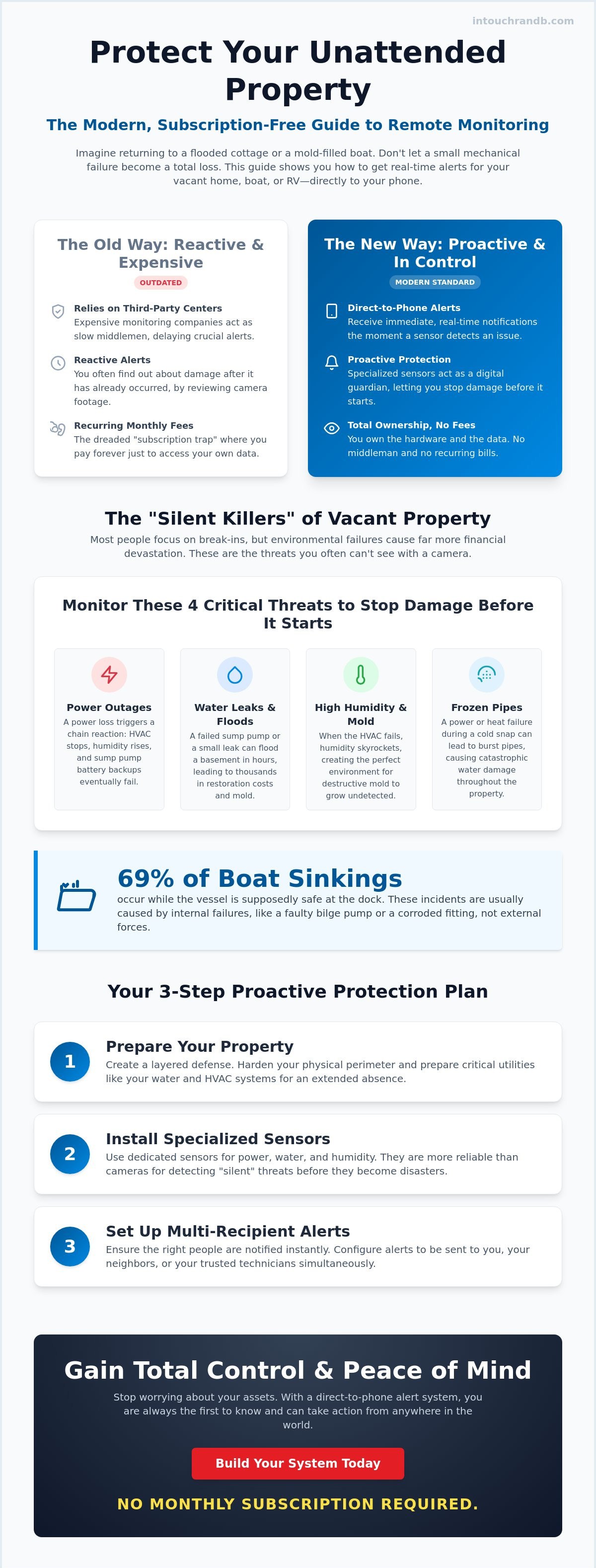
- Learn how modern remote monitoring for vacant properties allows you to receive direct, real-time alerts on your phone, making expensive third-party monitoring centers a thing of the past.
- Follow a practical checklist to harden your property's perimeter and prepare critical utilities, like your water and HVAC systems, for an extended absence.
- Discover why specialized sensors are more reliable than cameras for detecting "silent" threats like power outages, basement leaks, or high humidity levels.
- Set up a multi-recipient notification system that ensures you, your neighbors, or your technicians are all informed the moment a sensor detects a problem.
- Adopt a proactive security strategy that stops physical and environmental damage before it starts, giving you total control over your home or boat.
Understanding the New Standards for Vacant Property Security
When we talk about remote monitoring for vacant properties, we aren't just describing a camera pointed at a front door. In 2026, true remote monitoring is a 24/7 proactive alert system that acts as a digital guardian for your most valuable assets. It's the difference between watching a recording of a disaster and receiving a live notification that allows you to stop the damage before it starts. This technology has evolved to focus on the health of the property itself, ensuring that your home, boat, or RV remains in peak condition while you're away.
The landscape of property protection has shifted significantly. For years, owners relied on professional monitoring centers to bridge the gap between an alarm and a response. However, modern advancements have made these expensive middlemen redundant for many owners. Today, high-speed connectivity and smart sensors allow for direct-to-phone communication that is faster and more accurate than a third-party call center. By adopting these New Standards for Vacant Property Security, you gain immediate transparency without the delay or the monthly bill of traditional security models.
To better understand this concept, watch this helpful video:
There is a common misconception that remote monitoring is only for traditional real estate. We call this the "unattended asset" paradox. Owners often worry about their primary residence but leave their boat or RV completely vulnerable. These assets are essentially mobile homes; they have complex plumbing, electrical systems, and climate needs. A boat docked at a marina is just as susceptible to a power failure or a plumbing leak as a suburban house, yet it often lacks the same level of vigilance. Shifting your mindset from reactive security, like checking camera footage after a weekend, to proactive vigilance through sensors is the key to total asset protection.
External vs. Internal Property Threats
Most people associate property risk with physical intrusion, such as theft or vandalism. While these are valid concerns, environmental failures are often the "silent killers" of vacant properties. A slow water leak or a failed air conditioning unit can cause far more financial devastation than a broken window. For boat owners, the statistics are even more sobering. Research from organizations like BoatUS indicates that 69% of boat sinkings occur while the vessel is supposedly safe at the dock. These incidents are usually caused by internal failures, like a faulty bilge pump or a corroded through-hull fitting, rather than external forces.
The Financial Impact of Undetected Failures
The cost of a single undetected failure can be staggering. When a Sump Pump Minder isn't there to alert you to a pump failure, a basement can flood within hours, leading to thousands of dollars in restoration costs and permanent mold issues. Similarly, a power loss during a cold snap can lead to frozen pipes that eventually burst, causing catastrophic water damage throughout a home. Power loss often triggers a chain reaction; the HVAC stops, the humidity rises, and critical systems like sump pumps eventually lose their battery backup. Proactive maintenance is identifying a fault before it leads to a flood.
The Comprehensive Vacant Property Security Checklist
Preparing a property for a long absence is about more than just turning a key. It's about creating a layered defense that protects your investment from every angle. When you implement remote monitoring for vacant properties, your physical preparations work in tandem with your digital alerts. This dual approach ensures that if a physical barrier is breached or a mechanical system fails, you're the first to know. By following a structured plan, you can leave your home or boat with the confidence that you've accounted for both obvious and hidden risks.
Hardening the Physical Perimeter
Your first line of defense is always the most visible. Start by upgrading to high-quality deadbolts and reinforcing window locks. These simple mechanical upgrades provide a baseline level of security that deters casual intruders. To build a more robust plan, you can consult The Comprehensive Vacant Property Security Checklist for detailed physical security standards. Beyond locks, you should focus on the "illusion of occupancy." This means ensuring your lawn is mowed, mail is forwarded, and lights turn on and off at natural intervals. A static timer is easy for observers to spot; instead, you can find tools on a comparison matrix of all minders that help you manage lighting and more to keep your property from looking like an easy target.
Securing Internal Utilities and Equipment
While perimeter security keeps people out, utility management keeps the property intact. For homeowners, this starts with the plumbing. If you're leaving a property in a cold climate, a full "drain down" of the plumbing system is a smart move to prevent burst pipes. You should also ensure your HVAC drip pans are clear and that your sump pump is in good working order. Before you leave, go through this quick utility audit:
- Test the sump pump by manually lifting the float switch to ensure it triggers.
- Clean out HVAC condensate lines to prevent blockages that lead to leaks.
- Inspect shore power cords on boats for signs of wear, heat, or corrosion.
- Shut off the main water valve if the property doesn't require irrigation or fire suppression.
A Sump Pump Minder can be a lifesaver during this process, sending an alert if the water level rises unexpectedly. For boat and RV owners, the checklist is slightly different. You'll want to verify your bilge pump is clear of debris and that your battery voltage is stable. A sudden drop in voltage often signals a shore power failure, which could disable your entire monitoring setup. Using an AC Minder allows you to track power status in real time. If the power goes out, you'll receive a notification before the batteries die and the cabin starts to grow mold. These small steps provide the practical foundation needed for true peace of mind. You can explore proactive monitoring tools that help you manage these checklists from any location.
Environmental Monitoring: Defending Against Silent Killers
A camera can show you someone walking up your driveway, but it's blind to the water pooling in your basement or the heat wave killing your boat's refrigerator. While it is important to explore CCTV Surveillance Systems from specialists like Asset Resources Group for visual security, sensors are far more effective than video surveillance alone for detecting environmental failures. In the context of remote monitoring for vacant properties, sensors act as early warning systems for issues that don't make a sound. By catching a leak or a power failure in its first few minutes, you can prevent a minor mechanical hiccup from becoming a catastrophic insurance claim. Many insurance providers now recognize the value of this technology, often offering lower deductibles or premium discounts for owners who use active monitoring to mitigate risk.
Detecting Water Intrusion and Pump Failures
Water damage is a relentless threat that often starts where you can't see it. A common but overlooked risk is a clogged HVAC condensate line. This is the small pipe that carries moisture away from your air conditioner. If it clogs, water can overflow into an attic or ceiling, causing thousands of dollars in structural damage before you ever see a drop. For those with vessels on the water, a Bilge Minder provides this same level of security by watching the water levels in your hull while you're away. It's a proactive way to ensure your boat stays afloat without needing a physical inspection every day.
To get the most out of your system, don't just monitor the basement. Place sensors near high-risk appliances like water heaters, dishwashers, and washing machines. These are the most frequent sources of internal floods in unoccupied homes. A Sump Pump Minder ensures that if your primary defense fails during a heavy storm, you'll know immediately. It sends a notification the moment the water level crosses a critical threshold, giving you a window of time to act before the floor is ruined.
Managing Temperature and Humidity Remotely
Temperature and humidity are the primary drivers of mold growth, especially in coastal environments. If your air conditioning fails while you're out of town, the "dew point" can be reached quickly. This is the temperature at which air becomes saturated and moisture forms on surfaces, leading to mold in boat cabins and warped wood in homes. Using an HVAC Minder allows you to set specific thresholds for temperature and humidity so you aren't left guessing about the air quality inside. The relief of receiving a simple text alert the moment your AC unit stops functioning is immense. It gives you the chance to call a technician before the air becomes stagnant and the damage becomes permanent.
Choosing the Right Remote Notification System
The hardware you install is only as good as the notification system that tells you something is wrong. Effective remote monitoring for vacant properties relies on speed and accuracy. You have two main choices: a third-party monitoring center or direct-to-phone alerts. While call centers were once the standard, they often introduce a frustrating delay. By the time a dispatcher calls you to report a power failure, your freezer might already be thawing. Direct alerts via text or email cut out the middleman, ensuring you're the first to know the moment a sensor is triggered. For a deeper dive into these options, check out our Remote Notification Systems Guide.
Modern systems use a "trigger and response" mechanism that is both simple and effective. For example, when an AC Minder detects a loss of shore power, it immediately sends a signal to the cloud, which then pushes an alert to your device. This happens in seconds, not minutes. Setting up multi-recipient alerts is also a smart move. If you're on a long-haul flight or in a meeting, having a neighbor or a trusted technician also receive the notification ensures that someone can respond even if you can't. This redundant layer of communication is what provides true asset security.
WiFi vs. Cellular: Reliability in Remote Locations
Reliability depends heavily on your connection type. While WiFi is convenient for a suburban home, it's often the weakest link for boats and RVs. If the local power grid goes down, your router dies, and your monitoring system goes dark. We discuss this in detail in The Myth of WiFi-Dependent Monitoring. For the best protection, consider a cellular-based system or ensure your WiFi router is connected to a robust uninterruptible power supply (UPS) to maintain connectivity during an outage.
Configuring Your Alert Frequency
You can usually customize how often you hear from your system. Some owners prefer a "heartbeat" message once a day just to know everything is fine, while others want real-time updates. Knowing the exact time a power loss occurs is critical for more than just security. If you know the power went out at 2:00 PM on a Tuesday, you can calculate exactly how long your refrigerator has been without cooling. This precision removes the guesswork and the anxiety that usually accompanies travel. The relief of being informed is the ultimate cure for that "did I leave the stove on?" feeling. To find the right setup for your specific needs, you can view our full range of monitoring solutions.
Proactive Protection with inTouch R&B Solutions
After reviewing the checklists and environmental risks, it's clear that successful remote monitoring for vacant properties depends on having the right tools in place before a crisis occurs. At inTouch R&B, our philosophy centers on being proactive rather than reactive. Reactive security tells you that a disaster happened; proactive protection tells you it's about to happen so you can stop it. This shift in mindset is what separates a stressful property ownership experience from one defined by peace of mind. By choosing hardware designed for specific mechanical and environmental threats, you're investing in a watchful guardian that never sleeps.
For those managing larger homes or multiple structures, the AC Minder 3-Pack provides a comprehensive way to monitor power status across an entire property. You can place one in the main house, one in the guest cottage, and one in the detached garage. If a circuit breaker trips or a local outage occurs, you'll know exactly which area is affected. For owners with mobile assets, our GPS Tracking System offers an extra layer of security for trailered boats and RVs. It ensures that if your asset moves without your permission, you're notified immediately. This is professional-grade security that works for you, giving you the same level of protection used by high-end facilities without the complexity or the high overhead.
Specialized Minders for Every Asset
One of the best things about this technology is its versatility. The same sensors that protect a luxury yacht in a marina can be used to guard a family vacation home in the mountains. For those managing high-end investments, AShock Enterprises offers professional guidance on luxury real estate that pairs perfectly with a proactive security plan. Whether you're worried about a bilge pump failure or a frozen pipe, there's a specialized minder for the job. These sensors are designed for easy installation, utilizing Bluetooth and WiFi-enabled technology to get you up and running in minutes. We believe in providing "A value you cannot ignore" by offering reliable hardware that simplifies long-term property care. You don't need to be a tech expert to secure your assets; you just need the right partner in your corner.
The Freedom of Ownership
The traditional security industry is built on the idea of keeping you locked into a contract. We believe you should own your security, not rent it. There are significant financial benefits to owning your hardware outright. When you buy an inTouch R&B system, you're done with the payments. There are no recurring fees to access your data or receive your alerts. Our secure cloud reporting ensures that no alert is ever lost, providing a chronological record of every event at your property. This transparency is vital for insurance documentation and your own personal records. You deserve a solution that prioritizes your safety and your budget equally. NO Monthly Subscription Required.
Secure Your Peace of Mind Today
Protecting your property shouldn't be a source of constant stress or a drain on your wallet. By shifting from a reactive mindset to a proactive one, you can catch environmental threats like water leaks or power outages before they lead to catastrophic damage. This modern approach to remote monitoring for vacant properties puts you in the driver’s seat, allowing you to manage your home, boat, or RV from anywhere in the world.
Since 2014, inTouch R&B has brought over a decade of remote monitoring expertise to owners who value reliability. Our specialized sensors are designed for the unique challenges of marine, RV, and residential environments. Because we use secure cloud-based reporting, you have the assurance that no alert is ever lost. You can view our full comparison matrix to find the right Minder for your property and start building your subscription-free security strategy today. You've worked hard for your assets; now let a professional-grade system give you the freedom to enjoy your time away with total confidence.
NO Monthly Subscription Required.
Frequently Asked Questions
What is the biggest risk for an unoccupied property?
Water damage is the leading cause of loss for empty buildings and vessels. Whether it's a burst pipe or a failed sump pump, liquid can destroy flooring and grow mold in just a few days. Remote monitoring for vacant properties allows you to detect moisture before it spreads. A practical tip is to place sensors at the lowest point of your basement or near high-risk appliances like water heaters.
How can I monitor my vacant home without a monthly subscription fee?
You can monitor your home without fees by choosing "direct-to-user" hardware. These systems send alerts straight to your smartphone via text or email, bypassing the need for a central call center. This setup gives you full control of your security data. It's a one-time investment in hardware that provides long-term protection without the burden of a recurring bill.
Will my insurance cover damage if my property is unoccupied?
Standard insurance policies in the US often include vacancy clauses that may limit or void coverage if a property is empty for more than 30 or 60 days. To maintain protection, many owners must add an "unoccupied property" rider or demonstrate that the home is being actively managed. Using a remote system to log environmental data provides a digital trail of vigilance that can be helpful during the claims process.
Is WiFi or cellular monitoring better for remote properties?
Cellular monitoring is the more reliable choice for remote locations. While WiFi is common, it depends on your router having power and a stable internet connection. If the power goes out, your WiFi goes down too. Cellular sensors operate independently, making them ideal for boats at a dock or cabins where the internet service might be spotty or unreliable during a storm.
What happens to my remote monitoring system during a power outage?
When the power fails, an AC Minder detects the drop in voltage and sends an immediate alert. Most hardware includes a battery backup or a "last gasp" feature that ensures the notification reaches your phone before the device shuts down. This trigger and response mechanism allows you to respond to the outage before secondary systems, like your refrigerator or sump pump, stop working.
Can I monitor my boat bilge pump and my home sump pump with the same system?
Yes, you can monitor different assets within the same account. You might use a Bilge Minder for your vessel and a Sump Pump Minder for your primary residence. This unified approach to remote monitoring for vacant properties ensures that all your "unattended assets" are protected by the same reliable alert system, regardless of where they're physically located.
How do I get notified if my HVAC system fails while I am away?
You receive a notification through an HVAC Minder that tracks temperature and humidity. If your air conditioner fails in the summer, the humidity inside will spike. The sensor detects this change and sends a text alert to your phone. This gives you a window of time to call a technician before mold starts to grow in the stagnant indoor air.
Is it difficult to install remote monitoring sensors myself?
Installation is designed to be a simple, do-it-yourself process. Most sensors are either plug-and-play or involve connecting a few clearly labeled wires to your existing equipment. You won't need to hire an expensive technician or deal with complex programming. Most owners can have their entire system active and testing within less than thirty minutes.
NO Monthly Subscription Required.

Article by
Jimmy Nesbitt
Principle
Be the first to comment