

Did you know that 69% of boat sinkings actually happen while the vessel is sitting right at the dock? It's an unsettling thought for any owner who has to leave their boat unattended between weekend trips. You probably already know the nagging worry of wondering if a heavy storm tripped your shore power or if a bilge pump finally gave out. Installing a reliable cellular boat monitoring system is the most effective way to replace that anxiety with real-time data. By using LTE-M cellular networks, which are the specialized frequencies used by modern smart devices for better range and reliability, these systems act as a 24/7 guardian for your bilge, batteries, and cabin environment.
We all want the peace of mind that comes with knowing our boat is safe without having to drive to the marina every time the weather turns. In this guide, you'll learn how to set up a system that sends immediate text alerts the moment high water is detected or power is lost. We will explore how to protect your vessel from sinking, battery failure, and even theft using modern, responsive sensors. We're going to break down exactly how these monitors work and how you can achieve total vessel security with a simple, reliable setup that keeps you informed every second of the day.
Key Takeaways
- Understand why a cellular boat monitoring system is more reliable than marina WiFi; if the dock loses power, your cellular system stays active while WiFi-dependent monitors go offline.
- Discover how to track bilge pump activity and battery levels so you can catch small mechanical issues before they turn into expensive insurance claims.
- Follow our guide to setting up your system, from performing a baseline equipment check to finding the best central location for your communication hub.
- See how multi-recipient alerts and secure cloud servers ensure no alert is ever lost, notifying both you and your marina manager the moment a sensor is triggered.
- It's easy to gain the peace of mind that comes with professional vessel security and NO Monthly Subscription Required.
Why Every Unattended Boat Needs a Cellular Monitoring System
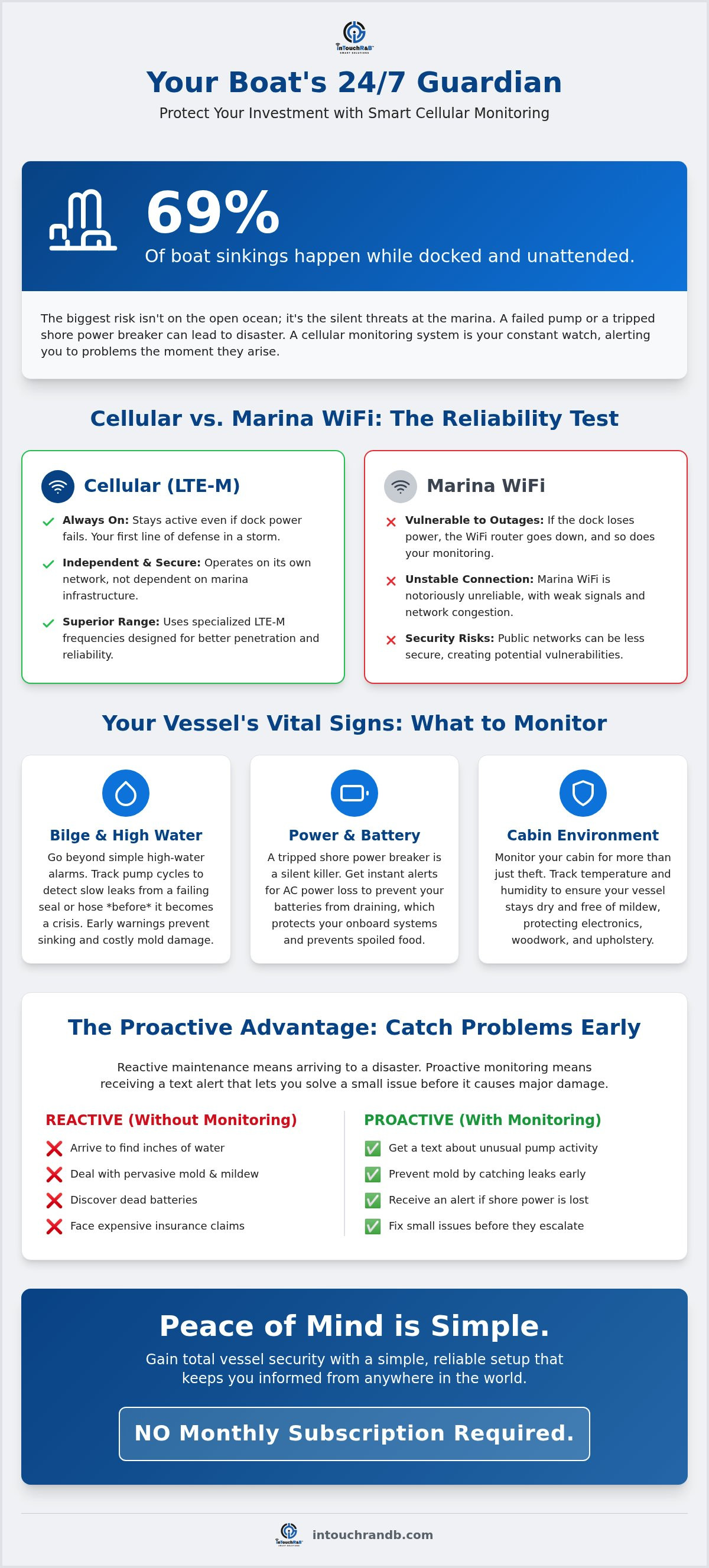
Most boat owners think of the open ocean as the most dangerous place for their vessel. But statistics tell a different story. According to BoatU.S., 69% of boat sinkings actually happen while the boat is sitting right at the dock. This highlights the "Unattended Boat" risk. Your boat spends the majority of its life without you there to hear the bilge pump running or notice a shore power trip. A cellular boat monitoring system acts as a remote "eyes-on-glass" solution, giving you a live look at your boat's vitals from your smartphone.
While many marinas offer free WiFi, relying on it for safety is a gamble. Marina WiFi is notoriously unstable. If the dock loses power during a storm, the WiFi router goes down immediately. This happens exactly when you need an alert the most. Choosing a reliable cellular boat monitoring system means you aren't gambling on the marina's infrastructure. These systems use dedicated networks that stay active even when the local power grid fails, ensuring you never miss a critical notification.
The Role of a Remote Communication Hub
The heart of any modern setup is the communication hub. This device acts as a central brain that collects data from various sensors like the Bilge Minder. It then pushes that data to the cloud. While professional Vessel Monitoring Systems (VMS) are often used for commercial tracking and regulatory compliance, consumer cellular hubs focus on your personal safety. They move you away from local sirens that no one hears to instant mobile notifications. This transition means that whether you're at the office or on vacation, you'll know the moment something changes on your boat.
Proactive vs. Reactive Boat Maintenance
There's a massive difference between finding a problem and receiving an early warning. Reactive maintenance is what happens when you arrive on Saturday morning to find three inches of water in the cabin and the smell of mold. Proactive maintenance is getting a text on Tuesday night saying your bilge pump has cycled five times in the last hour. Early detection doesn't just prevent sinkings; it stops secondary damage before it starts. Consider these benefits of an early warning:
- Mold Prevention: Catching a leak early keeps humidity levels low and prevents mildew.
- Battery Health: Getting alerts for power loss prevents deep-cycle batteries from draining completely.
- Asset Protection: Monitoring shore power ensures your fridge stays cold and your food doesn't spoil.
For long-distance owners, this technology provides a sense of protective vigilance. You don't have to wonder if your batteries are draining or if your fridge is warming up. You simply check your phone and see that everything is exactly as it should be.
Critical Boat Systems Your Remote Monitor Should Watch
Instead of monitoring every single wire on your boat, focus on the three systems that keep your vessel afloat and operational. Insurance data shows that water ingress, electrical failure, and theft are the primary drivers of claims. A cellular boat monitoring system should prioritize these specific threats so you don't get buried in useless data. By adopting a stance of protective vigilance, you can ensure that you only receive alerts that actually require your attention.
Bilge Pump Activity and High Water Alerts
High water alerts are essential, but they are often the final warning before a disaster. You want to be proactive. A pump that runs frequently suggests a failing shaft seal or a leaking hose. If your pump runs for 15 minutes straight, it's a red flag. You can choose between a wired sensor for maximum reliability or a wireless one for an easier install. Many owners prefer the Bilge Minder because it tracks these cycles precisely, letting you see patterns on your phone before the water reaches the floorboards. Don't ignore the signs of a pump that's working too hard.
Shore Power and Battery Health Monitoring
Shore power is the lifeblood of your boat's systems while docked. A simple tripped pedestal breaker can start a destructive chain reaction. When the AC power cuts out, your charger stops, and your batteries begin to carry the entire load of the fridge and electronics. Eventually, the voltage drops to a critical level, perhaps reaching 11.37 VDC (Volts Direct Current). At this point, the batteries are too weak to start the engines or even run the bilge pumps. This leads to spoiled food, cabin mold, and eventually, a sinking risk. It's smart to monitor your AC connection to catch these trips before the batteries die. We recommend setting your voltage alerts to 12.2V to give yourself a healthy buffer.
Environmental and Security Sensors
Security monitoring keeps your boat safe from more than just intruders. While a formal Vessel Security Plan is a regulatory requirement for larger commercial ships, recreational owners need a practical way to detect unauthorized boarding. Simple sensors on canvas snaps or cabin doors can alert you to movement instantly. Installing a cellular boat monitoring system also allows you to track humidity and temperature. This prevents the "science experiment" that happens when your climate control fails in the summer heat. You can find more details in our HVAC remote monitoring guide. Protecting these core systems ensures your boat is always ready for your next adventure. Explore our full range of boat protection sensors to build your custom setup.
Cellular vs. WiFi: Which Boat Monitoring is Actually Reliable?
Choosing between a WiFi-based monitor and a cellular boat monitoring system often comes down to a choice between convenience and true reliability. Many boaters assume that because the marina offers free internet, they should use it to save on data costs. However, in a real-world emergency, that "free" connection is often the first thing to fail. If you want a watchful guardian for your vessel, you need to understand how these signals behave in a marine environment.
The Hidden Weakness of Marina WiFi
Marina WiFi networks are notoriously crowded and unstable. Signal interference is a constant battle because every mast, hull, and stainless steel railing acts as an obstacle. Even if you have a strong signal at the dock office, it may be non-existent by the time it reaches your slip. Another major hurdle is the "captive portal" (the login screen where you have to click 'I Agree' to get online). Most simple monitoring sensors can't navigate these screens, meaning they'll never actually connect to the internet.
Actionable Tip: Before you buy any system, stand at your boat's helm and check your phone's WiFi signal. If you see fewer than two bars or if the connection frequently drops and reconnects, a WiFi-only monitor will likely fail when you need it most. You should also check if the marina's power and WiFi routers are on the same circuit; if they are, a dock power failure will take your monitoring offline instantly.
Why Cellular is the Gold Standard for 2026
By 2026, LTE-M (Long Term Evolution for Machines) has become the industry standard for maritime security. This technology is a specialized version of cellular service designed specifically for smart devices. It offers much better "penetration" than standard cell signals, meaning it can reach deep into a fiberglass or wood hull where a standard phone might struggle. Because a cellular boat monitoring system operates independently of the dock's infrastructure, it continues to work even if the marina's internet goes down or the local power grid fails.
To ensure total reliability, modern hubs include internal backup batteries. When the boat's main battery bank is disconnected or fails, the hub stays alive long enough to send a "dying gasp" alert. This is where Cloud Reporting becomes vital. Our systems use secure cloud servers that act as a middleman. If your boat's hub stops checking in for any reason, the server notices the silence and sends you a notification. This "heartbeat" monitor ensures that no alert is ever lost, giving you the relief of knowing that silence actually means safety.
Bluetooth sensors are often used for short-range communication inside the cabin, but they shouldn't be your primary link to the outside world. They simply lack the range to reach the dock from inside the bilge. A robust system uses cellular for the long-distance heavy lifting while using wired or short-range wireless connections for the individual sensors.
Essential Tips for Setting Up Your Boat’s Remote Alert System
Setting up your cellular boat monitoring system doesn't have to be a complicated weekend project. Before you even mount the first sensor, it's vital to establish a baseline for your vessel. Test your batteries with a multimeter and run your bilge pumps manually to ensure everything is in peak condition. If you install a monitor on a system that's already failing, you'll spend your first week chasing "ghost" alerts instead of enjoying the peace of mind you bought the system for.
Step-by-Step Configuration Strategy
Most modern communication hubs use a temporary captive portal for the initial setup. You'll connect your smartphone to the hub's private WiFi signal and enter a default IP address, typically 192.168.4.1, into your browser. This is where you'll link the hub to the cellular network and name your sensors. We recommend being as specific as possible. Naming a sensor "Main Salon Bilge" or "Engine Room Battery" is much more helpful than a generic "Sensor 1" when you're looking at an alert on your phone. Once you're done, verify the status by looking at the LED indicators on the hub; a solid Green light usually confirms power, while a Blue light shows you're successfully connected to the cloud.
Actionable Tips for Sensor Placement
The location of your hub determines its reliability. You should position it in a central, high location, away from heavy metal shielding or appliances like microwaves that can disrupt the signal. When mounting high-water sensors, place them roughly two inches above the point where your bilge pump normally activates. This prevents "nuisance alarms" from tiny amounts of condensation but still gives you an early warning if the pump can't keep up. For those protecting expensive gear, our asset tracking solutions provide excellent guidance on where to hide GPS antennas for maximum security.
Securing Trailered Boats from Theft
A cellular boat monitoring system is just as valuable on a trailer as it is in a slip. By setting up a GeoFence (a digital perimeter around your boat's location), you'll get an immediate text if the trailer is hitched up and towed away. You can even use the "Anchor Watch" feature while the boat is in your driveway to detect unauthorized movement. Pairing this with motion sensors in cockpit compartments ensures that any attempt to board or tamper with your vessel is met with an instant notification. If you're ready to secure your investment, you can browse our full line of remote boat monitors to find the perfect fit for your setup.
The inTouch R&B Advantage: Professional Security Without the Monthly Fee
The inTouch R&B system is built for the owner who wants professional-grade protection without the burden of complex management. When you invest in a cellular boat monitoring system, you're essentially hiring a digital watchman that never sleeps. Our "No Alert is Lost" guarantee is backed by secure cloud servers that track every signal from your vessel. If a sensor triggers, the system doesn't just hope you see a notification; it pushes immediate text or email alerts directly to your phone. You can even set up multi-recipient notifications so both you and your marina manager get the news at the same time. This ensures that if you're stuck in a meeting or traveling, someone on-site can step in to check your lines or bilge pumps immediately.
Installing these components is a straightforward DIY process designed for the modern boat owner. You don't need to be a marine electrician to get your hub online. By following the simple setup steps we discussed earlier, you can have your entire vessel under a protective umbrella in just one afternoon. It's about practical application rather than technical frustration.
Customizable Alerts and Reporting
One of the most practical features is the ability to choose how often your boat checks in. You can set alert frequencies to hourly, daily, or on-demand depending on your specific needs. This flexibility allows you to stay informed without feeling overwhelmed by data. Additionally, the system maintains a detailed bilge pump activity log. This isn't just a safety feature; it's a valuable document for resale value. Being able to show a prospective buyer a clean log of pump activity proves that the hull has been well-maintained and dry. To see which specific sensors fit your boat best, you can review our Comparison Matrix.
Total Vessel Protection
A complete monitoring strategy provides a shield against the biggest threats to any vessel: sinking, power loss, and theft. By combining bilge monitoring with shore power alerts and GPS tracking, you create a comprehensive safety net. This level of 24/7 vigilance offers a unique kind of relief, much like how specialized software like RateHighway helps car rental agencies manage their fleets with automated pricing strategies. You can finally enjoy your time away from the marina, knowing that your unattended boat is communicating its status directly to you. It's time to stop worrying about what might be happening at the dock and start relying on a system that keeps you in control. Protecting your investment has never been more accessible or reliable.
NO Monthly Subscription Required.
Secure Your Vessel's Future with Proactive Monitoring
Your boat is one of your most significant investments, and keeping it safe shouldn't feel like a part-time job. We've explored how a modern cellular boat monitoring system provides a reliable, 24/7 link to your vessel that marina WiFi simply can't match. By focusing on critical systems like bilge pump activity and battery voltage, you move from reacting to disasters to preventing them before they start. You now have the tools to set up a central communication hub, position sensors for maximum accuracy, and configure multi-recipient alerts for total peace of mind.
With simple text and email alerts delivered straight to your phone, you'll always be the first to know if something goes wrong. It's about maintaining protective vigilance so you can enjoy your time on land as much as your time on the water. Don't leave your boat's safety to chance or unstable dock connections. You can Protect Your Vessel Today with Bilge Minder and gain 24/7 protection and control over your boat's security starting right now. Ensuring your boat stays afloat and ready for your next adventure is easier than ever.
NO Monthly Subscription Required.
Frequently Asked Questions
Does a cellular boat monitoring system work if the marina WiFi goes down?
Yes, a cellular boat monitoring system is completely independent of the marina's infrastructure. While WiFi systems fail the moment the dock loses power or the router resets, cellular systems use dedicated networks like LTE-M to stay connected. This ensures that you receive alerts even during a major storm or a local power outage. It's the most reliable way to maintain a constant link to your vessel's safety sensors without relying on shared public internet.
How much data does a boat monitoring system use per month?
Most systems use a very small amount of data, typically measured in kilobytes rather than gigabytes. Because the sensors only send text-based status updates and small data packets to the cloud, you won't need a high-speed data plan. Even with 24/7 monitoring, the total monthly usage is negligible. This efficiency is one reason why modern cellular boat monitoring system technology is so cost-effective for owners who want long-term protection without heavy data fees.
Can I install a cellular boat monitor myself or do I need a pro?
You can absolutely install these systems yourself without hiring a professional marine electrician. Most components are designed for simple DIY installation, often requiring just basic tools to mount sensors and connect the hub to a power source. The configuration usually happens through a smartphone browser, making the setup process approachable for the average owner. If you can handle basic 12V wiring, you'll find the installation to be a straightforward afternoon project.
Will the monitoring system drain my boat batteries?
These monitoring systems are designed with extremely low power consumption to ensure they don't drain your house batteries. The communication hub typically draws less power than a small LED light, and many sensors are battery-powered themselves. Additionally, the main hub often includes an internal backup battery. This allows the system to continue sending alerts for several hours even if your boat's main battery bank is completely disconnected or fails.
What is a GeoFence and how does it protect my boat from theft?
A GeoFence is a virtual security perimeter that you draw around your boat's location using GPS coordinates. If your vessel moves outside this digital boundary, the system triggers an immediate theft alert. This is incredibly effective for detecting if a boat is dragging its anchor or if it's being towed away on a trailer. It provides an invisible layer of security that works 24/7 to notify you the moment unauthorized movement occurs.
Can I monitor my boat from my smartphone while I am in another state?
Yes, you can monitor your boat's status from anywhere in the world as long as you have an internet connection on your smartphone. Since the boat's hub sends data to a secure cloud server, your location doesn't matter. Whether you are in another state or traveling abroad, you can check battery voltage, bilge activity, and cabin temperature in real-time. This global reach is what provides true peace of mind for long-distance owners.
What happens if my bilge pump runs continuously for more than 15 minutes?
If your bilge pump runs for more than 15 minutes, the system will send an emergency alert to your phone. A pump running for this long usually indicates a significant leak that the pump is struggling to overcome, or a faulty float switch that won't turn off. Receiving this early warning allows you to contact the marina manager or a neighbor to inspect the boat before a minor mechanical failure turns into a catastrophic sinking.
Is there a difference between a high water alarm and a bilge pump monitor?
There is a major difference. A high water alarm is a reactive device that sounds a local siren only after water has reached a dangerous level in the bilge. In contrast, a bilge pump monitor like the Bilge Minder is a proactive tool. It tracks how often and how long your pump runs, alerting you to small leaks before the water level ever becomes critical. This allows you to fix seals before an emergency occurs.
NO Monthly Subscription Required.

Article by
Jimmy Nesbitt
Principle
Be the first to comment