

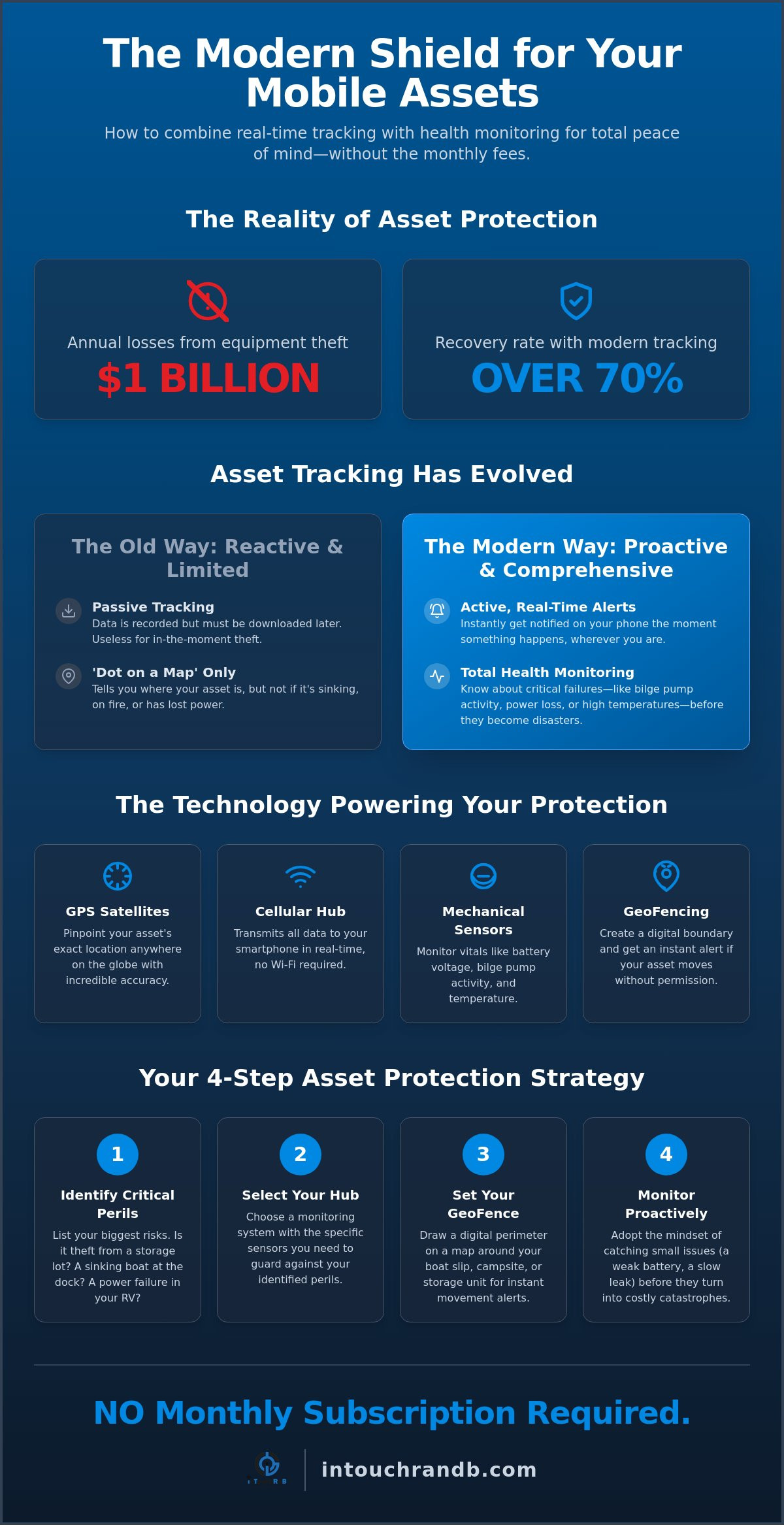
Did you know that equipment theft results in annual losses of up to $1 billion, yet assets equipped with modern asset tracking solutions have a recovery rate of over 70%? It's a staggering reality for any boat or RV owner who's ever felt that pit in their stomach after leaving an investment at a remote marina or storage lot. You want to feel like a watchful guardian over your property, but the market is often flooded with "cheap" devices that quickly become expensive once those mandatory monthly fees start rolling in.
We understand the frustration of wanting professional security without being tethered to a never-ending subscription. In this guide, you'll discover how to monitor your most valuable mobile assets with total precision. We're going to explore how real-time location data combined with mechanical alerts, such as notifications for bilge pump failures or power loss, can give you true peace of mind. You'll also find practical steps to help you secure your gear immediately, ensuring your equipment stays exactly where it belongs and stays in perfect working order.
Key Takeaways
- Learn how to combine physical sensors with smart software to create a 24/7 protective shield around your mobile property.
- Understand why modern asset tracking solutions use GPS and cellular technology to send instant alerts the moment something moves or fails.
- Discover how to prevent costly disasters, like boat sinkings or RV power loss, by monitoring your equipment while you're away.
- Follow a simple, step-by-step strategy to identify your "Critical Perils" and select the perfect monitoring hub for your needs.
- Adopt a pro-active mindset to catch small mechanical failures before they escalate into catastrophic and expensive damage.
What Are Asset Tracking Solutions and Why Do You Need One?
Asset tracking is much more than just a fancy way to label your property. It's a sophisticated combination of hardware, like GPS units and environmental sensors, and software that delivers instant alerts directly to your phone. For years, people relied on manual inventory lists or physical locks, but those methods only tell you what happened after the damage is already done. Digital monitoring changes the game. It gives you a live, 24/7 connection to your belongings.
This technology has two primary jobs: helping you recover stolen property and keeping an eye on your equipment's health. While a fixed asset like a warehouse stays put, mobile assets like boats and RVs are constantly on the move and exposed to the elements. This makes specialized asset tracking solutions essential for anyone who isn't always physically present to check on their gear. You need to know if your trailer is being towed or if your boat is taking on water before it becomes a total loss.
To better understand how this technology is evolving to protect your investments, watch this helpful video:
The Difference Between Active and Passive Tracking
Passive tracking systems act like a black box; they record data that you can download and look at later. While that's fine for reviewing a delivery route, it's useless if someone is driving away with your trailer right now. Active tracking provides real-time updates through cellular communication hubs. Since Wi-Fi isn't always available at a boat ramp or a remote campsite, cellular-based systems ensure your data reaches you no matter where the asset is located. For high-value mobile security, active tracking is the only way to ensure you can respond to a crisis as it happens.
Why 'Dot on a Map' Isn't Enough Anymore
Knowing exactly where your boat is sitting doesn't help much if it's currently taking on water at the dock. Modern asset tracking solutions have evolved into comprehensive health monitoring systems. This means you get alerts for more than just movement; you can track bilge pump activity, battery voltage, and even internal temperatures. It's about being pro-active rather than re-active. You want to fix a small leak today instead of hauling a sunken vessel tomorrow.
Actionable Tip: When choosing a system, look for "GeoFencing" capabilities. This lets you draw a digital boundary around your asset on a map, so you get an instant alert the second it crosses that line without your permission.
The Technology Powering Modern Asset Monitoring
Modern asset tracking solutions rely on a sophisticated ecosystem of hardware that works together to keep you informed. At the heart of this system is the Global Positioning System, or GPS. This network of satellites allows your tracker to pinpoint its exact location anywhere on the globe with incredible accuracy. However, knowing the location is only half the battle. Cellular communication hubs act as the delivery vehicle, pushing that data to your smartphone in real-time. This ensures that whether you're at home or in another state, you're always just a tap away from your property.
If you've ever wondered What is Asset Tracking? in a modern context, it's the ability to set digital boundaries. This is known as GeoFencing. You can draw a virtual perimeter around your boat slip or storage unit on a digital map. The moment your asset crosses that line without your permission, an alarm triggers on your device. This immediate notification is often the difference between a successful recovery and a permanent loss.
GPS vs. Bluetooth vs. Wi-Fi: Which Wins?
When choosing a tracking method, it's vital to understand the trade-offs. GPS is the gold standard for long-range, outdoor tracking. It works across the country without needing a local connection. Bluetooth, specifically Bluetooth Low Energy (BLE), is excellent for "left behind" alerts on smaller items like tools or gear bags. It's perfect for things that stay within fifty feet of you. Wi-Fi is helpful for initial configuration or monitoring while your RV is parked in your driveway, but its range is too limited for a mobile lifestyle. For true security, GPS combined with cellular is the winning combination.
Sensors: The Nervous System of Your Asset
Think of wireless sensors as the nervous system of your boat or RV. While GPS tells you where the asset is, sensors tell you how it's doing. Water sensors are a critical defense against sinking; they monitor bilge pump activity and alert you if the pump is running more than usual. Voltage sensors keep an eye on your battery health, which is vital for starting your engine after a long storage period. Temperature sensors are equally important for preventing mold growth or frozen pipes during the winter months. By integrating these sensors, you can maintain a proactive stance on maintenance. You might want to check out the HVAC Minder to see how environmental monitoring can protect your interior from extreme conditions.
Evaluating Asset Tracking for Boats, RVs, and Critical Equipment
When you begin comparing different asset tracking solutions, it's vital to look past general security and focus on the specific dangers your property faces. For boat owners, the risks are often hidden beneath the waterline. Research indicates that 69% of boat sinkings actually happen while the vessel is moored at the dock. These incidents are rarely sudden; they are typically the result of a slow leak or a pump failure that goes unnoticed because nobody was there to hear the alarm. Digital monitoring acts as your eyes and ears when you're miles away.
RV and trailer owners deal with a different set of "critical perils." A trailer can be hitched and towed away in just a few minutes if it isn't actively monitored. Beyond the threat of theft, there is the silent danger of shore power failure. If the power pedestal at a marina or campground fails, it triggers a destructive chain reaction. Your batteries begin to drain (which eventually kills your bilge pumps or security systems), and your refrigerator stops cooling, leading to hundreds of dollars in spoiled food. A smart monitoring system catches this break in the circuit the moment it happens.
For campground and resort managers who prioritize both safety and guest satisfaction, you can explore Commercial Inflatable Water Park Sales and Custom Design to learn how custom water attractions can enhance your secure waterfront facility.
Marine-Specific Monitoring Needs
In a marine environment, monitoring your bilge pump cycles is the most effective way to detect a slow leak before it becomes a catastrophe. If your system notifies you that the pump is running every ten minutes instead of once a day, you know you have a problem that needs immediate attention. High-water alarms should always serve as your final line of defense, providing a loud, instant notification if the water level reaches a dangerous point. For a complete breakdown of these setups, you can read our Ultimate Guide to Bilge Pump Monitoring.
RV and Trailer Security Essentials
For trailers and campers, an anti-theft GPS unit is essential for quick recovery. You want a device that allows you to set a digital boundary so you're alerted the second the trailer leaves its parking spot. Many owners also prioritize interior temperature monitoring. This is especially important if you travel with pets or keep climate-sensitive cargo inside the rig. Keeping your interior within a safe range prevents heat stroke for animals and stops mold from taking hold in humid conditions. You can find more specific advice in our guide on the Best GPS Tracker for Trailer.
To choose the right system, start by identifying your biggest worry. If you're docked in a high-rain area, water sensing is your priority. If you store your RV in a remote lot, location tracking and power monitoring take center stage. For those prioritizing mechanical longevity, the choice to comprar motorbull 300ml provides advanced metal protection for your engines. By matching the technology to your specific environment, you ensure that you're prepared for the most likely problems before they occur.
Setting Up Your Asset Protection Strategy: A Step-by-Step Guide
Setting up your own security network doesn't have to be a complicated or intimidating process. By following a methodical path, you can transform your boat or RV into a self-monitoring asset that keeps you informed of its status at all times. The goal of modern asset tracking solutions is to move from a state of worry to a state of protective vigilance. Here is how you can build your strategy from the ground up.
- Step 1: Identify your 'Critical Perils'. Think about what keeps you awake at night. Is it the fear of a slow leak in the bilge, a trailer being towed from a storage lot, or a power failure that kills your batteries? Pinpointing the most likely risks helps you prioritize which sensors to buy first.
- Step 2: Choose your hub. Your central hub is the brain of the operation. You need to ensure it supports the specific sensors you identified in step one, whether that is a GPS Tracking System for location or specialized sensors for water and power.
- Step 3: Install sensors in high-risk areas. Focus on the "nerve centers" of your asset. This includes the bilge for boats, the main battery bank, and the HVAC drip pan or refrigeration unit in an RV.
- Step 4: Configure your alerts. Decide who needs to know when something goes wrong. You can set up the system to notify you, a spouse, a trusted neighbor, or even a marina manager.
- Step 5: Test the system regularly. Once everything is in place, trigger a test alert. This ensures your cellular signal strength is consistent and that your notifications are actually reaching your phone.
To find the right foundation for your setup, you can compare our specialized monitoring hubs to see which one fits your specific needs.
Actionable Tips for DIY Installation
When you're installing your hardware, placement is everything. Actionable Tip: Place your GPS trackers in a location where they have a relatively clear "view" of the sky. Avoid hiding them behind heavy metal shielding or deep inside an engine room, as this can block the satellite signal. Actionable Tip: Use wired sensors for mission-critical equipment, like your primary bilge pump, but feel free to use wireless sensors for convenience items like interior temperature. Actionable Tip: Always check your battery voltage 24 hours after installation. This ensures that your new monitoring system isn't causing a parasitic drain that could leave you with a dead battery.
Configuring Multi-Recipient Alerts
One of the greatest benefits of modern monitoring is the ability to share the responsibility of oversight. If you travel frequently, you can configure your alerts to reach a "Home Watch" service or a friend who lives near your marina. You can also adjust the frequency of these updates, choosing between hourly status checks or on-demand reports. This multi-recipient approach provides the relief of being informed without requiring you to be the only person on call. It effectively reduces travel anxiety, knowing that a local contact will be notified the second a sensor detects an issue.
The inTouch R&B Advantage: Comprehensive Security Without the Fees
Choosing the right asset tracking solutions involves looking at the total cost of ownership rather than just the initial purchase price. Our GPS Tracking System serves as a premier example of how you can achieve real-time location data and high-level security without being drained by recurring costs. We believe in a "Pro-Active vs. Re-Active" philosophy. This approach means our technology helps you identify a failing drain line for a $75 repair today, rather than leaving you to deal with a $5,000 flood restoration project next month. It is about catching the small triggers before they turn into major responses.
To help you decide which level of protection is right for your specific setup, we've developed a Comparison Matrix of all inTouch R&B Minders. This tool breaks down exactly what each device monitors, allowing you to build a custom suite of asset tracking solutions that fit your lifestyle. Our systems typically operate on a 2.4GHz Wi-Fi connection. This is the standard frequency used by most routers because it has a longer range and can pass through solid objects, like fiberglass or wood, much better than higher-frequency signals. Your data then travels to secure cloud servers, which are protected digital storage spaces that keep your information safe and accessible from anywhere in the world.
The 'Minder' Family of Products
While a generic GPS tracker might tell you where your boat is, our specialized "Minder" family tells you how it's actually performing. The Bilge Minder focuses on the heartbeat of your vessel's safety, while the HVAC Minder ensures your interior climate stays within safe limits. We even offer a Sump Pump Minder to bring that same level of protective vigilance to your home's basement. These tools provide granular data, such as pump cycle counts and temperature fluctuations, that a standard location tracker simply cannot offer.
Why No Subscription Matters for Long-Term Value
When you look at fee-based competitors, the costs can skyrocket over a three to five-year period. Many trackers require monthly fees ranging from $15 to $30, which can add up to over $1,500 in just a few years. By removing those monthly charges, you keep that money in your pocket while maintaining the same professional-grade monitoring. It is "A value you cannot ignore!" because it respects your budget while prioritizing your peace of mind. Our system is built on the promise that "No Alert is ever lost." Thanks to our secure cloud reporting, every notification is logged and delivered, giving you a chronological history of your asset's health. You get the relief of being informed without the burden of a monthly bill.
NO Monthly Subscription Required.
Take Control of Your Property's Security Today
Protecting your boat or RV is about more than just theft recovery; it's about maintaining total control over your property's health. We've explored how high-water alarms and power monitoring prevent the most common causes of loss. Modern asset tracking solutions provide the watchful eye you need while you're away. Since being founded in 2014, inTouch R&B has combined 24/7 protection and control with specialized marine and HVAC expertise to help owners avoid expensive repairs.
A great final step is to regularly review your alert history to identify any patterns in equipment behavior. This proactive approach ensures you're always one step ahead of mechanical failure. Secure your assets today with the inTouch R&B GPS Tracking System and enjoy the peace of mind that comes with professional monitoring. You've worked hard for your equipment, so let's make sure it stays safe and functional for years to come.
NO Monthly Subscription Required.
Frequently Asked Questions
What is the difference between a GPS tracker and an asset monitoring system?
The main difference is that a GPS tracker focuses solely on location, while an asset monitoring system tracks the physical health and environment of your property. While a tracker tells you where your boat is, an asset monitoring system tells you if it's sinking or if the power has failed. Combining these features into asset tracking solutions gives you a complete picture of your asset's security and operational status.
Do I need a monthly subscription for inTouch R&B asset tracking?
No, you aren't required to pay any monthly fees for our products. We believe that once you purchase your hardware, you should own the data it produces without being tethered to a recurring contract. This approach allows you to protect your boat, RV, or home for years without worrying about another monthly bill hitting your credit card. It is professional security with a simple, one-time investment.
Can I monitor my boat's bilge pump and location in the same system?
Yes, you can monitor both by integrating specialized sensors with our GPS Tracking System. By connecting a Bilge Minder to your setup, you'll receive real-time location data alongside instant alerts if your bilge pump starts running more frequently than normal. This dual-layer approach ensures you're protected against both theft and the common mechanical failures that lead to dockside sinkings.
How does GeoFencing protect my trailer from being stolen?
GeoFencing protects your trailer by allowing you to draw a virtual "safe zone" around its parking spot on a digital map. If someone hitches your trailer and moves it outside of this boundary, the system triggers an immediate alarm on your smartphone. This instant notification gives you the best chance of recovering your property by allowing you to alert the authorities the moment the theft begins.
Will these sensors drain my boat or RV battery?
Our sensors are specifically designed with an extremely low power draw to prevent significant battery drain during long-term storage. While every electronic device uses a small amount of energy, these systems are engineered to monitor your assets for months without compromising your ability to start the engine. You can also use the app to check your battery voltage remotely, giving you extra peace of mind about your power levels.
What happens if my asset loses Wi-Fi connection?
If your asset loses its Wi-Fi connection, the hub will continue to monitor your sensors locally, but it won't be able to send live alerts to your phone. For the most reliable protection in mobile environments, we recommend using a cellular-based hub. This ensures that your data reaches our secure cloud servers even when you're away from a marina or home network, keeping your notifications consistent and reliable.
Can I install an asset tracking solution myself or do I need a pro?
You can definitely install these systems yourself as they are designed for straightforward, DIY setup. Most owners find that they can have their hub and sensors configured in less than an hour using basic tools and our step-by-step app instructions. If you're uncomfortable with basic electrical wiring on your boat or RV, any local technician can easily handle the installation for you, but it's not a requirement.
How do I get alerts if I'm in a different state or country?
You'll receive alerts anywhere in the world as long as your smartphone has an active internet connection. Your monitoring system sends data to secure cloud servers, which then push notifications to your device regardless of your physical distance from the asset. Whether you're across town or on a different continent, you'll stay informed about your property's status the moment a sensor detects a change.
NO Monthly Subscription Required.

Article by
Jimmy Nesbitt
Principle
Be the first to comment