

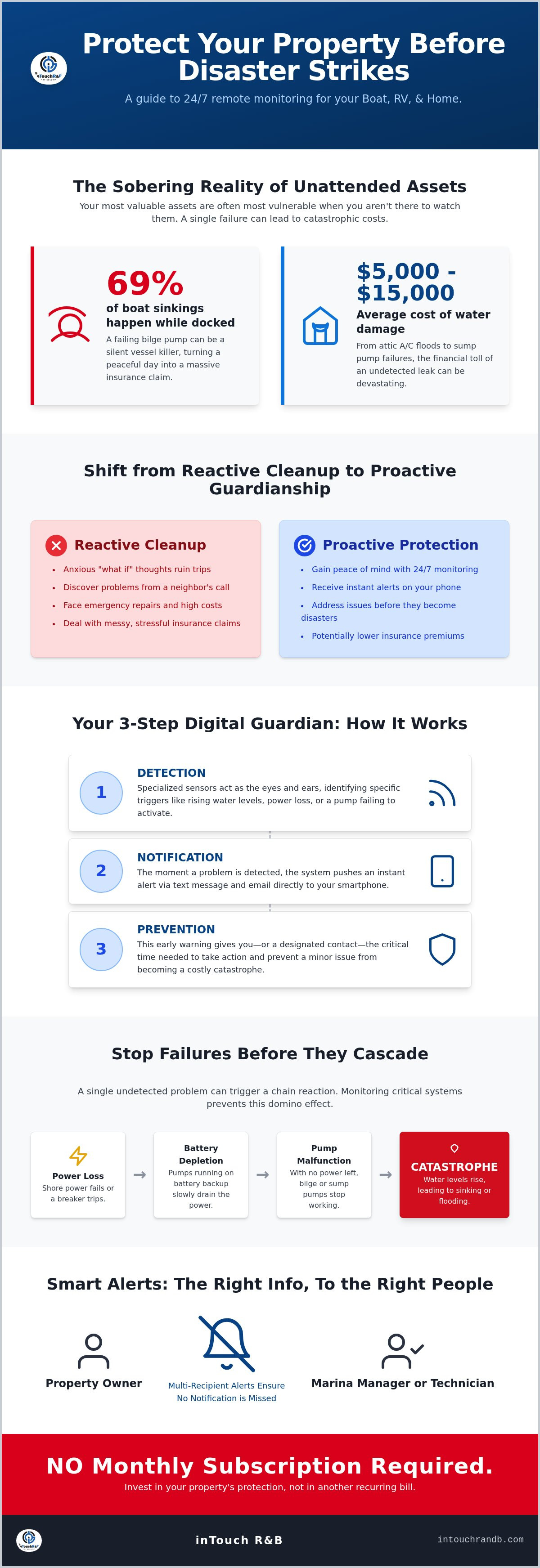
According to BoatU.S., 69% of boat sinkings happen while the vessel is safely docked; a sobering reminder that your most valuable assets are often most vulnerable when you aren't there to watch them. Whether it's a failing bilge pump in a coastal marina or a sump pump struggling during a heavy storm, the anxiety of "what if" can ruin any trip. Integrating reliable remote equipment monitoring systems into your property management strategy changes the dynamic from reactive cleanup to proactive protection. Just as Insoft Services provides businesses with the networking and cybersecurity expertise needed to prevent digital disasters, these monitoring tools offer a similar layer of protection for your physical assets. You don't have to wait for a neighbor's phone call or a massive insurance claim to find out something went wrong.
We understand the frustration of technology that feels like a burden, especially when it involves complex setups or endless recurring bills. This guide shows you how to protect your boat, RV, and home from catastrophic damage, like the $5,000 average loss from attic A/C flooding, using straightforward, effective tools. You'll learn how to set up instant alerts that keep you informed 24/7, ensuring you're the first to know if a critical system fails. We'll explain the mechanics of using 12vdc power and 2.4GHz WiFi to create a watchful, ever-present guardian for your property. NO Monthly Subscription Required.
Key Takeaways
- Shift your approach from reactive repairs to proactive guardianship by understanding how digital monitoring acts as a 24/7 security guard for your assets.
- Explore the core components of modern remote equipment monitoring systems, including how 12vdc power and 2.4GHz WiFi ensure reliable operation in mobile environments like boats and RVs.
- Learn to identify your property's "Critical Perils" to prevent a chain reaction of failures, such as power loss leading to battery depletion and pump malfunction.
- Discover how to configure multi-recipient alerts for both owners and marina managers to ensure that no critical notification is ever missed.
- Implement a professional-grade monitoring strategy that provides instant text and email updates with NO Monthly Subscription Required.
What are Remote Equipment Monitoring Systems?
Think of remote equipment monitoring systems as a digital security guard that never sleeps. While many people associate "remote monitoring" with IT servers or industrial data centers, this technology has evolved to protect your personal physical property. It watches over your bilge pumps, HVAC units, and sump pumps 24/7. Instead of reacting to a disaster after it happens, you're looking at a fundamental shift toward proactive prevention. You aren't just buying hardware; you're investing in a system that monitors the health of your gear so you don't have to.
The primary benefit of these systems is the relief of being informed. Whether you're across the state or across the country, knowing your equipment is functioning correctly provides a level of peace of mind that manual checks simply can't match. This process of Remote monitoring and control ensures that you aren't left in the dark about the status of your most critical assets. It bridges the gap between your physical equipment and your mobile device, providing a constant link to your home, boat, or RV.
To better understand how these systems are designed to protect your property, watch this helpful video:
The Three Pillars: Detection, Notification, and Prevention
A reliable system operates on three core principles that work in a logical sequence. Detection happens when specialized sensors identify a specific trigger, such as water touching a probe or a circuit losing voltage. Notification follows instantly; the system pushes an alert through the cloud to your smartphone as a text or email. Prevention is the final, most critical step. By receiving that alert early, you can shut off a valve, reset a breaker, or call a technician before a minor drip becomes a $15,000 flood.
Why Proactive Monitoring is Essential in 2026
In 2026, the financial stakes of property ownership are higher than ever. Repair costs and insurance deductibles continue to rise, making a single equipment failure a major financial burden. For example, sump pump failure damages can average between $6,000 and $15,000. Modern remote equipment monitoring systems provide a practical way to mitigate these risks. These systems are specifically designed to operate on 12vdc power and utilize 2.4GHz WiFi, making them easy to install in boats, RVs, and homes without complex rewiring or specialized technical knowledge.
Actionable Tip: Contact your insurance provider to see if they offer discounts for installing verified leak detection or bilge monitoring systems. Many companies now incentivize proactive protection because it significantly reduces the likelihood of high-value claims. NO Monthly Subscription Required.
How Remote Monitoring Systems Work: The Tech Simplified
Sensors act as the primary detection point for your property. They're designed to monitor specific environmental triggers, such as rising water levels, humidity spikes, or AC voltage drops. For marine environments, the Bilge Minder serves as a specialized sensor that monitors both pump activity and high-water triggers simultaneously. You can choose between wired sensors for permanent, high-reliability installations or wireless versions for areas where running cables is impractical. Each sensor type provides a specific "trigger and response" mechanism. When a threshold is met (such as water touching a probe), the sensor immediately signals the hub to take action.
The Communication Hub: Your Assets’ Brain
The communication hub serves as the brain of the operation. It constantly polls the connected sensors and, upon detecting a trigger, pushes that data to secure cloud servers. This dedicated architecture is far more reliable than a standard smart home plug, which is often prone to dropping connections during minor power flickers. When choosing a location for your hub, keep it away from microwaves to avoid signal interference on the 2.4GHz band. Understanding the devices and equipment for remote monitoring helps you appreciate the engineering required to keep your assets safe. If you're unsure which configuration fits your specific vessel or home, you can review the comparison matrix to see how different hubs handle various sensor loads. NO Monthly Subscription Required.
Preventing the Chain Reaction of Equipment Failure
Equipment failure rarely occurs as a single, isolated event. Instead, it typically follows a "Chain Reaction" where one minor oversight leads to a catastrophic result. For instance, a shore power cord might become slightly unplugged, leading to a slow drain on your battery bank. Once those batteries are depleted, your bilge pump loses the power it needs to cycle. This exact sequence is a primary reason why 69% of boat sinkings occur while the vessel is docked. By installing remote equipment monitoring systems, you interrupt this chain at the first link. You receive a notification the moment power is lost, giving you hours or even days to rectify the situation before your property is at risk.
The financial logic for this technology is clear when you compare the cost of a single sensor to the average $5,000 loss caused by attic HVAC flooding. Beyond environmental damage, these systems also offer a layer of security for mobile assets. If a boat or RV equipped with GeoFencing moves outside its designated "safe zone," the system triggers an immediate alert. This provides a critical advantage in theft recovery that standard locks simply cannot offer. It turns your equipment from a passive asset into one that actively reports its status and location.
Protecting Against Water Intrusion and Flooding
Water damage often begins with small, hidden issues like clogged HVAC drain lines. Over time, bacterial growth and algae can create a "slime" that blocks the condensate path, forcing water into your ceiling or flooring. In a residential setting, a sump pump monitoring system acts as a vital safeguard against basement flooding during heavy rain. It monitors the pump's electrical draw and water levels to ensure the system is actually moving water when needed. If the pump fails to activate or the water level continues to rise, you'll know instantly.
Actionable Tip: Position your high-water alarm probe slightly below the critical flood level. This provides a "buffer zone" that gives you extra time to respond before water reaches sensitive flooring or drywall. This simple adjustment can be the difference between a quick cleanup and a total renovation.
Monitoring Power and Temperature for Total Security
Maintaining a stable environment is about more than just comfort; it's about structural integrity. During winter, a sudden drop in temperature can lead to frozen pipes, while high humidity in the summer encourages mold growth. Receiving shore power failure alerts allows you to save the contents of your refrigerator and ensure that climate control systems remain active. Additionally, you should learn how to monitor boat battery health remotely to ensure your starting and house batteries are always topped up and ready for use. Keeping a watchful eye on these vitals ensures your assets are protected year-round. NO Monthly Subscription Required.
Actionable Steps to Set Up Your Monitoring Strategy
Setting up remote equipment monitoring systems requires a methodical approach to ensure every vulnerability is covered. It isn't enough to simply install a sensor; you must build a communication chain that functions when you're absent. This process begins with identifying your "Critical Perils." A boat owner might prioritize bilge water levels, while a homeowner focuses on the sump pump or attic HVAC unit. Once you've identified these risks, you can map your WiFi signal strength at the exact equipment location. Because these devices rely on 2.4GHz WiFi for its superior penetration, you should verify that the signal remains strong even inside engine rooms or utility closets.
After confirming your signal, you'll need to choose between a bundled sensor package or a custom array. Bundles are excellent for standard setups, but a custom array allows you to tailor the system to unique layouts, such as a multi-bilge vessel or a home with several HVAC zones. The final step is the most vital: configuring multi-recipient alerts. By adding a backup contact, such as a marina manager or a trusted neighbor, you ensure that a critical notification is never ignored. If you're ready to start, you can browse our full range of monitoring solutions to find the right hardware for your needs.
Customizing Your Alert System for Peace of Mind
Precision in your notification settings eliminates confusion during an emergency. You can name each sensor specifically, using labels like "Main Bilge" or "Attic A/C," so you know exactly where the trouble is the moment your phone buzzes. This clarity is especially useful when sending alerts to a secondary recipient who may not be familiar with your equipment layout. To determine which hub supports the number of sensors you require, consult the Minder Comparison Matrix to find your perfect fit. This ensures your hub has the "brain power" to manage your entire property perimeter effectively.
Maintenance and Testing for Reliability
Ongoing reliability depends on occasional verification of the system's status. Most hubs feature a simple LED sequence to communicate their health; a solid Green or Blue light typically indicates a successful connection to the cloud and power source. We recommend performing a "dry run" test every few months. You can manually trigger a water sensor with a damp cloth or briefly disconnect shore power to verify that the text alert arrives on your device within seconds. For a deeper look at long-term care, see the remote property condition monitoring guide for more tips. This proactive testing confirms that your watchful guardian is ready for a real-world failure. NO Monthly Subscription Required.
Why inTouch R&B is the Smart Choice for Monitoring
Choosing the right partner for property protection involves more than just buying a sensor; it requires a shift in how you manage your assets. The inTouch R&B philosophy is built on a "Pro-Active vs. Re-Active" approach. While most owners only address equipment issues after a failure has occurred, our remote equipment monitoring systems allow you to intervene before the damage starts. This mindset doesn't just save you from the stress of a midnight emergency; it saves thousands of dollars in repair costs and prevents the loss of use of your boat or RV during the peak season.
Reliability in these systems is non-negotiable because an alert is only useful if it actually reaches you. We utilize secure cloud reporting to ensure that "No Alert is ever lost." When a sensor triggers, the signal is pushed through the cloud to multiple recipients simultaneously. This means that if you're busy or out of cell range, your marina manager or a neighbor can still receive the notification and take immediate action. Whether you're managing a high-end yacht, a luxury motorhome, or a coastal residence, this multi-layered communication provides a level of protective vigilance that standalone alarms can't match.
A Solution for Every Critical Asset
We've developed specialized hardware to address the unique vulnerabilities of different properties. For homeowners, the HVAC Minder provides essential protection against condensate overflows that can ruin ceilings and floors. If you're concerned about power stability for medical equipment or expensive appliances, the AC Minder monitors critical power circuits and alerts you the moment a breaker trips. These tools are designed to work together seamlessly under a single management umbrella. Actionable Tip: Use the inTouch R&B App as a visual tool to manage all your assets in one view, allowing you to check the status of your home and boat in seconds without toggling between different platforms.
The Ultimate Value: Freedom from Subscriptions
The most significant barrier to effective monitoring is often "subscription fatigue." Many modern technology companies hook you with a low entry price only to charge monthly fees for the life of the product. We believe that protecting your property shouldn't come with an endless bill. Our systems represent a one-time investment in your peace of mind. You get professional-grade, 24/7 protection for the life of the device without any hidden costs or recurring charges. This commitment to transparency and value ensures that your focus remains on enjoying your assets rather than managing their maintenance costs. NO Monthly Subscription Required.
Securing Your Assets for the Years Ahead
Transitioning from hoping for the best to actively knowing the status of your equipment is the most effective way to protect your investments. By implementing remote equipment monitoring systems, you eliminate the uncertainty that often accompanies property ownership. You've learned how a simple "trigger and response" mechanism can stop a chain reaction of failure before it leads to a total loss. Whether it's a bilge pump in a remote marina or a sump pump in your basement, the goal is always the same: total awareness through simple, easy-to-read text and email alerts.
Proactive monitoring isn't just about avoiding repairs; it's about reclaiming your time and peace of mind. You can now step away from your home or vessel with the confidence that a watchful guardian is on duty. Protect your property today with inTouch R&B Smart Solutions and experience the relief of being truly informed. Your assets represent years of hard work and memories; they deserve a defense that is as dedicated as you are. NO Monthly Subscription Required.
Frequently Asked Questions
What happens if my boat loses power at the dock?
The system detects the loss of AC voltage immediately. Because the hub and sensors run on 12vdc power directly from your battery bank, they remain operational even when shore power fails. You'll receive an instant text or email alert the moment the circuit breaks. This early notification allows you to address the issue before your batteries drain and your bilge pumps stop functioning, preventing a potential chain reaction of failure.
Do I need a special app to receive equipment alerts?
No, you don't need to download or maintain a specialized app to receive notifications from these remote equipment monitoring systems. Alerts are delivered via standard SMS text messages and emails to ensure compatibility with any modern smartphone. Configuration is handled through a simple browser-based Captive Portal during the initial setup. This approach eliminates the frustration of app updates or compatibility issues between different mobile operating systems, keeping you informed without the tech-heavy burden.
Can I monitor my RV battery voltage remotely?
Yes, you can monitor your house and chassis battery health in real-time. The system measures the 12vdc power supply and can be configured to send an alert if the voltage drops below a safe threshold. This proactive monitoring is essential for RV owners who store their vehicles off-site, as it prevents deep-discharge damage that can shorten the lifespan of expensive deep-cycle or lithium battery banks, ensuring your vehicle is always ready for the road.
What is GeoFencing and how does it protect my mobile assets?
GeoFencing creates a virtual digital perimeter around your boat or RV using GPS coordinates. If the asset moves outside this designated area without your authorization, the system triggers an immediate high-priority alert. This feature acts as a silent alarm for theft prevention and unauthorized use. It provides the relief of being informed about your property's physical location at all times, even when you are hundreds of miles away from the marina or storage lot.
Will the monitoring system work if my WiFi signal is weak?
Remote equipment monitoring systems are engineered to utilize 2.4GHz WiFi specifically because this frequency offers superior range and better penetration through obstacles like fiberglass or concrete. While a stable connection is required, the 2.4GHz band is much more resilient in marina and residential environments than 5GHz alternatives. If the signal is exceptionally weak, you might consider a simple WiFi extender to ensure the hub maintains a consistent, reliable link to the secure cloud servers.
How many people can receive alerts from a single system?
You can configure the system to send notifications to multiple recipients simultaneously. This often includes the primary owner and a secondary contact, such as a marina manager, a neighbor, or a professional property watch service. This multi-recipient feature ensures that critical alerts are never missed, even if you are unavailable to respond immediately. It provides a shared layer of protection for your most valuable physical assets, ensuring a swift response to any detected peril.
Is it difficult to install the sensors myself?
Installation is designed to be straightforward for the average owner. Most sensors are either plug-and-play or require simple mounting with basic tools. The system uses 12vdc power, which is safer and easier to handle than high-voltage AC wiring. By following the chronological steps in the setup guide, you can have your monitoring perimeter active in a short amount of time without the need for professional electrical contractors or complex specialized equipment.
Can this system help prevent mold from growing on my boat?
Yes, by monitoring humidity and temperature levels, the system helps you maintain an environment that discourages mold and mildew growth. If the humidity rises above a certain percentage, you'll receive an alert to check your dehumidifier or HVAC system. This is a key part of our proactive maintenance philosophy, stopping small environmental changes from becoming expensive cleaning and remediation projects later. Constant vigilance helps preserve the interior integrity of your vessel year-round.
NO Monthly Subscription Required.

Article by
Jimmy Nesbitt
Principle
Be the first to comment