

Imagine driving three hours to your marina only to be met by the sour smell of a warm refrigerator and the eerie silence of a dead battery bank. It's a nightmare scenario that usually starts with a simple tripped breaker or a sudden summer storm while you're miles away. If you've been relying on a basic shore power failure alert that depends on shaky marina Wi-Fi, you might be more vulnerable than you think. We understand that the constant worry about your boat or RV shouldn't haunt your time away from the water or the road.
This article will show you how to set up a foolproof monitoring system that saves your batteries and your peace of mind with inTouchRandB .com We'll break down the confusion between monitoring outlets versus battery voltage; we'll also explain how 2026 safety standards like Grounding Monitor Interrupters (which are designed to check for safe ground connections) impact your setup. You will walk away with a clear plan to ensure your bilge pumps stay active and your notifications arrive instantly, even if the local network fails. It's about moving from uncertainty to total, protective vigilance over your home on the move.
Key Takeaways
- Understand why a shore power failure alert is your first line of defense against spoiled food and depleted battery banks.
- Learn how professional sensors monitor the 120V AC circuit directly to provide instant, reliable notifications.
- Discover why common consumer smart plugs often fail in marine or RV environments due to corrosion and connectivity issues.
- Get a step-by-step guide on performing a "Power Audit" to protect your most critical onboard systems like refrigeration and bilge pumps.
- Find out how to maintain a 24/7 secure link to your vessel's power status without relying on unstable marina Wi-Fi.
Table of Contents
What is a Shore Power Failure Alert and Why Do You Need One?
To understand the value of a protective system, we first have to look at the connection itself. What is shore power? Simply put, it's the umbilical cord that provides AC electricity from a dock or campsite pedestal to your vessel or RV. A shore power failure occurs when this 120VAC connection is broken, whether by a summer lightning storm, a tripped pedestal breaker, or a neighbor accidentally unplugging your cord. A shore power failure alert inTouchRandB model AC Minder acts as a digital watchdog, monitoring the presence of voltage and sending a remote notification to your phone the second the flow of electricity stops.
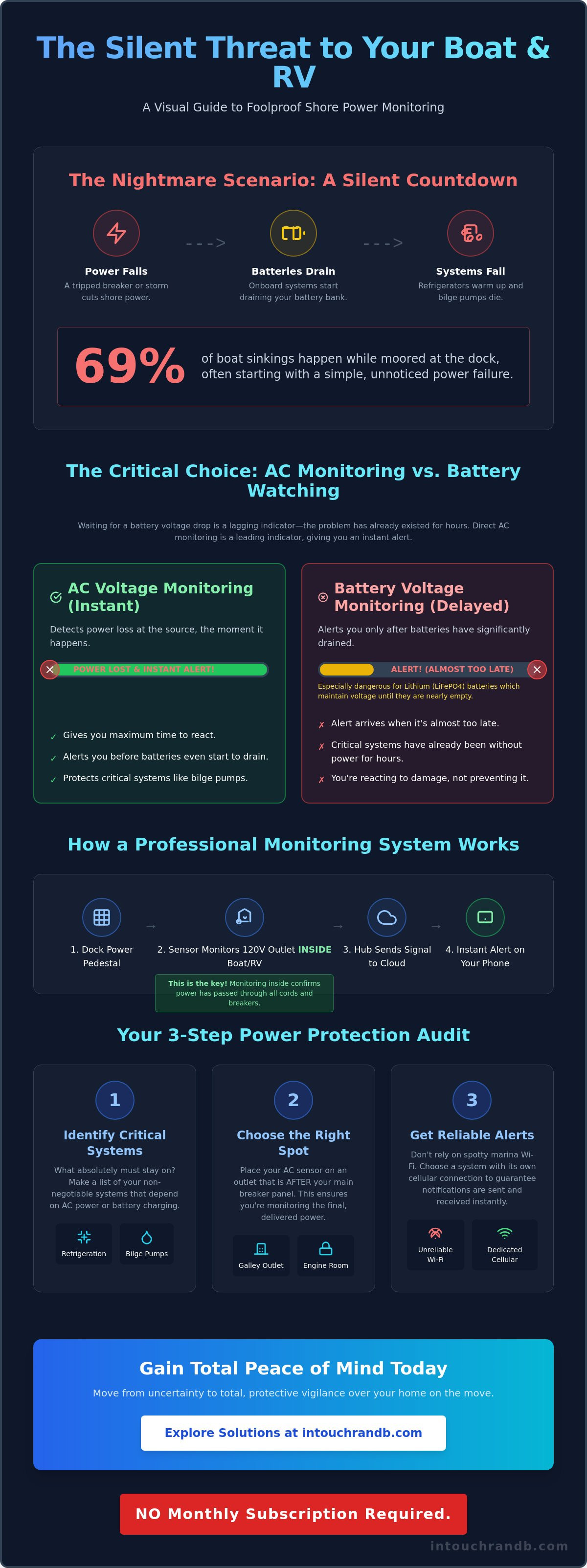
You might wonder why you need a dedicated system when your boat or RV already has a panel full of circuit breakers. While breakers are excellent at preventing fires by cutting power during a surge, they're passive devices. They don't have a way to reach out and tell you they've done their job. Shore power alerts are the first line of defense against the "dockside sinking" statistic, which shows that 69% of boat sinkings happen while the vessel is moored at the dock. Without a notification, a simple tripped breaker can stay unnoticed for days, leaving your most critical systems completely vulnerable.
The Silent Chain Reaction of Power Loss
When the AC power vanishes, your onboard systems immediately begin pulling from your battery bank. This starts a dangerous countdown. Without the charger running to replenish the juice, your batteries can hit a "dead" state within hours, especially if your refrigerator or HVAC system is running. If a heavy rainstorm hits while your batteries are flat, your bilge pumps won't have the power to move water, which is how many boats end up partially submerged. Your refrigerator and climate control are the first victims, leading to thousands of dollars in spoiled food or a dangerously overheated interior.
Common Myths About Shore Power Reliability
Many owners fall into the trap of believing that "the marina manager will call me if the power goes out." In reality, marina staff rarely check individual pedestals, and they might not notice a single tripped breaker for an entire weekend. Another myth is that a high-end battery charger will keep things running indefinitely; however, a charger is only as good as the AC power it receives. The reality is that most owners only discover a failure when they arrive at the dock and find the damage is already done. Using a dedicated monitor like the AC Minder ensures you're the first to know when the power drops, not the last.
How Shore Power Monitoring Systems Actually Work
A shore power failure alert AC Minder doesn't just guess when things go wrong; it uses a systematic "trigger and response" process to keep you informed. The mechanism starts with a sensor plugged into a standard 120V AC outlet inside your boat or RV. This sensor acts like a digital pulse-taker, constantly verifying that the electrical current is flowing. When the power drops, the sensor immediately detects the loss of voltage and signals the communication hub. This hub then translates that electrical data into a digital message and sends it to the cloud, which triggers an instant text or email to your phone.
It's vital to understand where you are monitoring. Some owners try to monitor the power at the dock pedestal, but that only tells you if the marina has power. Monitoring "at the appliance" or through an interior outlet is much more effective. This method confirms that the electricity has actually traveled through your shore power cord, past your onboard breakers, and into your living space. If a cord becomes loose or an internal breaker trips, an interior sensor will catch it, while a pedestal monitor would remain silent. For a closer look at how different sensors handle these tasks, you can check out the comparison matrix of all Minders to see which setup fits your vessel.
AC Voltage Monitoring vs. Battery Drop Detection
Direct AC monitoring is significantly faster than waiting for a battery voltage drop. If you only monitor your batteries, you're looking at a "lagging indicator," meaning the power has already been gone long enough for your systems to drain the reserves. This is especially dangerous with modern Lithium (LiFePO4) batteries. Lithium batteries have a very flat discharge curve, staying at a nearly constant voltage until they are almost completely empty. By the time a voltage-based alert triggers, your batteries are likely minutes away from shutting down. The AC Minder solves this by reporting the status of the AC circuit itself, giving you hours of lead time to react before your batteries even feel the strain.
The Communication Lifeline: Wi-Fi vs. Cellular
The biggest weakness in many DIY setups is a reliance on marina Wi-Fi. In a severe storm, the marina's internet router is often the first thing to lose power or crash. If your monitoring system depends on that Wi-Fi to send an alert, the message will never leave the dock. Following modern electrical safety standards often involves ensuring that your safety equipment remains independent of local infrastructure. A dedicated hub with a robust connection ensures that even if the local network goes dark, your alert still reaches the cloud. Practical Tip: When installing your system, always test the signal range from the deepest part of your cabin or engine room to ensure the sensor can always "talk" to the hub without interference.
Busting the 'Cheap Fix' Myth: DIY vs. Professional Alerts
It's tempting to think a twenty dollar smart plug from a big-box store is all you need to keep tabs on your vessel. After all, if it can turn on a lamp at home, why can't it send a shore power failure alert from the dock? The reality is that consumer-grade electronics aren't built for the harsh realities of marine or mobile environments. High humidity, salt air, and extreme temperature fluctuations inside a closed RV or boat cabin can cause rapid corrosion on internal circuit boards. When these "cheap fixes" fail, they don't usually send a warning; they just go silent, leaving you with a false sense of security while your batteries drain in the background.
Professional systems are engineered to meet the rigorous demands of the American Boat & Yacht Council (ABYC) standards for electrical safety. One of the most significant advantages of a purpose-built system is the ability to set up multi-recipient alerts. Instead of the notification only going to your phone, it can simultaneously alert a marina manager or a trusted neighbor. This ensures that someone on-site can flip a breaker or check a connection immediately, even if you are hours away or out of cell range. Actionable Tip: Always designate a local "emergency contact" in your alert settings who has a key to your vessel or RV for rapid response when you aren't there.
The Hidden Risks of Homemade Alarm Circuits
DIY enthusiasts often try to wire their own relay circuits or audible buzzers, but this approach carries serious risks. Using non-marine-grade components can create fire hazards, especially in the high-vibration environment of a boat or RV. Also, a homemade system often lacks a "heartbeat" function. If the DIY device loses its own power or connection, it won't tell you. Professional systems like the inTouch R&B suite are designed for 24/7 vigilance, meaning the cloud service monitors the device itself to ensure it's always online and ready to protect your assets.
Comparing the Features That Matter
When choosing a system, you need to look beyond a simple "on or off" notification. You can review the Comparison Matrix of all inTouch R&B Minders to see how specialized tools outperform generic alternatives. One critical feature is historical logging. This allows you to see if your power is "blipping" frequently, which could indicate a failing shore power cord or a pedestal that needs maintenance before a total failure occurs. Cloud reporting ensures that your data is stored safely off-site, providing a reliable record that local-only alarms simply cannot match.
Actionable Steps to Protect Your Boat or RV Today
Setting up a reliable shore power failure alert begins with a simple power audit. Start by identifying which systems are truly critical for your vessel or RV. For most owners, this includes the refrigerator, the bilge pumps, and the HVAC system, especially if you travel with pets. Once you've identified these, choose a sensor location that sits on the same circuit as your main power inlet. This ensures the sensor monitors the actual flow of electricity coming from the pedestal, rather than a secondary circuit that might have its own separate issues.
It's also essential to verify your battery bank's health. Knowing your "buffer time" is vital; this is the amount of time your batteries can keep critical systems running without AC power. If your batteries are older, your window for response is much smaller. After installation, perform a real-world test by manually flipping the pedestal breaker. You should receive an alert on your phone within minutes. If you don't, you'll need to troubleshoot your connection or hub placement before leaving the vessel unattended.
Don't forget to set up a secondary recipient for your notifications. Whether it's a trusted neighbor at the marina or a local service technician, having someone on-site who can react immediately can save you a long drive or a ruined weekend. Protect your critical systems today by browsing the full range of reliable monitoring solutions.
Optimizing Your Alert Strategy
A smart monitoring strategy goes beyond just knowing when the power is out. You should also set a "power restored" alert so you know exactly when your systems are back to normal. If the shore power stays off for an extended period, you can integrate a Bilge Minder as a secondary backup. This ensures that even if your batteries start to fail, you'll get a specific warning if water begins to rise. To avoid notification fatigue, you can adjust your settings to provide hourly updates or on-demand status checks instead of constant pings for minor fluctuations.
Routine Maintenance for Your Monitoring Hardware
To keep your protective system in peak condition, perform a quick monthly check. Look for the "Blue LED" status indicators on your hub to ensure it's still communicating clearly with your router. Wiping down your sensors with a dry cloth is also a good habit; this prevents salt spray or dust buildup from interfering with the electronics. Finally, if you change your Wi-Fi password or the marina updates their network, remember to update the credentials in your monitoring app immediately so your connection remains unbroken.
The inTouch R&B Advantage: Proactive Power Protection
Choosing the right protection for your boat or RV means moving from a reactive mindset to a proactive one. The AC Minder is specifically engineered to be the definitive solution for your shore power failure alert needs. While other generic systems might only tell you when your batteries are dangerously low, our technology identifies the root cause the moment it happens. It utilizes a dedicated Communication Hub to create a secure, 24/7 link between your vessel and the cloud, ensuring you're never left wondering about your power status while you're away.
The core philosophy of this system is centered on the relief of being informed early. It's much better to catch a tripped pedestal breaker at 2:00 PM on a Tuesday than to discover a moldy interior or a refrigerator full of spoiled food on a Friday evening. When the power drops, the sensor triggers an immediate response, sending a clear text and email alert directly to your mobile device. We've intentionally avoided complex, clunky apps that can be frustrating to navigate when you're in a hurry or dealing with a poor signal. You get the vital information you need in a simple, reliable format that allows for instant action.
A Holistic Approach to Safety
Our commitment to your peace of mind is built into every layer of the hardware. The promise that "No Alert is ever lost" is possible because the system doesn't just send a message and hope for the best; the cloud-based reporting monitors the connection itself. For owners who want total environmental control, the AC Minder works seamlessly alongside the HVAC Minder. This combination allows you to monitor not just the electrical flow, but also the temperature and humidity levels inside your cabin, providing a complete picture of your asset's health at all times.
Taking control of your vessel's security is a straightforward process that yields long-term rewards. Your final step in building a truly foolproof monitoring system is to review your specific requirements and match them with the right tools. We suggest you examine the Comparison Matrix to build a custom protection suite that fits your boat or RV perfectly. By choosing a system designed specifically for the rigors of the marine and RV world, you're investing in the safety of your critical systems and your own tranquility.
NO Monthly Subscription Required.
Securing Your Peace of Mind on the Water and the Road
Protecting your boat or RV against electrical failure is about more than just convenience; it’s about guarding the systems that keep your lifestyle functional. We’ve explored why a professional shore power failure alert is essential for bypassing the lag of battery monitoring and the unreliability of shared Wi-Fi networks. By choosing a system that offers 24/7 cloud-based monitoring and dual-recipient alert technology, you ensure that a notification reaches you and a local contact the moment the voltage drops. This level of protective vigilance is why yacht owners and RVers nationwide trust our solutions to act as a watchful guardian over their assets. For owners of larger commercial or industrial vessels who need comprehensive energy solutions beyond electrical monitoring, you can check out Secure Supplies Group for specialized maritime bunkering and bulk fuel delivery.
You now have the practical steps to perform a power audit and implement a system that works even when you aren't there to check a breaker. Taking these proactive measures today means you don't have to worry about spoiled food or deep-cycle battery damage tomorrow. Protect your investment with the AC Minder and enjoy your time away from the dock with total confidence.
NO Monthly Subscription Required.
Frequently Asked Questions
How do I know if my shore power is lost when I'm not at the boat?
You can stay informed through a remote monitoring system that sends an instant text or email notification the moment the voltage drops. Unlike a standard breaker, which is silent when it trips, a dedicated sensor plugged into your interior outlet acts as a constant watchdog. This ensures you know about the power loss within minutes, allowing you to react before your batteries drain or your food spoils.
Can I monitor my boat's shore power on my smartphone?
Yes, you can receive real-time updates directly on your smartphone through automated text and email alerts. These notifications provide the status of your AC circuit without requiring you to constantly check a complex app. It is a simple, reliable way to maintain protective vigilance over your vessel's electrical health from anywhere in the world, giving you the freedom to enjoy your time away from the dock.
What is the best power failure alarm for an RV with pets?
For RV owners with pets, the best solution is a system that monitors both AC power and interior temperature. While a shore power failure alert tells you when the electricity stops, combining it with an HVAC Minder ensures you are also notified if the cabin temperature reaches unsafe levels. This dual-layered approach protects your animals from heatstroke if the air conditioning fails while you are away from the campsite.
Do I need Wi-Fi for a shore power failure alert system to work?
Most systems require an internet connection, such as a marina Wi-Fi network or a dedicated cellular hotspot, to send alerts to the cloud. The sensor itself communicates with a central hub, which then uses the internet to reach your phone. It is a good idea to ensure your hub is placed in a location with a strong, stable signal to prevent any gaps in your vessel's monitoring coverage.
Will a shore power alert tell me if my battery charger fails?
A standard shore power monitor specifically tracks the presence of 120V AC electricity. If your battery charger fails while the shore power is still active, the AC alert won't trigger because the outlet still has power. To catch a charger failure, you would need to monitor your battery voltage separately. However, knowing that the AC power is active helps you narrow down the problem to your onboard charging equipment.
What happens if the marina Wi-Fi goes down during a power outage?
If the marina Wi-Fi fails, a professional system provides a "heartbeat" check through the cloud. When the hub stops talking to the server because the internet is down, the system recognizes the silence as a potential issue and sends you an offline notification. This ensures that a local internet crash doesn't leave you in the dark; instead, you get a shore power failure alert indicating a loss of communication.
Is there a shore power alarm that doesn't require a monthly fee?
Yes, the AC Minder is designed to provide reliable, 24/7 monitoring without the burden of recurring costs. Many competitors charge high monthly fees for cloud access, but this system allows you to protect your boat or RV with a one-time hardware purchase. It is a pragmatic, cost-effective way to ensure your critical systems remain active without adding another subscription to your monthly bills.
Can I get alerts sent to my boat mechanic or marina manager too?
You can absolutely set up multi-recipient alerts to include your mechanic, marina manager, or a trusted neighbor. This feature is vital because it allows someone on-site to investigate the problem immediately while you are traveling. For owners of larger vessels or those operating near major hubs like the Panama Canal, professional technical providers like Panama Ship Service offer the comprehensive operational oversight needed to maintain safety and efficiency. By sharing the notification, you increase the chances of a quick fix, such as flipping a tripped pedestal breaker, before any serious damage occurs to your refrigeration or bilge systems.
NO Monthly Subscription Required.
Principle

Article by
Jimmy Nesbitt
Principle
Be the first to comment