

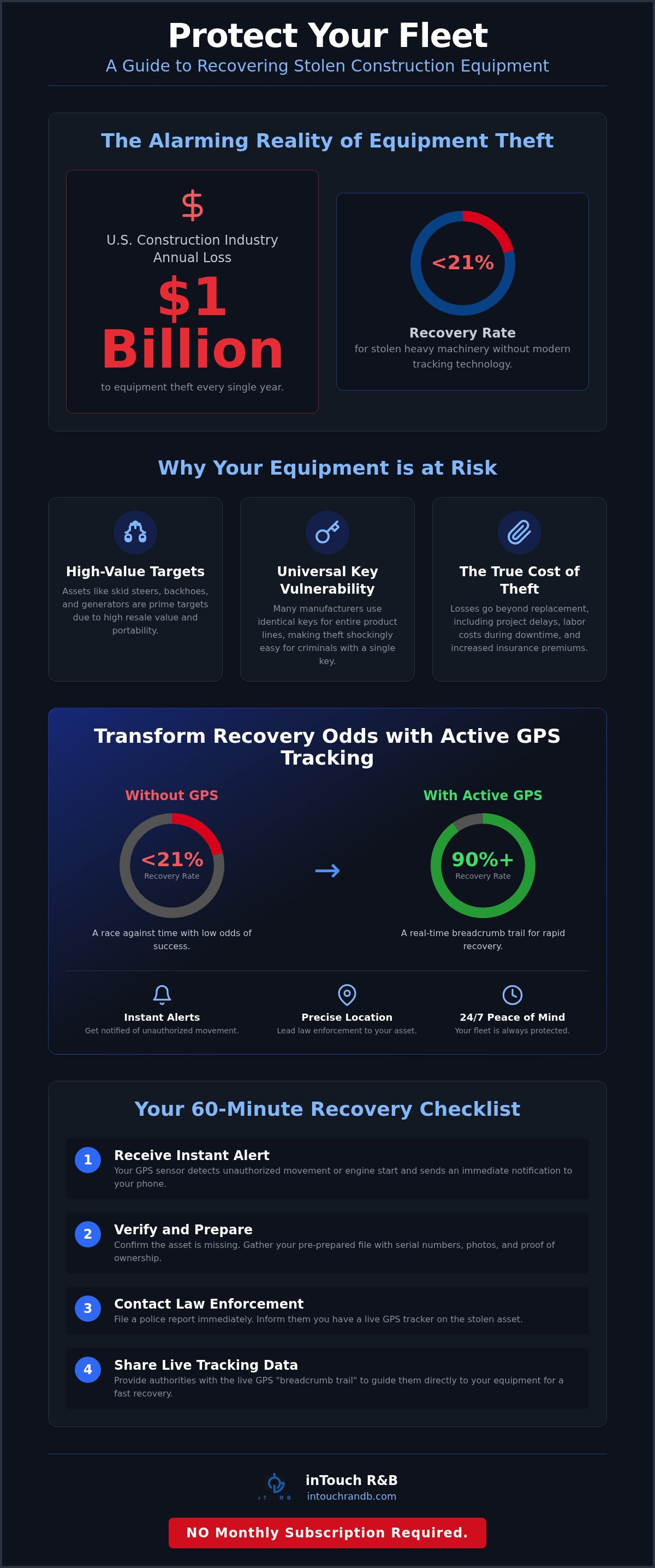
Did you know that the U.S. construction industry loses up to $1 billion every single year to equipment theft? It is a staggering figure that translates to stalled projects, massive replacement costs, and endless headaches for site managers. We know that recovering stolen construction equipment often feels like a losing battle, especially when you realize that fewer than 21% of heavy machines are ever found without the right technology in place. You've worked hard to build your fleet, and it is only natural to feel a sense of protective vigilance over the tools that drive your business forward.
You're likely tired of the "security tax" that comes with traditional tracking services, specifically those monthly fees that eat into your project margins. This 2026 guide provides pragmatic reassurance. We will show you how to implement a "set it and forget it" security solution that offers real-time alerts and fast recovery paths. If a sensor detects unauthorized movement, the hardware sends an immediate alert to your phone (allowing you to act before the asset even leaves the site). We'll walk through a 60-minute recovery checklist and explain how to leverage GPS tracking systems to ensure your assets stay where they belong. By the time you're finished, you will have a clear, actionable plan to protect your livelihood without the constant drain of recurring fees.
Key Takeaways
- Understand why machines like skid steers are such common targets and how universal keys make theft easier than it should be.
- Learn the specific, real-time steps for recovering stolen construction equipment by using GPS breadcrumbs to lead law enforcement right to your assets.
- See how you can avoid the "subscription trap" by choosing a security model that doesn't rely on expensive monthly fees.
- Build a 60-minute recovery plan so you've got your serial numbers and photos ready to go the moment you notice something is missing.
- Discover how a pro-active GPS Tracking System gives you 24/7 peace of mind and instant alerts for your fleet. NO Monthly Subscription Required.
The $1 Billion Reality: Why Recovering Stolen Equipment is a Challenge
The construction industry faces a massive hurdle that grows more complex every year. Theft accounts for nearly $1 billion in annual losses across the United States. High-value assets like skid steers, backhoes, and portable generators are primary targets because they're relatively easy to transport and have a high resale value on the secondary market. Because of this constant demand, recovering stolen construction equipment becomes a race against time before the machinery is hidden or dismantled for parts.
Construction equipment theft is often the work of organized rings rather than random vandals. These groups understand that traditional site security, such as chain-link fences and motion-activated lights, often fails to provide a real barrier. They can cut through a fence in seconds and be gone before anyone notices the breach. Without a pro-active alert system, you might not even realize a machine is missing until your crew arrives the next morning to find an empty spot on the lot.
To better understand the speed and precision required for a successful recovery, watch this helpful video:
One of the biggest hurdles for law enforcement is the lack of standardized Vehicle Identification Numbers (VINs) on many types of heavy machinery. Unlike cars or trucks, construction equipment often relies on serial numbers that aren't tracked in a centralized national database (making it difficult for an officer to confirm a machine is stolen during a routine transport stop). If you haven't pre-registered your equipment or installed a GPS Tracking System, the odds of a successful recovery stay low once the asset leaves your sight.
The True Cost of a Stolen Asset
When a piece of equipment vanishes, the financial impact ripples far beyond the initial replacement cost. You have to factor in the "utilization gap," which is the period your projects are stalled while you wait for replacement machinery to arrive. During this time, you're still paying for labor and overhead despite the drop in productivity. For businesses that want to avoid such downtime and instead focus on growth, you can learn more about RWC Inc. and their custom robotic manufacturing systems that enhance operational efficiency. Additionally, filing an insurance claim often leads to inflated premiums that can impact your business for years, creating a long-term financial drain that hurts your bottom line.
Why Universal Keys are a Security Nightmare
It's a frustrating reality that many manufacturers use identical ignition systems across entire product lines. This means an opportunistic thief with a single "universal" key can potentially start and drive away dozens of different models. This vulnerability allows them to move quickly without needing to hotwire the engine. To protect your fleet, you need an independent layer of security that acts as a watchful guardian. Adding a GPS tracker that operates independently of the machine’s standard electrical system ensures you're notified the moment an engine starts or a trailer moves.
How GPS Tracking Systems Transform Recovery Odds
While the statistics on equipment theft can feel overwhelming, technology has shifted the power back to the owners. GPS tracking provides a silent, real-time breadcrumb trail that law enforcement can follow directly to the source. Without this data, police are often searching for a needle in a haystack; with it, they have a specific address or coordinate. It is the difference between a total loss and a successful recovery within hours.
When choosing a system, it's vital to understand the difference between active and passive tracking. Passive systems store data internally, which is only useful after you've already found the equipment. Active systems (the kind you need for security) transmit location data continuously or whenever movement is detected. This allows for the immediate response necessary for recovering stolen construction equipment before it is moved into a shipping container or a remote chop shop.
Placement is just as important as the technology itself. Skilled thieves often check common areas like the cab or near the ignition for tracking devices. To outsmart them, consider hiding your tracker in unconventional spots, such as inside a light housing, behind the radiator, or even within the seat padding. A well-hidden GPS Tracking System acts as a watchful, invisible guardian that stays operational even if the thief thinks they've cleared the machine of security measures.
Understanding Geofencing for Job Sites
Geofencing is a powerful tool that allows you to draw a virtual boundary around your job site or storage yard using a map interface. Think of it as a digital perimeter that doesn't need a physical padlock. The moment a piece of machinery crosses that line, the system triggers an alert. To get the most out of this, set your geofences to only send high-priority alerts during "off-hours," such as 7:00 PM to 5:00 AM. This prevents your phone from buzzing every time a crew member moves a skid steer during the day, ensuring that when you do get a notification, you know it's a real emergency. If a theft occurs, having this data ready allows you to report the incident to the National Equipment Register with pinpoint accuracy.
The Power of Real-Time Notifications
In the world of asset security, timing is everything. Text and email alerts are far superior to "check-in" systems that only update once or twice a day. These instant notifications provide the relief of being informed, letting you know the exact second something is wrong. You can also set up secondary alert recipients, such as your site manager or a dedicated security team, so that the response can begin even if you're away from your phone. This multi-layered notification strategy ensures that no alert goes unnoticed, providing a pragmatic reassurance that your fleet is protected 24/7. If you are also looking to secure entire commercial yards or facilities with intelligent monitoring, check out Tektronix Technologies for advanced AI surveillance and access control solutions that safeguard physical premises around the clock.
Financial Vigilance: Subscription-Free vs. Monthly Fee Models
When you invest in security, you expect it to work for you, not become another line item that drains your bank account every month. Many tracking companies rely on a "subscription trap" where the initial hardware seems affordable, but the recurring fees quickly mount up. If you're paying between $20 and $50 per month for each asset, a small fleet of five machines can cost you thousands of dollars over a five-year lifespan. This recurring burden is often why small contractors eventually abandon their tracking systems, leaving their machinery unprotected just when they're most vulnerable.
Choosing a model that requires no monthly fees ensures that your security isn't tied to a credit card expiration date or a fluctuating monthly budget. By owning your hardware and your data outright, you protect your project margins and ensure that recovering stolen construction equipment remains a high-priority capability without an ongoing "security tax." This approach offers a much higher return on investment because the protection stays active for the life of the equipment, regardless of how often you use it.
Calculating the Total Cost of Ownership (TCO)
To understand the true value of your security, you must look at the Total Cost of Ownership over several years. Contrast a one-time purchase against a typical 36-month contract. With a contract, you are essentially "renting" your peace of mind, and if you stop paying, the system goes dark. For seasonal equipment like snow removal attachments or specialized paving gear that may sit idle for months, paying a monthly fee makes little financial sense. A subscription-free model is a far better fit for these assets, providing 24/7 vigilance without the waste. To see how different systems stack up against each other, you can check out our Minder Comparison Matrix.
Reliability Without the Recurring Bill
Modern GPS units are designed to be incredibly efficient, reporting to secure cloud servers only when movement is detected or at set intervals. This "trigger and response" format means you don't need a complex, expensive contract to get the information you need. In an emergency, you don't want to navigate a complicated dashboard full of analytics; you want a simple and easy-to-read alert that tells you exactly where your machine is. This streamlined approach is what makes recovering stolen construction equipment possible for busy owners who don't have time to manage software subscriptions. Organizations like the National Equipment Register emphasize that having a reliable, active recovery plan is the best way to lower your insurance risks and keep your fleet secure. Knowing that your watchful guardian is always on duty, without a monthly bill, provides the kind of pragmatic reassurance that allows you to focus on the job at hand.
The 60-Minute Recovery Checklist: What to Do After a Theft
The moment you realize a piece of equipment is gone, your adrenaline spikes; it is a natural reaction to a direct threat to your livelihood. However, your success in recovering stolen construction equipment depends on how you handle the next sixty minutes. This "golden hour" is when the trail is warmest and the thieves are most likely still in transit or moving the asset to a temporary staging area. By following a structured response, you act as a watchful guardian for your business, turning a potential disaster into a managed recovery operation.
Before an incident ever occurs, you should have a recovery folder ready to go. This folder needs to contain high-resolution photos of the machinery from every angle, including close-ups of any unique identifying marks, such as custom paint, weld repairs, or company decals. You also need the serial numbers and PINs (Product Identification Numbers) documented in a digital format that you can email to an officer in seconds. When you call your insurance provider, having this documentation ready ensures your claim is processed smoothly and helps prevent the headache of a denied or delayed payout.
Step 1: Activate Your Tracking Protocol
Your first move is to log into your GPS portal immediately. Don't just look at the screen; capture a screenshot of the current location and the timestamp right away. This creates a permanent record of where the asset was the moment you noticed it was missing. Most modern systems include a "History" feature that allows you to see the exact path the thieves took. This breadcrumb trail is vital because it can show law enforcement if the thieves stopped at a specific warehouse or if they're heading toward a known shipping port.
It is vital to remember one rule: never attempt to recover the equipment yourself. Confronting thieves is dangerous and can lead to situations that no piece of machinery is worth. Your role is to provide the data that allows the professionals to do their jobs safely. For a reliable way to stay connected to your fleet, you can invest in a GPS Tracking System that provides these real-time updates without the burden of a monthly bill.
Step 2: Provide Law Enforcement with the Right Data
When the police arrive, they need specific, technical details to enter the theft into their systems. Give them the make, model, and year, but most importantly, give them the live GPS coordinates. If your asset is registered with a national database like the National Equipment Register (NER), make sure to mention that. This registration helps officers across different jurisdictions identify your equipment if it crosses state lines, which happens more often than you might think. Providing this level of detail shows that you are a pro-active owner, which often leads to a faster and more focused response from the department. To stay ahead of the curve, you can learn more about asset tracking solutions that are specifically designed for the challenges of 2026.
Securing Your Assets with inTouch R&B GPS Solutions
The philosophy at inTouch R&B is built on the idea of being a watchful guardian for your most valuable assets. While many security systems are designed to tell you what happened after a crime, our GPS Tracking System focuses on pro-active monitoring. This means you are notified the moment a piece of machinery moves or a trailer is hitched, giving you the best possible chance of recovering stolen construction equipment before it disappears forever. By providing 24/7 protection for unattended assets, we help you eliminate the constant worry that comes with leaving expensive gear on a remote job site.
Setting up the system is designed to be straightforward and logical. You don't need to be a technical specialist to get started. Using our browser-based Captive Portal (a user-friendly interface that lets you manage your devices from any smartphone or tablet), you can configure your alert settings and recipient lists in just a few minutes. This system is versatile enough to monitor not just the physical location of your fleet, but also power status and environmental factors. This comprehensive coverage ensures that you have a full picture of your equipment’s safety at all times.
Tailored Security for the Unattended Site
Construction sites are often left alone for long periods, especially during weekends and holidays. This is when your equipment is most at risk. We focus on these unattended windows by providing remote monitoring that acts as an ever-present specialist who understands your hardware. To create a truly robust security net, you should consider a multi-layered approach. For example, you can combine your GPS tracking with an AC Minder to monitor power loss at your site office or storage unit. If a thief cuts the power to disable cameras or lights, you will receive an immediate alert. You can explore the AC Minder for site power monitoring to see how this fits into your overall security strategy.
Simple, Reliable, and Effective
We believe that security should offer a value you cannot ignore. This is why we prioritize simple and easy-to-read alerts that come directly to your phone via text or email. You don't have to navigate through complex dashboard analytics to find out if your skid steer is safe. Instead, the technology responds to specific triggers, such as unauthorized movement or battery disconnection, and notifies you immediately. This level of transparency is what builds trust and provides pragmatic reassurance when recovering stolen construction equipment becomes a necessity. When you own your hardware and your data, you are no longer at the mercy of a service provider's billing cycle. This ownership model is simply the most effective way to protect your margins and your machinery.
NO Monthly Subscription Required.
Take Control of Your Fleet's Future
Securing your business doesn't have to be a source of constant stress or a recurring financial drain. By shifting from a reactive mindset to one of pro-active vigilance, you put yourself in the best position for recovering stolen construction equipment. Remember that the first hour after a theft is the most critical; having your documentation ready and your GPS coordinates live can make all the difference for law enforcement. You've worked hard to build your fleet, and it deserves a watchful guardian that doesn't sleep.
Since 2014, owners have trusted us to provide 24/7 pro-active monitoring that delivers easy-to-read text and email alerts the moment trouble is detected. It's time to step away from the subscription trap and embrace a security strategy that protects your margins as much as your machinery. You can Secure Your Fleet with inTouch R&B GPS Tracking today and enjoy the peace of mind that comes with true asset ownership. Your equipment is the backbone of your business, so keep it safe and stay focused on the projects ahead. NO Monthly Subscription Required.
Frequently Asked Questions
What is the recovery rate for stolen construction equipment?
The recovery rate for heavy machinery without tracking technology is approximately 21%. For smaller tools and attachments, that number drops significantly to below 7%. These low figures highlight why recovering stolen construction equipment is so difficult without pro-active measures. By using a GPS Tracking System, you significantly increase the odds that law enforcement can locate your asset before it is moved or dismantled.
How can I track a stolen skid steer in real time?
You can track your skid steer in real time by installing an active GPS Tracking System that reports movement to secure cloud servers. Once configured via a captive portal, the device sends immediate text or email alerts if the machine crosses a digital boundary. You can then log into your portal to see the exact breadcrumb trail of where the equipment is currently located, allowing you to provide precise coordinates to the police.
Do GPS trackers for heavy equipment require a monthly fee?
While many providers use a subscription-based model that costs between $10 and $50 per month, there are better alternatives. Our system is designed to provide 24/7 protection without the burden of recurring bills. You own the hardware and the data outright, ensuring your security stays active even during seasonal downtime. This "set it and forget it" approach provides pragmatic reassurance without the long-term financial drain of a monthly contract.
What is geofencing and how does it prevent theft?
Geofencing is a specialized tool that allows you to define a virtual perimeter around your job site or storage yard. It prevents theft by acting as a digital alarm; the moment your equipment moves outside the defined area, the system triggers an automated alert. This pro-active notification gives you the lead time needed for recovering stolen construction equipment before the thieves can hide the machine in a remote location.
Where is the best place to hide a GPS tracker on an excavator?
The best place to hide a tracker is in an unconventional location where thieves are unlikely to look. Avoid common areas like the cab or the battery compartment. Instead, consider hiding the device inside a light housing, deep within the engine bay near the radiator, or even tucked into the seat padding. A well-hidden tracker acts as an invisible guardian, continuing to report its location even if the ignition system is tampered with.
Can thieves jam GPS tracking signals on construction sites?
While signal jamming technology exists, it is relatively uncommon for opportunistic thieves. Most modern systems are designed to be resilient, and the initial alert is often sent the moment movement is detected, before a jammer can be activated. Our "Minder" philosophy focuses on being pro-active, ensuring that you are notified of unauthorized activity immediately, which significantly complicates a thief's ability to successfully hide your machinery.
What should I do if my equipment is moved outside the geofence?
If you receive an alert that your equipment has crossed a geofence, you should immediately log into your captive portal to verify the movement. Capture a screenshot of the current GPS coordinates and the direction of travel. Once you have confirmed the theft, call law enforcement and provide them with the live tracking data. Never attempt to confront the thieves yourself; your role is to provide the data that ensures a safe recovery.
Does GPS tracking lower my construction equipment insurance premiums?
Many insurance providers offer lower premiums to owners who install pro-active anti-theft and recovery systems. By reducing the risk of a total loss, you demonstrate to your insurer that you are a responsible owner. Additionally, having a high-recovery strategy in place helps you avoid the high cost of replacement and the potential for inflated premiums that follow a major theft claim.
NO Monthly Subscription Required.

Article by
Jimmy Nesbitt
Principle
Be the first to comment