

Did you know that a single leaky attic A/C unit results in an average loss of $5,000 for the property owner? For many landlords, the first sign of trouble isn't a helpful phone call from a tenant. Instead, it's a water stain spreading across a ceiling or a massive repair bill that arrives because a guest cranked the cooling until the coils froze solid. It's frustrating to feel like you have zero visibility into your system health until something expensive breaks.
We agree that your rental investment deserves better protection than just hoping for the best between inspections. If you are looking for a professional to assess your property's condition, click here to learn about expert inspection services. This guide will show you how implementing hvac monitoring for rental property can transform your approach from reactive to proactive. You'll discover how to get real-time alerts for water leaks and maintain remote visibility into temperature and humidity levels. We'll walk through how tools like the HVAC Minder identify potential failures and trigger instant alerts without recurring fees; this ensures you never walk into a $5,000 surprise again.
Key Takeaways
- Learn how hvac monitoring for rental property shifts your strategy from expensive reactive repairs to cost-effective proactive maintenance.
- Discover why simple water level sensing can prevent the $5,000 average loss associated with unmonitored attic A/C leaks.
- Understand the importance of power monitoring to receive instant alerts if your system loses 120 VAC power; this is the standard electrical supply for your unit.
- See how the HVAC Minder provides complete visibility into temperature and humidity using your existing 2.4GHz WiFi connection.
- Get a step-by-step plan to audit your rental’s HVAC setup and install specialized sensors in high-risk areas like attics or basements.
The Hidden Risks of Unmonitored HVAC in Rental Properties
Many landlords assume that as long as the thermostat is set, the property is safe. However, the #1 cause of HVAC failure is actually a simple lack of routine maintenance. When a unit is tucked away in an attic or a dark crawl space, it's easy to ignore until a crisis occurs. This is why hvac monitoring for rental property is a necessity rather than a luxury. Small issues, like a clogged primary drain line, quickly escalate into disasters. In an attic installation, this "time bomb" often results in a $5,000 flood when the secondary pan overflows. A proactive $350 drain line flush is a small price to pay compared to the cost of replacing water-damaged ceilings and flooring throughout a home.
The Financial Impact of HVAC Neglect
Beyond the immediate repair bill, the financial fallout is often deeper than expected. Most insurance policies for landlords specifically exclude coverage for "gradual leaks." If a slow drip from an AC unit causes wood rot or drywall damage over several weeks, you'll likely pay for the restoration out of pocket. There is also the human cost to consider. If a major failure makes the home uninhabitable, you face the expense of tenant displacement. This might include paying for hotel stays or losing a month of rent. Investing in a tool like the HVAC Minder provides a clear financial advantage by stopping these events before they become catastrophic.
Environmental Hazards for Remote Owners
For those managing properties from a distance, environmental shifts are silent killers. In warm, humid climates, mold starts growing almost immediately after an AC failure. High humidity levels inside a closed-up rental can ruin drywall and upholstery in just a few days. Conversely, in cold climates, a power loss to the HVAC system triggers a dangerous chain reaction. When the interior temperature drops, batteries in electronic devices die faster and pipes eventually freeze and burst. Using sensors to monitor the dew point helps you predict when condensation will form in crawl spaces; this allows you to act before wood rot begins. This level of oversight ensures your investment remains protected, even when you aren't there to walk the halls.
Actionable Tip: Check your HVAC condensate drain line at least once a year. If you see standing water in the emergency overflow pan, it's a clear sign that the primary drain is blocked and needs a professional flush before it spills over.
Essential Monitoring Features Landlords Need
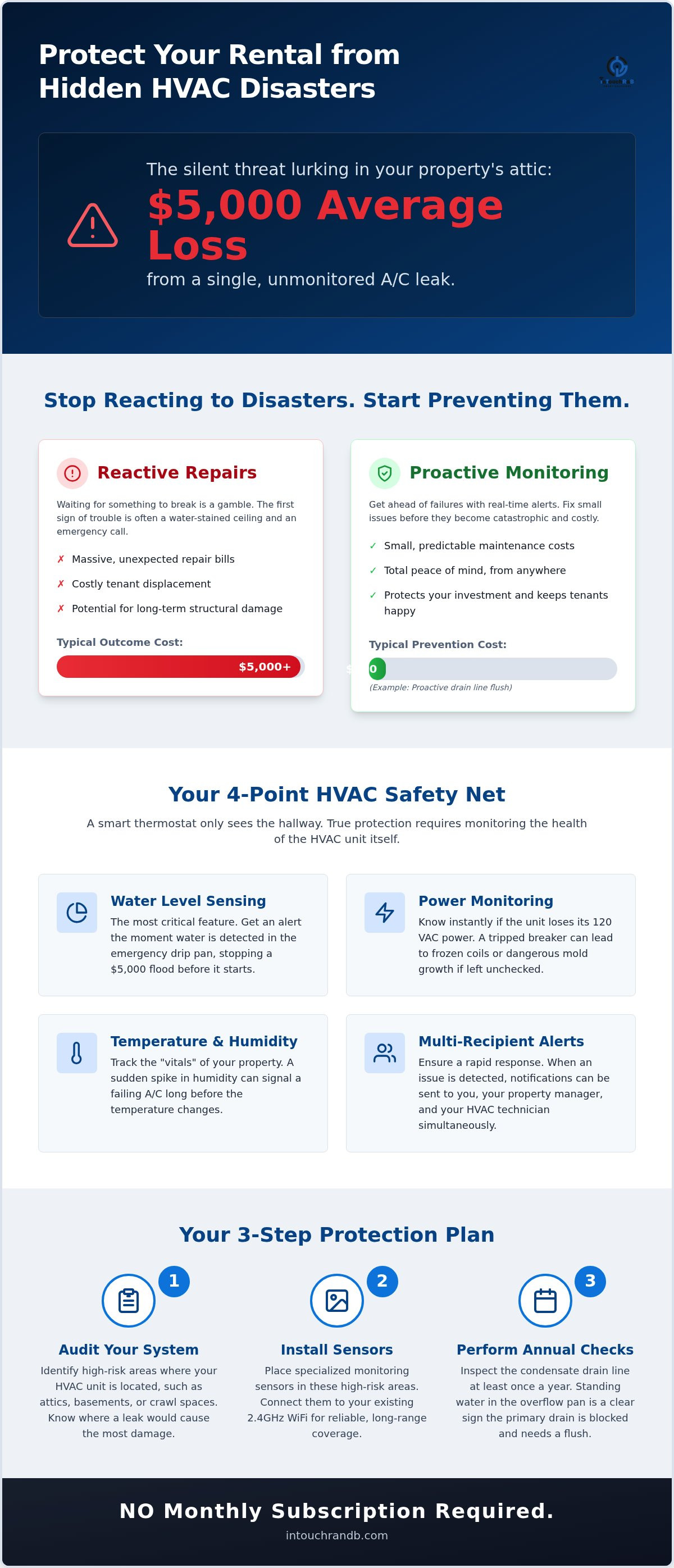
Effective hvac monitoring for rental property requires more than just checking if the air feels cool. You need to see what's happening inside the mechanical components that tenants never look at. By focusing on specific environmental and electrical triggers, you can catch a failing system before it causes structural damage to your home. This protective approach relies on four primary data points: water levels, power status, temperature, and humidity.
Water level sensing is perhaps the most critical feature. By detecting standing water in the drip pan before it overflows, you can address a clogged drain line while it's still a simple maintenance task. Without this, that water eventually spills over, leading to the expensive ceiling repairs discussed previously. Power monitoring is equally vital. You need to receive an alert if the HVAC circuit loses 120 VAC power, which is the standard electrical voltage used to run your indoor unit. If a breaker trips and you aren't notified, the lack of airflow can lead to frozen coils or a rapid spike in indoor humidity.
Tracking temperature and humidity provides a complete picture of the "vitals" of your property. If the humidity climbs while the temperature remains steady, your cooling system might be losing efficiency. Finally, multi-recipient alerts ensure that no crisis goes unnoticed. When a sensor is triggered, the notification shouldn't just go to you; it should also reach your property manager or service technician to ensure a fast response.
Beyond the Smart Thermostat
Many landlords believe a smart thermostat is enough, but these devices have a significant blind spot. A thermostat measures the air in the hallway, but it cannot tell you if your drain line is blocked or if your compressor is drawing too much power. Dedicated sensors for high-water and voltage monitoring provide the mechanical data that thermostats miss. By integrating a professional tool like the HVAC Minder, you gain total visibility into the health of the equipment itself, allowing you to stop leaks that a thermostat would never detect.
Connectivity and Reliability Requirements
For remote equipment monitoring, 2.4GHz WiFi is the preferred standard because it offers a much better range through walls and attic floors than 5GHz connections. Reliability is the most important factor in hvac monitoring for rental property; this is why secure cloud servers are used to ensure that "No Alert is ever lost." Even if your phone is off, the alert is logged and retried. It's also wise to consider how the system handles power outages, ensuring you're notified the moment the connection drops. If you want to see how different sensors can protect your specific property type, you can compare our monitoring solutions to find the best fit.
Actionable Tip: Set your humidity alerts to trigger at 60%. Anything higher than this creates an environment where mold can thrive, giving you a head start on troubleshooting before a tenant even notices a problem.
Proactive vs. Reactive Maintenance: A Cost Comparison
Choosing between a proactive or reactive strategy is the difference between a minor maintenance task and a full-scale renovation. A reactive strategy means waiting for a tenant to call you about a wet ceiling or a house that's 85 degrees inside. By then, the damage is already done. In contrast, hvac monitoring for rental property allows you to see trouble coming. You receive an alert the moment the drip pan hits a high level; this gives you hours or even days to send a technician before water ever touches your drywall.
We often use the "Three-Alert Rule" to help landlords identify systems in distress. If your sensor triggers three high-water alerts in a single afternoon, your system is condensing water faster than the drain line can clear it. This is a clear signal that a blockage is forming or the unit is being overtaxed. Addressing these signs early is essential for your bottom line. Most HVAC units have an average lifespan of only 10-12 years, but reducing mechanical strain through better oversight can help you reach the upper end of that range without premature compressor failure.
Preventing the $5,000 Attic Flood
Attic-based units pose the highest risk to your rental ROI because gravity is working against you. A simple $75 drain flush is a routine expense, but if that drain fails and goes unnoticed, you're looking at a $5,000 flood that ruins insulation and ceilings. This is why we recommend installing a High Level Water Sensor in every secondary drain pan. It acts as a digital insurance policy, catching the "attic time bomb" before it explodes and causes damage that far exceeds the cost of the equipment itself.
The Role of AC Voltage Monitoring
Cooling is just one part of the equation; you also need to know if the power to the unit has failed. Using the AC Minder allows you to monitor the 120 VAC circuit directly. This is vital during long vacancies when a tripped breaker can lead to stagnant air, high humidity, and eventual mold growth. It also helps you monitor auxiliary appliances like sump pumps or refrigerators. Reliable hvac monitoring for rental property ensures you don't return to a property filled with spoiled food or frozen pipes just because a single breaker tripped while the house was empty.
Actionable Tip: Place your water sensor at the lowest point of the secondary drain pan. This ensures you get the earliest possible notification, often before the water is even deep enough to trigger a traditional mechanical float switch.
Actionable Steps to Secure Your Rental HVAC
To start securing your investment, you must begin with a thorough audit of your equipment. Identify whether the air handler is tucked away in the attic, located in a hallway closet, or sitting in a damp basement. Each location presents unique environmental risks. For attic units, your primary focus should be water sensing to prevent ceiling damage. For basement units, humidity and power monitoring take center stage to prevent mold growth. Tailoring your hvac monitoring for rental property to these specific "danger zones" ensures you aren't wasting resources on unnecessary sensors.
Once your sensors are in place, it's time to configure your alert network. A common mistake is being the only person who receives notifications. You should add your property manager or your trusted HVAC technician as a secondary recipient. This allows them to see the same real-time data you do, which eliminates confusion when a tenant reports a problem. Additionally, take five minutes to educate your tenants or guests. A simple note near the thermostat explaining that setting the AC to 60 degrees in a humid climate will freeze the coils can save you an expensive emergency service call.
Installation and Setup Best Practices
Hub placement is vital for a reliable connection. Ensure your monitoring hub is within a stable 2.4GHz WiFi range, as this frequency penetrates walls much better than faster 5GHz signals. You should also avoid placing controllers near large appliances like microwaves or wireless routers that can cause signal interference. Finally, use clear naming conventions in your app. Labeling devices as "Main House AC" or "Guest Suite" makes it much easier to coordinate a response when an alert pops up on your phone during a busy weekend.
Maintenance Checklist for Remote Landlords
Consistency is what keeps a system healthy over the long term. Using a structured schedule allows you to identify minor mechanical shifts before they lead to a total shutdown.
- Monthly: Review your humidity and temperature logs for unusual patterns that might suggest a loss of efficiency or a refrigerant leak.
- Quarterly: Check for the 7 critical signs of HVAC failure to stay ahead of mechanical wear and tear.
- Annually: Physically verify sensor battery levels and ensure the WiFi signal strength remains strong at the unit location.
Following these steps turns your HVAC system from a hidden liability into a fully managed asset. You can compare our monitoring solutions to find the exact configuration that fits your rental property's layout.
Actionable Tip: Create a digital "HVAC Passport" for each property. Store the model number, filter size, and last service date in your monitoring app's notes section; this ensures your tech has all the info they need before they even arrive on site.
Why the HVAC Minder is the Smart Choice for Landlords
Choosing the right hardware is the final step in securing your property against the unexpected. The HVAC Minder provides a single, centralized hub that tracks water levels, temperature, humidity, and power status simultaneously. This device isn't a flimsy consumer gadget; it's built with the same rugged reliability required for marine environments. If you've ever relied on a bilge pump to keep a boat afloat, you understand the level of durability we bring to your rental's HVAC system. This professional-grade construction ensures that your monitoring stays active even in the high-heat and high-humidity environments found in attics or basements.
You have full control over how you receive your data. You can set the system to report hourly for high-turnover vacation rentals or daily for long-term tenants. If you need an immediate update, you can check the status on demand from anywhere in the world. Because we use secure cloud reporting, no alert is ever lost. If a sensor is triggered, the system continues to report until the message is acknowledged. The most significant benefit for your ROI is the lack of recurring costs. Unlike many competitors who charge a monthly fee for every device, we offer a "set it and forget it" solution that protects your profit margins as much as your property.
Comparing inTouch R&B Solutions
When you're deciding which device fits your portfolio, reviewing the Comparison Matrix of all Minders is a great place to start. It helps you see how the HVAC Minder differs from a standard leak detector. While a basic alarm might beep in an empty hallway, our system provides comprehensive mechanical oversight. This allows you to scale your protection from a single condo to a full portfolio of properties without increasing your management workload. For auxiliary units like wine coolers or basement dehumidifiers, you can also integrate the AC Minder to monitor power draw and prevent failures before they lead to mold growth.
Getting Started with Proactive Protection
Setting up your system is a straightforward process that doesn't require a computer science degree. You can access the configuration via the browser-based Captive Portal; this is a local setup page that appears on your smartphone and allows you to connect the device to your 2.4GHz WiFi network in minutes. Once connected, your device begins reporting to our secure servers immediately. Property managers can also take advantage of our Special Introductory Offer to outfit multiple units at once. Ultimately, true peace of mind comes from being informed by real-time data rather than just being lucky between tenant visits.
Actionable Tip: Before you leave the property after installation, perform a "dry test" by briefly placing the water sensor in a cup of water. This confirms the notification chain works and ensures your property manager receives the alert on their phone as expected.
NO Monthly Subscription Required
Secure Your Investment with Smarter Oversight
Protecting your property shouldn't feel like a guessing game. By implementing hvac monitoring for rental property, you move away from the stress of unexpected repairs and toward a model of constant, vigilant protection. We've explored how simple alerts for water levels and power status prevent the catastrophic failures that often result from neglected maintenance. This proactive approach ensures you catch minor issues before they escalate into major restoration projects.
The ability to send alerts to multiple recipients ensures that you and your service team are always on the same page. Homeowners and professional technicians nationwide trust this technology to act as a watchful guardian for their assets. It's about more than just avoiding a big bill; it's about the confidence that comes with knowing your property is safe even when you're miles away. You can secure your rental property with the HVAC Minder today and start enjoying the benefits of remote visibility.
Taking this step today means you won't have to worry about what's happening in your attic or basement tomorrow. You have the tools to be a proactive, informed owner. NO Monthly Subscription Required
Frequently Asked Questions
Why do I need HVAC monitoring if I have a smart thermostat?
A smart thermostat only measures the air temperature in your hallway; it can't tell you if your drain line is clogged or if your drip pan is about to overflow. By using hvac monitoring for rental property, you get eyes on the mechanical parts of the system. The HVAC Minder detects standing water and power loss before the temperature even begins to change, giving you a head start on repairs that a thermostat simply cannot provide.
How does the system notify me of an HVAC failure?
When a sensor is triggered, the device sends a signal through your 2.4GHz WiFi to secure cloud servers. These servers then push an alert directly to your smartphone or email. Because we use cloud-based reporting, your notifications are reliable and persistent. This system ensures that even if you miss a single text, the data is logged and retried until it's acknowledged, so you're never left in the dark about a critical failure.
Can I monitor my rental property HVAC without a monthly subscription?
Yes, you can absolutely protect your investment without recurring costs. Unlike many competitors who require a monthly fee for cloud access, our devices are a one-time purchase. This makes hvac monitoring for rental property much more sustainable for long-term landlords. You get the full benefit of real-time alerts and remote visibility into your system's health without a subscription eating into your monthly rental profit or complicating your bookkeeping.
What happens if the WiFi goes out at my rental property?
If the WiFi connection is lost, the device cannot send real-time updates until the signal is restored. However, the system is designed to reconnect automatically as soon as the network is back online. It's a good idea to place your monitoring hub in an area with a strong signal to ensure consistent reporting. Monitoring the power status also helps you identify if the WiFi is down because of a general power outage at the property.
Is the HVAC Minder difficult for a landlord to install?
The installation process is designed for a simple DIY experience. You don't need specialized tools or a background in electronics. You'll use a Captive Portal, which is a temporary setup webpage that appears on your phone, to connect the HVAC Minder to your local 2.4GHz WiFi network. Most landlords can have the system up and running in just a few minutes, making it an easy addition to your next property inspection.
Can I send alerts directly to my HVAC repair company?
The installation process is designed for a simple DIY experience. You don't need specialized tools or a background in electronics. You'll use a Captive Portal, which is a temporary setup webpage that appears on your phone, to connect the HVAC Minder to your local 2.4GHz WiFi network. Most landlords can have the system up and running in just a few minutes, making it an easy addition to your next property inspection. For a more comprehensive look at your rental's health, you can explore Property Inspection Services offered by Parent Inspections Inc.
Yes, the system allows you to add secondary recipients to your alert network. You can configure the settings so that your property manager or your trusted HVAC technician receives a notification at the same time you do. This multi-recipient feature speeds up response times significantly. Instead of playing phone tag, your repair company can see the exact nature of the problem, such as a high-water alert, before they even leave their shop.
Will this system help me prevent frozen pipes in a vacant rental?
This system is highly effective at preventing frozen pipes by monitoring both indoor temperature and power status. If the heat fails or a circuit breaker trips during a cold snap, you'll receive an instant alert. This allows you to intervene before the interior temperature drops low enough for water lines to burst. It's an essential layer of protection for vacant units or vacation rentals located in climates where winter temperatures frequently dip below freezing.

Article by
Jimmy Nesbitt
Principle
Be the first to comment