

Imagine returning from a relaxing weekend only to find your living room ceiling sagging under the weight of a $5,000 attic A/C leak. It's a scenario that happens far too often, especially since many traditional systems rely on local buzzers that nobody actually hears. You likely agree that maintaining a property is stressful enough without worrying about hidden water damage or mold growth taking hold while you're away. We understand that protective vigilance is the only way to truly rest easy, which is why having a dependable hvac failure alarm is no longer just an option; it's a necessity for modern owners who value their peace of mind.
This guide will show you how to identify early warning signs of mechanical distress before they escalate into a catastrophe. We'll explore how 2026 regulations (which phase out older refrigerants like R-410A and introduce more expensive A2L systems) affect your maintenance strategy and provide a practical checklist for remote monitoring. When a sensor detects an unusual rise in humidity or a drop in temperature (the trigger), you'll know exactly how to respond to prevent a crisis. You're going to learn how to track environmental shifts and moisture levels so you can stop a disaster in its tracks and keep your repair budget intact.
Key Takeaways
- Recognize that true HVAC failure involves more than just a system that won't turn on; it's often a slow loss of environmental control that invites mold growth.
- Understand why monitoring humidity is just as critical as tracking temperature to prevent water from condensing on your surfaces and causing hidden damage.
- Learn why a tripped circuit breaker serves as a vital hvac failure alarm, signaling mechanical distress in your compressor before a total breakdown occurs.
- Follow a proactive 2026 maintenance checklist, including weekly remote data reviews and monthly filter inspections, to avoid the high costs of emergency repairs.
- Discover how remote monitoring provides the relief of being informed by sending instant text alerts to you and your technician the moment a leak is detected.
What Are the Most Common Signs of HVAC Failure?
When most people think of HVAC failure, they usually picture a unit that simply refuses to turn on during a scorching July afternoon. However, true failure is actually defined as any time your system stops managing the safety and comfort of your environment. It's helpful to think of your HVAC unit not just as a heater or cooler, but as a complex machine responsible for moisture control and air quality. While a sophisticated Building automation system might handle these tasks for a commercial high-rise, residential and marine systems often lack that level of oversight. This is where a dedicated hvac failure alarm becomes essential. Failure can happen in two ways: sudden events, like a total power loss, or gradual issues, such as a slow refrigerant leak that lets humidity levels climb until mold begins to grow.
Attic-based units are essentially "leaky time bombs" because they sit directly above your living space. When these units fail, they don't just stop cooling; they begin to shed water. Because they are hidden away in a crawlspace or attic, a small drip can turn into a major flood before you even notice a spot on your ceiling. These units rely on gravity to drain out gallons of water every day. When that process is interrupted by a mechanical or plumbing issue, the results are almost always expensive. Having an hvac failure alarm in place ensures that you're notified the moment moisture starts to collect where it shouldn't be, at which point contacting a professional service like Nice and Cool Inc. can help you quickly address the underlying issue.
The Clogged Drain Line: A Silent Disaster
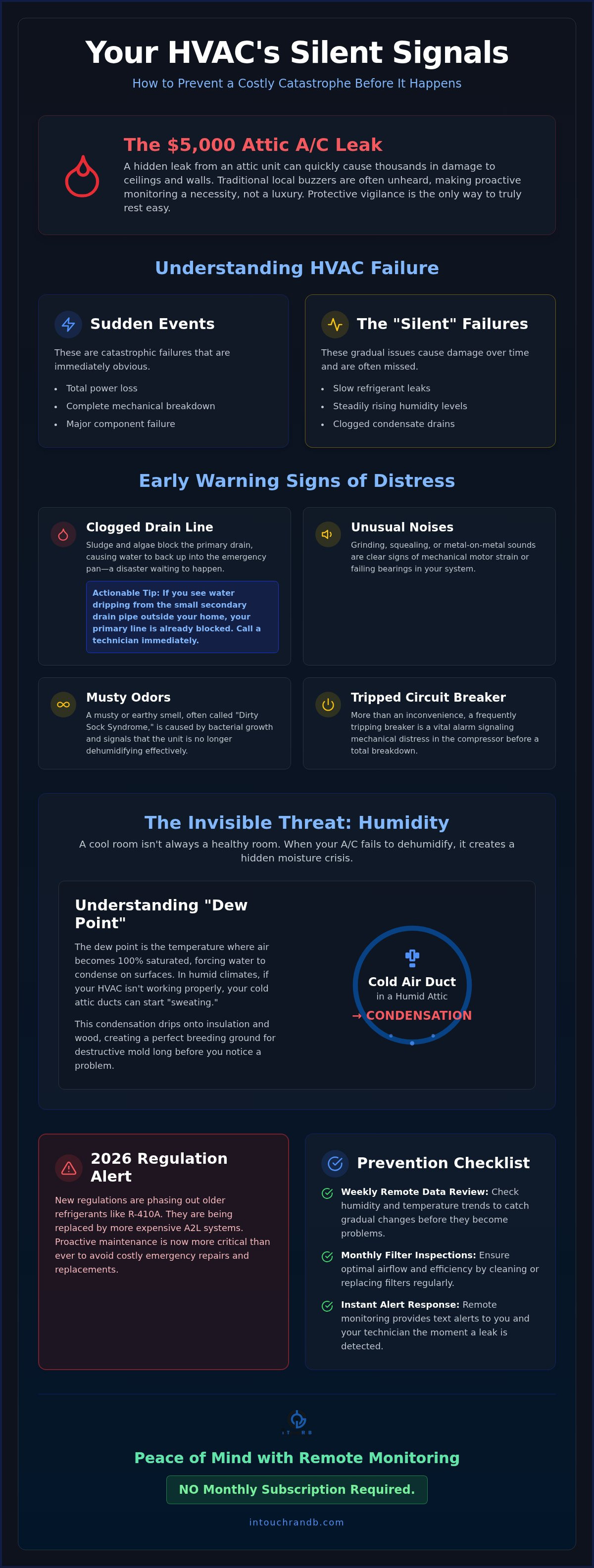
The primary cause of HVAC-related water damage is a clogged condensate drain line. As your system pulls moisture from the air, it creates a damp environment where bacteria, algae, and dust can combine into a thick sludge. This debris eventually blocks the pipe, forcing water to back up into the safety drip pan. If your system is working correctly, that pan should be bone dry. If you see even a small amount of standing water there, your system is failing to drain. Actionable tip: Locate your secondary drain line outside your home, which is usually a small PVC pipe near a window or under the eaves. If you see water dripping from this pipe, your primary line is already blocked, and you should call a technician immediately.
Unusual Noises and Odors
Your system often tries to tell you it's struggling before it quits entirely. Grinding, squealing, or metal-on-metal sounds usually point to mechanical motor strain or failing bearings. You should also be alert for "Dirty Sock Syndrome," which is caused by bacterial growth on the evaporator coils. A musty or earthy smell is a clear signal that the unit is no longer dehumidifying your space effectively. To keep a closer eye on these environmental shifts, many owners use the HVAC Minder to track humidity trends and catch these "silent" failures before the smell becomes unbearable or mold takes root.
The Silent Dangers: Monitoring Water and Humidity
Most homeowners and boat owners make the mistake of only watching the thermostat. While a steady temperature is a good sign, it doesn't tell the whole story of your system's health. You can have a perfectly cool room that is simultaneously harboring a hidden moisture crisis. This is because your air conditioner’s secondary job is dehumidification. When a system begins to fail, it often loses its ability to pull moisture from the air long before the compressor gives out entirely. Without a dedicated hvac failure alarm to track these invisible shifts, you might not realize there's a problem until you find mold growing on your drywall or upholstery.
A critical concept to understand is the "Dew Point." This is the specific temperature where air becomes so saturated with moisture that it can no longer hold it, causing water to form on surfaces. In humid climates, if your HVAC system isn't effectively lowering the humidity, your ducts in the attic or crawl space can begin "sweating." This condensation drips onto insulation and wood framing, creating a perfect breeding ground for mold. Modern fault detection and diagnosis (FDD) methods emphasize that tracking these environmental variables is just as important as monitoring mechanical parts.
High Water Sensors: Your First Line of Defense
If your primary drain line clogs, water backs up into the emergency drip pan. A High Level Water Sensor placed in this pan acts as a watchful guardian. While many units have a local shut-off switch that kills the power when the pan fills up, those switches are silent. If you're away for the weekend, you won't know the power is off until you return to a sweltering, humid house. A remote hvac failure alarm solves this by sending an immediate text alert the moment moisture is detected, giving you time to call a technician before the pan overflows. Wireless sensors are particularly helpful here because they can be placed in tight attic corners without the need for complex wiring.
Understanding Humidity and Dew Point
Relative humidity should ideally stay between 40% and 50%. Once you cross the 60% threshold, you've entered the danger zone where mold spores can begin to colonize. A dew point sensor is a sophisticated tool that helps predict when condensation is likely to occur on your walls or ceilings. By monitoring these trends, you can spot a failing evaporator coil or a refrigerant leak days before the system actually stops cooling. Actionable tip: To stay ahead of the curve, set your remote humidity alert to 55%. This provides a helpful early warning "buffer," allowing you to investigate the cause before the air becomes uncomfortably damp or damaging. For those seeking total peace of mind, the HVAC Minder provides constant oversight of these critical levels.
Power Loss Alarms: Why Your Circuit Breaker is a Clue
A tripped circuit breaker is rarely a random event. It is usually a protective response (the trigger) to a mechanical struggle occurring within your HVAC system. When a compressor or motor starts to fail, it often draws significantly more electrical current than its design allows. This surge trips the breaker (a safety mechanism intended to prevent overheating or electrical fires) but it also leaves your property vulnerable. Without power, the chain reaction begins immediately. The temperature rises, but more importantly, the humidity control we discussed earlier stops entirely. This leads to a rapid spike in moisture levels, creating an environment where mold thrives. In colder climates, this same power loss can lead to frozen pipes within hours, resulting in devastating water damage once the ice thaws. An effective hvac failure alarm needs to be sensitive to these electrical shifts to provide a complete safety net. By using an AC Voltage Monitor, you can track the status of your power supply in real-time. This is especially vital for boat owners who rely on a steady connection to the dock to maintain their onboard systems.
Detecting Power Loss Remotely
Relying on a local alarm (one that simply beeps in an empty hallway) offers no protection if you aren't there to hear it. Modern hvac failure alarm systems use secure cloud servers to ensure that no alert is ever lost. If the plug is pulled or a breaker trips, the system detects the loss of voltage and sends an instant notification to your smartphone. For boaters, knowing if your shore power is disconnected is the difference between a successful weekend and a disaster. This immediate notification allows you to reset a breaker or call for help before the internal environment reaches a critical state. It provides the pragmatic reassurance that your assets are being watched even when you're miles away.
Secondary Damage from Power Failure
The consequences of power loss extend far beyond a warm room. If your HVAC and main power fail, your refrigerator also stops, leading to expensive food spoilage and unpleasant odors that are difficult to remove. On a boat, the stakes are even higher. Many bilge pumps (the devices that remove water from the hull) rely on the vessel's electrical system to stay operational. If power is lost and a leak occurs, the risk of sinking becomes a very real concern. Actionable tip: Don't settle for a monitor that only checks in every few hours. Use a system that alerts you the moment power is lost so you can take action while you still have a window of opportunity to save your property.
The Ultimate HVAC Failure Prevention Checklist
Maintaining your HVAC system shouldn't be a guessing game. By following a structured routine, you can transform your approach from reactive repair to proactive protection. This checklist is designed to help you catch small issues before they trigger your hvac failure alarm or cause a major leak. When you stay ahead of the maintenance curve, you're not just saving money; you're ensuring the long-term safety of your property.
- Weekly: Open your monitoring app to review temperature and humidity trends. Look for any gradual climbs in moisture that might suggest your system is losing its dehumidification efficiency.
- Monthly: Replace your air filters. Clogged filters restrict airflow, forcing the motor to work harder and potentially tripping a breaker. While you're at it, clear any leaves or debris away from your outdoor condenser unit to ensure proper heat exchange.
- Seasonally: Flush your condensate drain line. Using a cup of distilled vinegar or a specialized cleaner helps prevent the bacterial sludge and algae that lead to blockages.
- Annually: Schedule a professional technician to check your refrigerant levels and motor health. You can visit Ray Brown Air and Heat to find expert support for these inspections, which is a vital financial strategy given that 2026 regulations are making new systems more expensive.
- Always: Periodically verify that your remote sensors are within range of your communication hub to ensure your watchful guardian never loses its connection.
Proactive Maintenance Tips
A simple drain line cleaning might cost around $75, which is a small price to pay when compared to the $5,000 average loss from a leaky attic unit. Beyond the HVAC itself, it's wise to check other high-risk areas during your routine inspections. For instance, data shows that 75% of hot water heaters fail after 12 years, often without any visible warning. Inspect your washing machine hoses for cracks or bulges at the same time. For a deeper dive into protecting your property from these hidden risks, read our guide on preventing water damage from equipment failure.
Setting Up Your Alert System
Your hvac failure alarm is only as effective as your response plan. We recommend configuring multi-recipient alerts so that both you and your trusted technician receive a text the moment a threshold is crossed. This allows your tech to potentially schedule a visit before you even get home. Customize your thresholds based on your specific climate; as we mentioned earlier, setting a humidity alert at 55% provides a safe buffer. Finally, make it a habit to test your sensors twice a year to confirm everything is communicating perfectly with the cloud. To ensure your home or boat is always protected, explore the HVAC Minder today.
Peace of Mind with the HVAC Minder
There is a unique sense of relief that comes from knowing your property is being watched by a dedicated specialist. While we've discussed the mechanical and environmental signs of trouble, the final piece of the puzzle is having a system that translates those signs into immediate action. The HVAC Minder acts as your 24/7 watchful guardian, bridging the gap between a potential disaster and a quick resolution. Unlike local alarms that simply beep in an empty house, this hvac failure alarm ensures you're the first to know about a problem, no matter where you are in the world. It provides the "Relief of Being Informed" through instant text messages that arrive long before water begins to soak through your floorboards or mold takes hold in your upholstery.
This level of oversight is particularly valuable for "The Unattended Boat" or a vacation home that sits empty for weeks at a time. In these environments, a small malfunction can quickly escalate into a catastrophic loss because there is no one there to hear a traditional buzzer. By integrating a remote monitoring solution, you're investing in proactive protection that often pays for itself by avoiding just one major leak or power failure. It's a pragmatic approach to asset management that allows you to focus on your life rather than worrying about what's happening back at the dock or the house.
Features of the HVAC Minder
Installation is designed to be straightforward, offering both wired and wireless sensor options to fit the unique layout of your attic, crawl space, or engine room. We use secure cloud servers to manage your data, which means no alert is ever lost in transit. If a sensor is triggered, the system immediately generates simple, easy-to-read text and email notifications. This ensures that you, and even your preferred technician, receive clear information about the nature of the fault (the response) the moment it occurs. This thoroughness ensures that every feature is working to protect your investment.
Why Proactive is Better Than Reactive
When you compare the modest cost of a monitoring system to the average $6,000 loss from a washing machine flood or a $5,000 attic A/C leak, the value becomes clear. Knowing your AC unit is monitored allows you to truly enjoy your time away, whether you're traveling for business or relaxing on vacation. One of the most significant benefits of our approach is the "no subscription" model. We believe that security shouldn't come with a recurring bill, providing you with long-term value and reliable protection without hidden fees. By choosing a system that prioritizes transparency and thoroughness, you're securing your property for 2026 and beyond. NO Monthly Subscription Required.
Secure Your Property for 2026 and Beyond
Your property deserves a watchful guardian that doesn't sleep. We've seen how mechanical strain, humidity spikes, and power loss can quickly turn into a $5,000 repair bill for a flooded attic or a mold-infested boat. By integrating a reliable hvac failure alarm into your maintenance strategy, you're choosing the relief of being informed over the stress of unexpected repairs. Since 2014, we've helped boat, RV, and homeowners protect their most valuable assets with technology that costs a fraction of the average flood damage.
Our system sends dual alerts to both you and your service technician simultaneously, ensuring that help is on the way before the first drop of water hits the ceiling. You can now step away from your property with the pragmatic reassurance that every environmental shift is being tracked. Protect your property with the HVAC Minder and enjoy the peace of mind you've earned. NO Monthly Subscription Required.
Frequently Asked Questions
What does an HVAC failure alarm actually monitor?
An hvac failure alarm tracks four critical environmental variables: water presence, temperature, humidity, and power status. When sensors detect moisture in your secondary drip pan or a sudden spike in humidity, the system triggers an immediate notification. This comprehensive oversight allows you to catch mechanical issues before they turn into a flood or a mold problem.
How much does it cost to repair a leaky HVAC drain line?
Clearing a simple clog in your drain line is relatively inexpensive, often costing around $75 for a professional service call. However, if that line remains blocked, the resulting flood from an attic unit can lead to an average loss of $5,000 in property damage. Proactive maintenance is always the more cost-effective choice compared to the high price of emergency restoration.
Can an HVAC failure alarm notify my repairman directly?
Yes, the system is designed to send simultaneous alerts to both the property owner and a service technician. By including your repairman as a secondary recipient, they receive the "trigger" notification at the same time you do. This often allows them to schedule a visit and resolve the issue before you even return home, providing a seamless response to mechanical distress.
Is an HVAC monitor different from a smart thermostat?
A smart thermostat primarily acts as a control interface for your comfort, whereas an hvac failure alarm acts as a safety monitor. While a thermostat might tell you the room is warm, it won't tell you if there's water in the overflow pan or if the circuit breaker has tripped. Monitoring provides the protective vigilance needed to prevent structural damage while you're away.
Why is humidity monitoring important for HVAC health?
Humidity monitoring is vital because it reveals how well your system is performing its secondary job of dehumidification. If indoor humidity levels consistently stay above 60%, it's a clear sign of a failing evaporator coil or a refrigerant leak. Tracking these trends helps you identify "silent" failures that a standard thermometer would miss until it's too late.
Do I need WiFi for an HVAC failure alarm to work?
Most modern monitoring systems require a stable internet connection, typically provided through your home or marina WiFi, to communicate with secure cloud servers. This connection ensures that your data is logged and that notifications are sent to your phone instantly. For remote locations without a router, you can use a cellular gateway to maintain this essential link.
What is the most common cause of HVAC water leaks?
The most common cause of water leaks is a buildup of bacteria and algae inside the condensate drain line. As this debris accumulates, it creates a blockage that forces water back into the unit and out into the emergency drip pan. Regular seasonal flushing with vinegar helps prevent these clogs from forming and keeps your system draining properly.
How do I prevent my pipes from freezing if my HVAC fails?
Preventing frozen pipes starts with receiving an immediate alert the moment your power fails or your indoor temperature drops below a safe threshold. With this early warning, you have time to open faucets to a slow drip or drain the plumbing system entirely. This quick response prevents the ice expansion that leads to burst pipes and expensive winter floods. NO Monthly Subscription Required.

Article by
Jimmy Nesbitt
Principle
Be the first to comment