

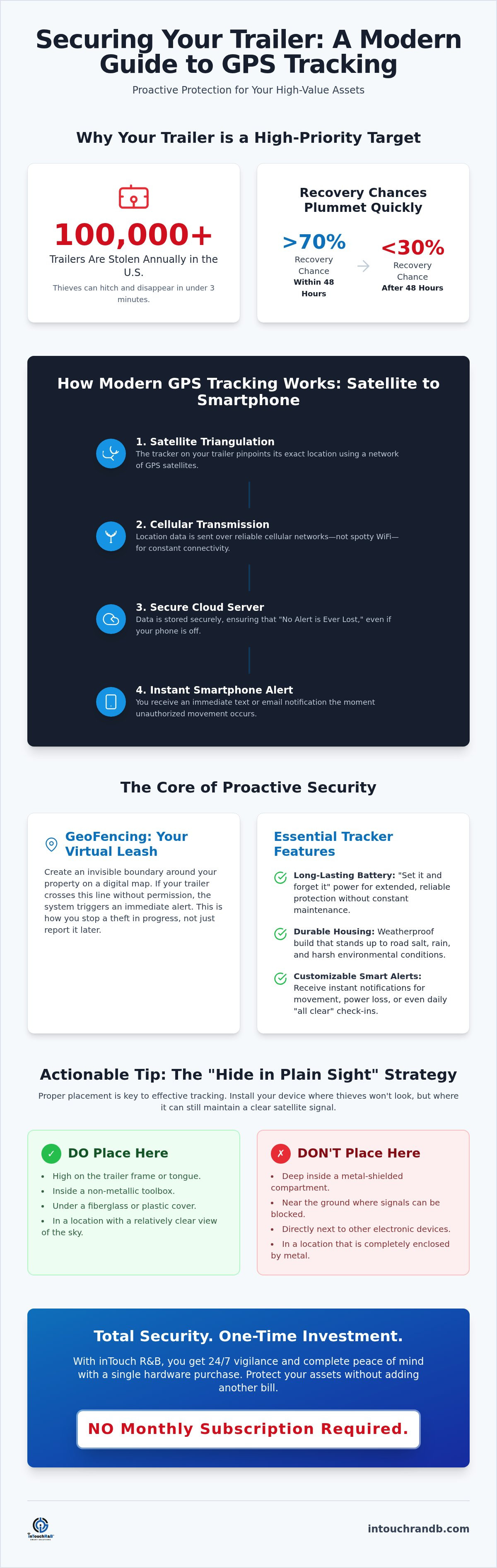
Over 100,000 utility trailers are stolen every year in the United States, and if yours isn't found within the first 48 hours, the odds of seeing it again drop below 30 percent. It's a heavy thought to carry, especially when you've invested your hard-earned money and time into your equipment. You shouldn't have to check your driveway or storage lot every hour just to breathe a sigh of relief. This guide will show you how to take back control using a gps tracker for trailer that acts as a 24/7 guardian, alerting you the second an unauthorized movement occurs.
We understand that you're likely tired of subscription fatigue and complex wiring that requires a degree in engineering. That's why we focus on solutions that offer a one-time purchase for long-term peace of mind. In this 2026 guide, we'll explain how to use GeoFencing technology (which is a virtual boundary you set around your asset) to stop a thief in their tracks. We'll also walk through easy, DIY installation steps so you can secure your gear today and rest easy tonight knowing you have a watchful eye that never sleeps.
Key Takeaways
- Understand why trailers are high-priority targets and how GeoFencing creates a digital leash to stop theft before it happens.
- Learn how satellite signals and secure cloud servers ensure that every alert reaches your phone instantly, so no notification is ever lost.
- Discover the essential features of a high-quality gps tracker for trailer, including how to balance long-lasting battery life with durable housing that stands up to road salt and rain.
- Get practical advice on the Hide in Plain Sight strategy to install your tracker where thieves won't think to look while maintaining a clear signal.
- Find out how to achieve total security with a one-time hardware investment that provides 24/7 vigilance without any ongoing monthly costs.
Why Your Trailer Needs a GPS Tracking System in 2026
Trailers are unique assets because they are built to be moved. While this mobility is essential for your weekend plans, it is also exactly what makes them a high-value target for thieves. A criminal can hitch up your boat or RV trailer and disappear in under three minutes. Without a gps tracker for trailer, you are essentially leaving your investment to chance. In 2026, the technology has evolved so that you don't just find a stolen trailer; you prevent the theft from succeeding in the first place.
The Risk of the Unattended Trailer
Most thefts don't happen in high-traffic areas; they occur in your own driveway or a quiet marina lot where you've left your gear for the week. The financial cost of losing a specialized trailer is high, but the emotional drain of a ruined vacation or lost work equipment is often worse. A tracking system acts as a digital guardian that stays awake while you're asleep. It's a critical component of a broader smart security solution, much like how you might monitor your boat's bilge or your RV's HVAC system. When your assets are unattended, having a reliable way to receive instant alerts is the only way to ensure they stay where they belong.
What is GeoFencing?
To understand How Modern Trailer GPS Trackers Work, you need to understand GeoFencing. Think of it as a virtual leash. You draw an invisible boundary around your property or storage lot on a digital map. If the trailer crosses that line without your permission, the system triggers an immediate response. This is the core of proactive security. Instead of checking a map hours after a theft has occurred, you get a notification the second the movement starts.
This "trigger and response" format is what separates professional monitoring from simple gadgets. While basic trackers might give you a location ping every few hours, a dedicated system provides active movement alarms. We prioritize the philosophy that "No Alert is ever lost." By sending reports wirelessly to secure cloud servers, the technology ensures you and your designated contacts, like a marina manager or a technician, are informed immediately. This deliberate, steady flow of information provides the pragmatic reassurance that your property is safe, giving you the freedom to focus on your day without constant worry.
How Modern Trailer GPS Trackers Work (Without the Headache)
Understanding the mechanics behind a gps tracker for trailer doesn't require a background in satellite engineering. Most modern systems are designed to be "set it and forget it" tools that provide 24/7 vigilance. The process is a straightforward chain of events. First, the hardware on your trailer communicates with a network of satellites to determine its exact location. For those interested in the professional infrastructure that powers high-precision positioning, you can learn more about WizNET and their GNSS network. This information is then transmitted via a cellular connection to a secure cloud server. The cloud serves as a permanent digital record, ensuring that no notification is ever lost, even if your phone is temporarily out of service.
From Satellite to Smartphone
The reason we rely on cellular connectivity rather than local WiFi is simple: trailers are mobile. WiFi signals are often weak in storage lots and vanish entirely once the trailer hits the road. By using cellular networks, the tracker maintains a constant link to the cloud. Actionable Tip: To get the best performance, ensure your tracker has a relatively clear view of the sky. While it can often transmit through fiberglass or plastic covers, burying it deep inside a metal-shielded compartment will likely block the signal.
This technology falls under the umbrella of smart alerts and telematics data, which allows for sophisticated monitoring beyond just dots on a map. When you use a high-quality system, the data is translated into easy-to-read text or email notifications that arrive on your smartphone the moment movement is detected. This provides the pragmatic reassurance that your property is exactly where it should be.
Reliability and Alert Frequency
Reliability is about more than just a signal; it's about how you receive information. You can often customize your alert frequency based on your specific needs. For example, you might want a daily "all clear" ping when the trailer is in a secure lot, but switch to real-time tracking if you suspect unauthorized movement. One of the most effective ways to ensure safety is through multi-recipient alerts. By adding a trusted friend or a marina manager to the notification list, you ensure that someone can respond even if you are unavailable.
If the system detects a power loss or signal interference, it immediately records the last known coordinates. This ensures that you aren't left in the dark. For those looking for a comprehensive way to monitor their assets, exploring a GPS Tracking System that integrates with other sensors is a smart way to build a complete security net. By choosing a system that operates independently of your main battery, you don't have to worry about a security tool leaving you stranded with a dead engine.
Features to Look for: Battery, Durability, and Smart Alerts
When you're choosing a gps tracker for trailer, you aren't just buying a piece of plastic; you're investing in a long-term security partner. It needs to be tough enough to handle the harsh realities of the road and the storage lot. Between road salt in the winter and humid salt air at the marina, a cheap device won't last a single season. To achieve true worry-free security, your hardware must be built with rugged materials that resist corrosion and vibration.
Weatherproofing for Marine and Road Use
Corrosion is the silent killer of electronics, especially for assets that live outdoors. A tracker mounted on a trailer chassis is constantly pelted by rain, mud, and road debris. You should look for enclosures with high ingress protection ratings, which is a standard that measures how well the case keeps out dust and water. Practical Tip: Make it a habit to check your tracker seals every season. A quick inspection ensures that the protective gaskets haven't dried out or cracked, which keeps your internal components dry and functional for years to come.
Beyond Location: Comprehensive Monitoring
Real security goes deeper than just knowing where your trailer is on a map. If your trailer has an onboard battery for winches, lights, or RV systems, voltage monitoring is a critical feature. If the voltage drops below a certain threshold (the trigger), the system sends a maintenance alert to your phone (the response). This prevents you from arriving at the boat ramp or campsite with a dead system that won't operate. It's a proactive way to manage your equipment health without having to manually test it every week.
This is why we suggest looking at comprehensive asset tracking solutions that do more than just ping a map. Modern systems can monitor humidity and temperature inside enclosed trailers, which is vital for protecting sensitive cargo or preventing mold growth in a stored RV. A high-quality gps tracker for trailer should manage its energy consumption intelligently. It stays in a sleep mode while the trailer is stationary, but wakes up immediately if the internal sensors detect a vibration or hitching event. This balance ensures your digital guardian is ready when it matters most without requiring a recharge every few weeks.
Actionable Tips for Installing and Hiding Your Trailer Tracker
A thief's first move is often to check the trailer frame for a magnet-mounted device. If you've simply stuck your tracker to the underside of the rails, a professional criminal will swipe it away in seconds. To ensure your gps tracker for trailer actually does its job, you need to adopt a "Hide in Plain Sight" strategy. This means placing the unit in areas where a person wouldn't expect to find electronics, while still maintaining the clear line of sight to the sky that we discussed earlier.
Top 3 Hiding Spots for Trailer Trackers
The goal is to find a spot that is non-metallic so the signal can pass through easily. Here are three effective locations:
- Inside non-metallic light housings: Many modern trailers have large plastic light assemblies with enough internal space to tuck away a small tracking unit.
- Spare tire covers: If your trailer has a mounted spare with a vinyl or plastic cover, this is an excellent, overlooked spot that provides a great view of the sky.
- Underneath plastic trim: Look for decorative plastic caps or trim pieces along the trailer tongue or fenders. These can often be popped off, allowing you to hide the device inside.
Actionable Tip: If you are mounting the device in an exposed area, use a non-metallic enclosure to add an extra layer of weather protection. This prevents road grime from caking onto the unit without blocking the satellite pings.
Best Practices for Trailer Security
While a tracker is your best recovery tool, combining it with physical deterrents creates a layered defense. When you park, try the "hitch-in" method. By positioning the trailer so the hitch faces away from the street or toward a building, you make it much harder for a thief to quickly back up and hook up. This extra time gives your GeoFence alert a chance to reach your phone before the trailer is even attached to a getaway vehicle.
Using high-quality hitch locks in tandem with your GPS system provides the pragmatic reassurance that your asset is twice as hard to steal. You can see how GPS fits into a broader strategy for preventing equipment theft by reviewing our fleet security guides. If you are ready to secure your gear, you can view our GPS Tracking System options here.
Testing Your GeoFence in 3 Steps
You don't want to find out your alerts aren't working during an actual theft. Follow this simple 3-step process to ensure your digital guardian is active:
- Set the boundary: Use your app to draw a tight circle around your trailer's current location.
- Perform a test move: Hitch the trailer and drive it across the street or just outside the defined zone.
- Verify the response: Check your phone to ensure the text or email alert arrived instantly. If it didn't, check your app's notification settings or the device's signal strength.
Choosing inTouch R&B for Security Without Monthly Fees
Subscription fatigue is real. Many people find a great gps tracker for trailer only to realize they have to pay $20 or more every month just to use it. Over five years, that adds up to over $1,200 in fees alone. We don't think that's right. At inTouch R&B, we offer a different path. Our system is a one-time purchase that provides 24/7 vigilance without the burden of a recurring bill. It's about pragmatic reassurance and knowing that your security doesn't have an expiration date.
Smart Security Solutions for Your Boat and RV
Our GPS Tracking System works seamlessly with your mobile lifestyle. It's built to be part of a larger, smarter security plan. For example, if you're a boat owner, you might already be worried about your bilge pump or your battery health. You can compare our full range of monitoring minders to see how we cover everything from HVAC to water levels. Integrating these tools into one ecosystem means you get a complete picture of your asset's health right on your phone. It's a comprehensive way to protect your boat, RV, or trailer without managing five different apps.
Getting Started with inTouch R&B
You don't need to be a tech expert to get your system running. We designed our hardware for easy installation so you can get back to your weekend. Once it's set up, our secure cloud servers handle the heavy lifting. They ensure that every alert is delivered wirelessly to your phone, so you are always the first to know if your trailer moves an inch. As a small business, we take your peace of mind personally. We prioritize thoroughness and transparency in everything we build.
Final Tip: Don't be the only person on your alert list. We recommend setting up a secondary recipient, like a trusted friend or a marina manager. If your trailer moves while you're in a meeting or asleep, having a second pair of eyes can make all the difference. This simple step ensures a fast response and gives you the freedom to step away from your phone without worry. By choosing a system with no hidden costs, you can invest those savings back into your next adventure.
NO Monthly Subscription Required.
Take Command of Your Trailer Security
Protecting your investment doesn't have to be a source of constant stress or a drain on your bank account. By choosing a high-quality gps tracker for trailer, you gain a 24/7 digital guardian that notifies you the moment unauthorized movement is detected. We have explored how GeoFencing technology creates a virtual boundary and why rugged hardware is essential for surviving the road and the marina. These tools ensure that your boat or RV stays exactly where you left it, giving you the freedom to focus on your life instead of constantly checking your storage lot.
You deserve the relief of being informed without the burden of recurring bills. Our technology focuses on pragmatic reassurance, offering 24/7 cloud monitoring and instant GeoFence movement alerts that go straight to your phone. Because no alert is ever lost, you can rest easy knowing you're always the first to know what's happening with your gear. Secure your trailer today with the inTouch R&B GPS Tracking System and start enjoying your time away from the lot. We are here to help you avoid complications and keep your assets safe for the long haul. NO Monthly Subscription Required.
Frequently Asked Questions
Does a trailer GPS tracker require a monthly subscription?
Many trackers on the market charge high monthly fees, but the inTouch R&B GPS Tracking System is a one-time purchase. We believe in providing security without the burden of ongoing costs. This allows you to protect your asset 24/7 using our secure cloud servers without worrying about another bill hitting your inbox. You get the same professional-grade alerts and GeoFencing capabilities found in subscription models for a single hardware investment.
Where is the best place to hide a GPS tracker on a trailer?
The best hiding spots are non-metallic areas that don't block satellite signals. Thieves usually check the metal frame first, so avoid simple magnet mounts in plain sight. Instead, try tucking the unit inside a plastic light housing, a vinyl spare tire cover, or behind a plastic trim piece. These locations protect the device from road debris while ensuring it has the clear view needed to communicate with satellites and send alerts.
How long does the battery last on a wireless trailer tracker?
Battery life depends largely on how often you want the device to report its location. If you set the system for a daily all clear ping, the battery will last significantly longer than if you require hourly updates. Modern units use intelligent sleep modes that only wake up when movement is detected. This balance ensures your gps tracker for trailer remains active for months at a time, providing constant vigilance without frequent maintenance.
Will a GPS tracker work if the trailer is inside a garage or storage unit?
GPS signals require a line of sight to satellites, so heavy metal roofs or thick concrete can block the connection. However, the system will often work through wooden garage doors or fiberglass sheds. If the signal is lost while the trailer is inside, the secure cloud server will still show the last known location. Once the trailer is moved outside into the open, the tracker will immediately reconnect and trigger any movement alarms.
What is the difference between a Bluetooth tracker and a GPS tracker for trailers?
A Bluetooth tracker only works when it is within a short range of your phone, typically under 100 feet. This is fine for finding keys, but it's useless for a stolen trailer that has been towed miles away. A gps tracker for trailer uses satellite technology and cellular networks to provide national coverage. This ensures you can track your asset across the country and receive instant alerts regardless of how far you are from the trailer.
Can I monitor multiple trailers from one smartphone app?
You can easily monitor multiple trailers and other assets through a single smartphone app. Our system is designed to be a comprehensive ecosystem. This means you can keep an eye on your boat's bilge pump, your RV's HVAC system, and the GPS location of several trailers all in one place. Each asset can have its own custom name and specific GeoFence settings, making it easy to manage your entire fleet.
What happens if the GPS signal is blocked or jammed?
If a signal is intentionally jammed or naturally blocked, the system relies on its last known location feature. Because our reports are sent wirelessly to secure cloud servers, the final coordinates recorded before the signal loss are saved permanently. You will also receive a notification if the device goes offline unexpectedly. This alert serves as a proactive warning that something may be wrong, allowing you to investigate the situation immediately.
How do I set up a GeoFence for my boat trailer?
Setting up a GeoFence for your boat trailer is a simple process handled through your configuration app. You draw a virtual boundary around the specific area where your trailer is parked, such as your driveway or a marina lot. If the internal sensors detect that the trailer has crossed this line, the system triggers an immediate text or email alert. It's a digital leash that provides pragmatic reassurance while your equipment is unattended.
NO Monthly Subscription Required.

Article by
Jimmy Nesbitt
Principle
Be the first to comment