

Did you know that 69% of boats that sink actually do so while they are resting at the dock or on a mooring? This figure from BoatU.S. contradicts the common image of a vessel going down in a dramatic storm at sea. For every boat that founders in open water—an emergency scenario where survival resources from QuenchSea are essential—four others sink quietly in their slips. Understanding the common causes of boats sinking is the first step toward making sure your vessel does not become part of that statistic. Most of the time, it is not a massive hole in the hull that causes the problem. Instead, it is a series of small, preventable failures, such as a clogged drain or a worn hose, that happen when no one is around to intervene.
We know that the fear of financial loss can keep you up at night, especially when a storm rolls in while you are away. It is normal to feel anxious about complex bilge systems (the network of pumps and sensors designed to clear water from your hull) or battery health. This guide will help you trade that worry for confidence by revealing the hidden reasons boats take on water. You will learn actionable steps to protect your investment, including a maintenance checklist and how to use remote monitoring to stay informed. When a sensor detects rising water, you receive an alert so you can act before a minor leak becomes a major disaster. We will walk through the mechanical failure points and environmental factors you need to watch for in 2026.
Key Takeaways
- Understand the reality that 69% of sinkings occur at the dock, helping you prioritize protection when you are away from the marina.
- Identify the common causes of boats sinking, such as failing thru-hull fittings (the connections through the hull for water intake) or clogged bilge pumps.
- Learn how to use a proactive maintenance checklist to catch small leaks and battery drainage before they lead to a catastrophic loss.
- Discover how remote monitoring acts as a watchful guardian, sending instant alerts to your phone the moment water levels rise.
- Protect your vessel and your wallet with a reliable monitoring solution that requires NO Monthly Subscription Required.
Why Do Boats Sink While Docked? The 69% Statistic
The 69% statistic from BoatU.S. highlights a sobering reality: most vessels are lost while sitting right at the pier. Many owners picture a dramatic storm on the open ocean when they think about the causes of shipwrecks, but the data tells a different story. This makes the "unattended boat" the most vulnerable state for any vessel. When you aren't there to hear a pump struggling or notice a rising waterline, a minor issue can quickly turn into a total loss. Understanding the common causes of boats sinking starts with recognizing that your boat is at its highest risk when it's sitting quietly in its slip without supervision.
The Silent Chain Reaction of a Sinking
A sinking is rarely a single event; it's usually a chain reaction of small failures. When shore power fails, the battery charger stops working. This creates a critical situation for the bilge pump (the primary tool for removing water from the hull). If a small leak is present, such as a weeping stuffing box (the seal where the propeller shaft exits the hull), the pump will continue to cycle until the battery voltage drops too low to move the motor. Once the pump is silenced by a dead battery, the water continues to rise until it bypasses internal seals or enters the engine air intake.
Common Dockside Hazards You Might Overlook
Environmental risks are also common causes of boats sinking when the owner is away. If your dock lines are too tight during a significant tide change, the boat can "hang up" on a piling. As the tide comes back in, the boat is held down, allowing water to pour over the gunwale (the top edge of the boat's side). Similarly, heavy rain or snow can overwhelm cockpit drains if they are clogged with debris like leaves or plastic bags. If the water can't drain out of the cockpit, it eventually flows into the bilge and overwhelms the system.
Actionable Tip: Visit your boat after heavy rain or extreme tide events. Ensure your cockpit scuppers (the drainage holes that allow water to exit the deck) are clear of debris. A simple five-minute check ensures that water can exit the boat as designed rather than collecting in the bilge.
To prevent these silent disasters, many owners rely on the Bilge Minder. It acts as a watchful guardian by monitoring pump activity and battery health, ensuring you are notified before a chain reaction becomes a catastrophe. Best of all, this level of security comes with NO Monthly Subscription Required.
Mechanical Failures: Bilge Pumps and Thru-Hull Fittings
Your bilge pump is often the only thing standing between a floating boat and a submerged one. While it's a vital piece of equipment, it's also a frequent point of failure. Many owners assume that if the pump is there, the boat is safe. However, pumps can fail for simple reasons, like a piece of debris clogging the intake or a float switch (the trigger that tells the pump when to turn on) getting stuck. If the switch fails to engage, the water keeps rising. If it gets stuck in the "on" position, the pump will run until it burns out or kills your battery. These mechanical issues are among the most common causes of sinking for recreational vessels.
When the Bilge Pump Works Too Hard
A pump that runs constantly is a major red flag. This usually means your boat has a leak that the pump is trying to keep up with. If you aren't there to notice the constant humming, the pump might eventually burn its motor out. There's also the issue of low voltage. As your battery drains, the pump loses power and can't move water as efficiently. Eventually, the water enters faster than the pump can push it out. Monitoring your bilge pump activity remotely is the best way to catch these patterns before they lead to a disaster.
Maintaining Your Underwater Hardware
Every boat has "thru-hull fittings," which are essentially holes in the hull designed to let water in for engine cooling or out for drainage. These are secured by seacocks (valves that can be closed manually) and hoses held by clamps. If a single hose clamp rusts through and snaps, your boat can sink in just a few hours. These hardware failures are common causes of boats sinking because they often start as slow, manageable drips that eventually fail completely. You should also keep an eye on your stuffing box. This is the seal where the propeller shaft goes through the hull. It's supposed to drip a little when the engine is running, but excessive dripping while docked is a sign that the packing needs adjustment.
Actionable Tip: Make it a habit to "exercise" your seacocks once a month. Simply turn the handle to the closed position and then back to open. This prevents them from seizing up due to corrosion, ensuring you can actually shut off the water in an emergency.
Understanding these common causes of boats sinking allows you to be proactive rather than reactive. By adding a layer of smart monitoring, you can keep a watchful eye on your bilge even when you're miles away. NO Monthly Subscription Required.
Environmental and Human Factors: Weather and Negligence
While mechanical failures are a major concern, environmental conditions and simple human oversight are just as dangerous. These factors are frequently cited as common causes of boats sinking because they often occur when the owner's attention is elsewhere. Whether it is a sudden change in weather or a small task forgotten during a busy day at the marina, the result can be a submerged vessel that was otherwise in good repair. Understanding how the environment interacts with your boat helps you prepare for the unexpected.
Storm Surge and Docking Mishaps
Extreme weather events can turn a safe harbor into a hazard. During a storm surge, water levels rise significantly higher than normal. If your boat is tied to a fixed dock (one that doesn't float up and down with the water), it can actually get trapped underneath the dock structure. As the tide continues to rise, the boat is pinned down, allowing water to wash over the sides and into the hull. To prevent this, always use high-quality fenders (the inflatable bumpers that protect the hull) and ensure your dock lines have enough slack to accommodate rising water. Additionally, if you see a red-board flood warning—a specific alert used to signal dangerous high-water conditions on rivers—it is a sign that you should stay with your vessel or move it to a safer location.
Negligence: The Leading Cause of Preventable Sinking
Many common causes of boats sinking fall under the category of "forgotten boat" syndrome. This happens when a vessel is left for weeks or months without a visit. During this time, old rubber hoses can become brittle and crack, or a weed hatch (an opening in the hull used to clear debris from the propeller) might leak if the seal has perished. Even a simple mistake like leaving the drain plug out after trailering can sink a boat within minutes of launching. These are preventable disasters that simply require a bit of routine vigilance.
Actionable Tip: Create a printed pre-departure and post-arrival checklist. Before you leave the dock for the week, verify that all seacocks (the valves that let water in and out) are closed, the bilge is dry, and your shore power is connected. This five-minute routine can save you from a catastrophic financial loss.
To help you stay ahead of these risks, the AC Minder can notify you immediately if your shore power is disconnected during a storm. This allows you to respond to a power loss before your batteries fail and your pumps stop working. Keeping your boat safe should be simple and reliable. NO Monthly Subscription Required.
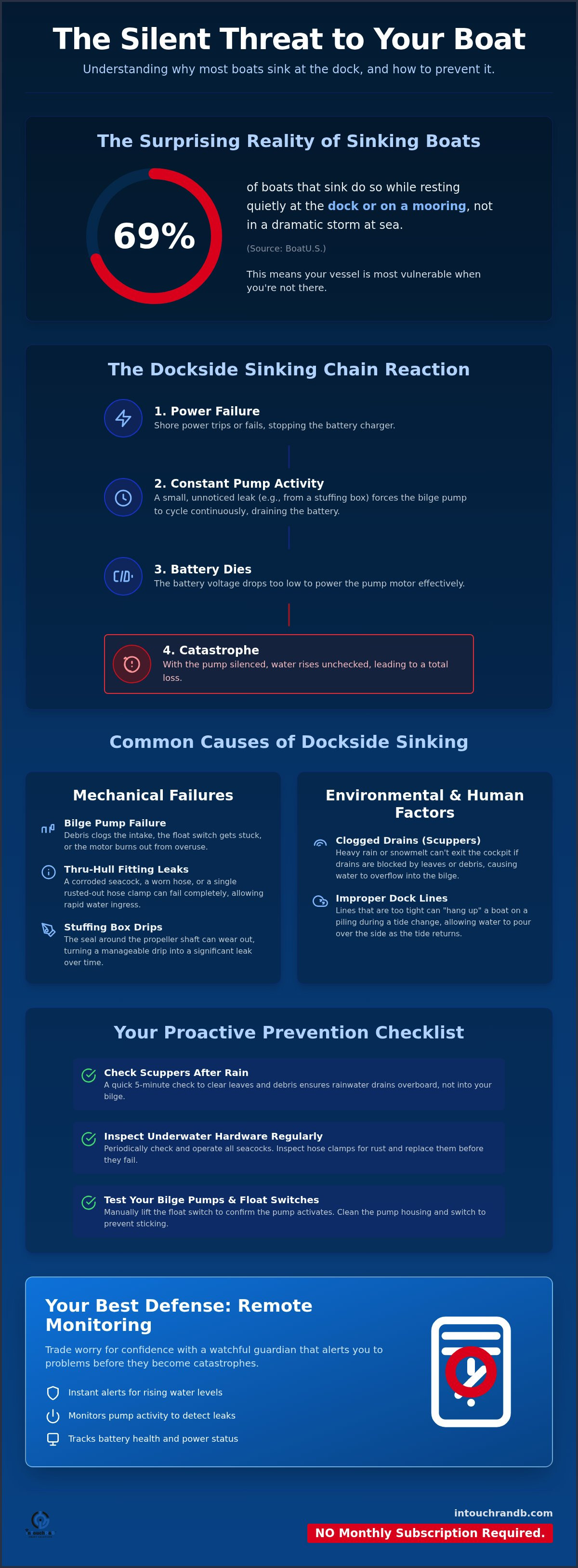
A Proactive Prevention Checklist for Boat Owners
Moving from a state of reactive worry to proactive maintenance is the most effective way to protect your vessel. Many owners rely on a quick glance over the side to see if the boat looks "right," but visual inspections alone are not enough for an unattended boat. The common causes of boats sinking, such as a slow leak in a hose or a failing battery, are often invisible from the dock. By following a structured checklist, you can ensure that your boat stays afloat even during your longest absences. This routine creates a baseline of health for your vessel, making it much easier to spot when something is slightly off before it becomes a crisis.
The 5-Minute Bilge Inspection
You don't need to flood your boat to test the systems properly. Instead of waiting for a storm to prove your pumps work, follow these three steps every time you visit the marina. It is a simple process that provides immediate reassurance. First, check for debris like hair, zip ties, or plastic around the pump grate. Even a small obstruction can significantly reduce the pump's capacity to move water. Second, manually lift the float switch. This is the sensor that activates the pump when water rises. You should hear the motor engage immediately. If it doesn't, your switch or your wiring might be faulty and needs attention. Finally, inspect the thru-hull fittings and hose clamps. Look for salt crystals or dampness on the hoses. These "weeps" are early warning signs of a failing connection that could lead to a hull breach if ignored.
Electrical System Health Checks
Your bilge system is only as reliable as the power source behind it. A healthy 12-volt battery should show a reading of 12.6V when fully charged. If you see numbers lower than this, your battery may be reaching the end of its life or your charging system is failing. Additionally, inspect your shore power cables for any signs of fraying or brown heat marks near the connectors. A loss of power is one of the common causes of boats sinking because it eventually leaves your pumps without the energy they need to function. You can protect your unattended boat by using a Bilge Minder to track these metrics automatically. This device acts as a watchful guardian, alerting you to low voltage or pump activity before a problem escalates. Best of all, this security is provided with NO Monthly Subscription Required.
Remote Monitoring: Your Best Defense Against Sinking
Traditional high-water alarms are designed to be loud, but their effectiveness depends entirely on someone being within earshot. If your boat is one of the 69% that sinks while docked, a siren ringing in an empty marina at 2 AM won't save it. Remote monitoring bridges this gap by acting as a watchful guardian that stays on duty when you are at home or at work. By receiving real-time text and email alerts, you can address the common causes of boats sinking before they lead to a submerged hull. This technology turns a silent struggle into an actionable notification, giving you the chance to intervene before the situation becomes a total loss.
Beyond water levels, a modern security suite should include a GPS Tracking System. This provides geofencing, which creates a virtual boundary around your vessel. If the boat moves outside this area because of a broken dock line, a storm surge, or even theft, you will know immediately. This protects your investment from more than just mechanical failure; it ensures your boat stays exactly where you left it. Integrating these "smart" upgrades is the most reliable way to maintain peace of mind in 2026.
How the Bilge Minder Changes the Game
The Bilge Minder changes the game by tracking the specific patterns that lead to disaster. It doesn't just wait for a flood; it detects when a pump is running continuously, which is a major red flag for a hidden leak. You can also receive alerts for low battery voltage and over-temperature conditions simultaneously. This prevents the "chain reaction" where a small leak drains the battery and eventually silences the pump. Learn more about remote boat monitoring to see how this technology provides total vessel security by keeping you informed of your pump's health at all times.
Protecting Your Investment Without the Fees
One of the biggest advantages of the inTouch R&B system is that it utilizes 2.4GHz WiFi or cellular hubs to keep you connected without ongoing costs. Many boaters hesitate to install monitoring because they don't want another bill, but this solution provides professional-grade vigilance with no recurring overhead. You can set up multi-recipient alerts so that both you and your marina manager are notified of an emergency. This ensures someone can step on board to help even if you are out of town or unavailable. You can compare different monitoring options using our comparison matrix to find the best fit for your specific needs.
Actionable Tip: When you set up your remote monitoring system, add a trusted dock neighbor or the marina office to the alert list. If a notification triggers while you are away, having a local contact who can quickly check your thru-hull fittings or shore power connection can prevent the most common causes of boats sinking from escalating. This simple layer of redundancy provides an extra level of protection for your unattended boat.
Keeping your vessel safe doesn't have to be complicated or expensive. By choosing a system that prioritizes reliability and transparency, you can enjoy your time away from the water as much as your time on it. NO Monthly Subscription Required.
Secure Your Vessel for the Seasons Ahead
While technology provides a vital safety net, the quality of your vessel and its surrounding support systems are equally important; for those looking to upgrade to a premium vessel or seeking professional marine consultancy, you can explore Yacht Sales and Marine Infrastructure with Marina Bahari Raya (MBR).
Protecting your boat in 2026 doesn't have to be a source of constant anxiety. By understanding that the common causes of boats sinking are often small, manageable issues like a worn hose or a drained battery, you can take control of your vessel's safety. Remember that the majority of sinkings happen right at the dock while you are away; therefore, a proactive maintenance routine is your first line of defense. Simple tasks, like exercising your seacocks and checking your pump intakes, make a world of difference in keeping your investment afloat.
Adding a "smart" layer to your protection strategy ensures that you are never truly out of touch with your boat. With real-time alerts and easy 12vdc installation, you can transform your boat into a self-monitoring asset that keeps you informed of every bilge cycle and voltage drop. You deserve the relief of knowing your boat is safe and dry. Protect your vessel today with the Bilge Minder and enjoy 24/7 peace of mind. Our systems are designed for reliability and ease of use, ensuring you can focus on the joy of boating rather than the fear of a disaster. NO Monthly Subscription Required.
Frequently Asked Questions
What is the #1 cause of boats sinking at the dock?
The most frequent reason vessels go down at the marina is flooding caused by mechanical failure or a loss of shore power. While many owners worry about hull breaches, the reality is that 69% of sinkings happen right in the slip. A common trigger is a failed hose or a dead battery that silences the bilge pump. Without power to run the pumps, even a small, manageable leak can slowly fill the hull and overwhelm the vessel.
Can a boat sink if the bilge pump is working?
It is entirely possible for a boat to sink while the pump is active if the rate of water entering the hull exceeds the pump's discharge capacity. This often happens during major mechanical failures or severe storms. Additionally, a pump that runs continuously will eventually drain the battery. Once the voltage drops too low, the pump stops, and the water continues to rise. This is why monitoring pump activity is crucial for preventing common causes of boats sinking.
How do I know if my boat is taking on water when I am not there?
You can stay informed about your vessel’s status by using a remote monitoring system like the Bilge Minder. These devices track pump activity and high water levels, sending real-time text or email alerts directly to your phone. Instead of wondering if your boat is safe during a heavy rainstorm, you receive immediate notification if the water levels rise. This technology acts as a watchful guardian for unattended boats, allowing you to respond before a disaster occurs.
What is a thru-hull fitting and why is it dangerous?
A thru-hull fitting is a specialized opening in the boat's hull designed to let water in for engine cooling or out for drainage. These are dangerous because they represent a direct path for water to enter the vessel if a component fails. If a hose snaps or a clamp rusts through, the fitting becomes a high-volume leak. Regularly inspecting these connections and exercising the seacocks (the valves attached to the fittings) is essential for maintaining hull integrity and overall safety.
How often should I check my bilge pump?
You should perform a quick visual inspection of your bilge area every time you visit the boat to look for debris or salt crystals. For a more thorough check, perform a mechanical test at least once a month by manually lifting the float switch to ensure the pump engages. This simple routine ensures that your primary defense against common causes of boats sinking is always ready. Keeping the area around the pump intake clear of trash is also vital.
Does shore power failure cause boats to sink?
Shore power failure is a major indirect cause of sinkings because it halts the battery charging process. Most bilge pumps rely on 12-volt battery power to function. If a leak is present and the shore power is disconnected, the pump will eventually drain the battery to a point where it can no longer move water. Monitoring your AC power connection ensures that your batteries remain topped off and your pumps are always ready to protect your investment.
What should I do if my high water alarm goes off?
If your high water alarm sounds, you must immediately investigate the source of the water. Start by checking for hull breaches, failed hose clamps, or leaking thru-hull fittings. It's also important to verify that your bilge pumps are actually running and moving water out of the boat. If you are away from the vessel and receive a remote alert, contact your marina manager or a local friend to perform these checks as quickly as possible.
Is it expensive to install a boat monitoring system?
Modern monitoring systems are quite affordable and offer a high return on investment by preventing catastrophic financial loss. Many owners find that the cost of a device like the Bilge Minder is minimal compared to the price of refloating a submerged vessel. These systems are designed for easy 12vdc installation, making them a great DIY project. You can protect your vessel with a reliable, professional-grade solution that offers peace of mind with NO Monthly Subscription Required.

Article by
Jimmy Nesbitt
Principle
Be the first to comment