

Imagine walking down the dock on a Saturday morning, coffee in hand, only to find your slip occupied by nothing but a set of taut dock lines and a shimmering oil slick. It's the nightmare every boat owner carries in the back of their mind, and unfortunately, it's a reality that happens far too often when we rely on "dumb" local alarms. You need a professional bilge pump monitoring system "inTouchRandB.com " that acts as a watchdog guardian, keeping you informed even when you're miles away from the marina.
We know the frustration of wondering if your batteries are holding a charge or if a slow, hidden leak is quietly taxing your pump. It's stressful to leave your investment at the mercy of a simple float switch that only makes noise for an empty parking lot. This guide will show you how to protect your vessel from sinking and equipment failure with professional-grade remote monitoring technology. You'll learn how real-time notifications with “inTouch R & B” and historical data can identify issues before they become catastrophes, providing you with the absolute peace of mind that your boat is safe 24/7.
Key Takeaways
- Understand how a professional bilge pump monitoring system inTouchRandB.com acts as a remote sentinel, transforming your boat from a silent asset into one that communicates its health directly to your smartphone.
- Learn to distinguish between high water alarms that signal an active crisis and cycle monitoring that identifies slow, manageable leaks before they cause major damage.
- Discover why cellular connectivity and battery voltage tracking are essential features for ensuring your monitoring hardware remains operational during shore power outages.
- Explore how the protective principles of vessel security can be integrated into your home through specialized tools like a Sump pump minder for total property peace of mind.
Table of Contents
-
What is a Bilge Pump Monitoring System and Why is it Essential?
-
The Bilge Minder Advantage: Reliable Protection for Your Vessel
What is a Bilge Pump Monitoring System and Why is it Essential @ inTouchRandB.com
A bilge pump monitoring system is essentially a digital sentry that maintains a constant watch over your vessel's most critical safety component. While you might already understand the basics of What is a Bilge Pump? and its role in moving water overboard, a monitoring system adds a layer of intelligence to this mechanical process. It doesn't just wait for water to arrive; it tracks the health, power supply, and activity of the pump itself. This technology acts as a communication bridge, sending vital data from your bilge to your smartphone so you're never left wondering about the state of your boat.
For many owners, the marina is hours away. This distance creates a vulnerability that traditional equipment cannot address. Industry reports consistently show that a significant majority of boat sinkings occur while the vessel is tied to the dock, often due to preventable mechanical failures that went unnoticed. A professional monitoring system provides the remote vigilance required to catch these issues before they escalate into a total loss, transforming your boat from a silent asset into one that actively reports its status.
The Limitations of Standard Automatic Bilge Pumps
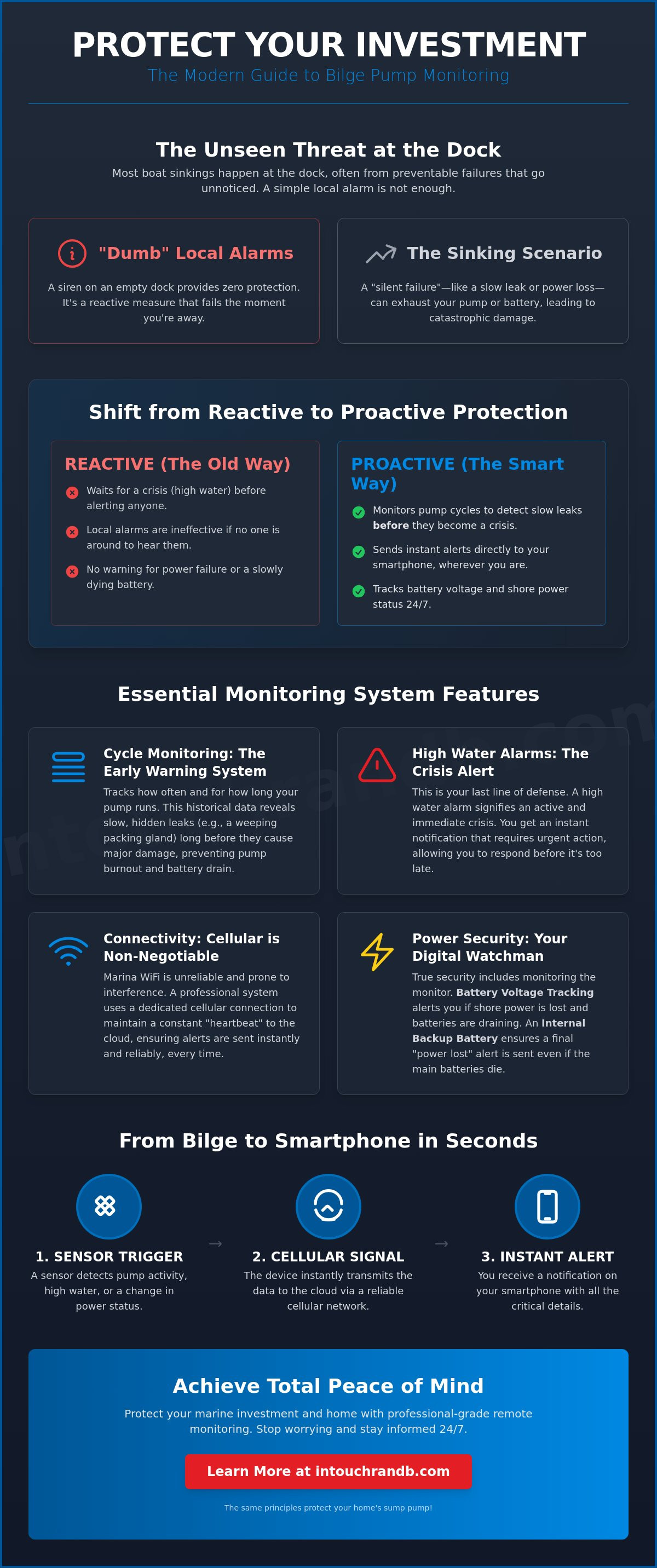
Standard automatic pumps are reactive by design. They rely on a float switch to trigger and the motor to spin. However, this sequence assumes everything is in perfect working order. If a debris-clogged intake prevents water flow or a tripped shore power breaker drains your batteries, the pump remains silent. You might have a local alarm that sounds a siren; but if no one is on the dock to hear it, that alarm provides no protection. The most dangerous scenario is the "silent failure," where a small leak causes the pump to run continuously until the motor burns out or the power source is exhausted, leaving the boat completely defenseless.
How Remote Monitoring Bridges the Security Gap
Remote monitoring changes the dynamic from reactive to proactive. By utilizing cellular networks and specialized sensors, these systems provide 24/7 visibility into your equipment's behavior. Instead of waiting for a frantic call from a dockmaster who noticed your boat sitting low in the water, you receive an instant notification the moment a pump cycle begins. This technology functions as a virtual watchman; it records every time the pump activates and for how long. This data allows you to identify a slow leak, such as a weeping packing gland or a failing hose, long before it becomes a crisis. It's about having the professional expertise of a full-time crew member available in the palm of your hand.
Selecting a high-quality bilge pump monitoring system @ inTouchRandB.com requires looking beyond basic "on/off" alerts. True security is built on the reliability of the hardware components and the method used to deliver information. Your monitoring device must be rugged enough to withstand constant exposure to salt air, high humidity, and engine room vibration. It also needs to be straightforward to install. A system that requires complex rewiring of your existing electrical harness often introduces more potential points of failure than it solves.
Federal bilge pump requirements mandate visual indicators for pump operation, but these are only effective if you are standing at the helm. Modern vessel security demands remote visibility that follows you home. This is why battery voltage tracking is a critical feature. If your shore power cord is accidentally knocked loose and your house batteries begin to drain, your monitoring system should notify you before it loses its own power source. Having internal backup power is equally essential; it ensures the system stays online to send a final "power lost" alert even if the main batteries go flat.
Connectivity: Cellular vs. WiFi
Cellular connectivity is the professional standard for marine applications. While some systems rely on marina WiFi, those networks are often inconsistent and prone to interference from large metal hulls or heavy rain. A cellular system maintains a persistent "heartbeat" connection to the cloud. This ensures that the moment a sensor is triggered, the notification is dispatched to your device without the lag or connectivity drops common with shared WiFi routers.
Sensor Precision and Data Logging
Precision isn't just about knowing if the pump is running. It's about knowing how long it ran and how often. A pump that triggers for ten seconds every hour might indicate a minor packing gland leak that needs a simple adjustment. Without a historical log, you might never notice this pattern until the leak worsens. This data is also a powerful tool for insurance claims, as it provides documented proof of diligent vessel maintenance and proactive care.
For ultimate peace of mind and total vessel security, choosing a reliable vessel monitoring solution like inTouch R&B is an investment that truly pays off.
Cycle Monitoring vs. High Water Alarms: Which Do You Need?
Many boat owners assume that a high water alarm is the ultimate defense against sinking. However, relying solely on a high water sensor is a reactive strategy that only notifies you once a crisis is already in progress. A comprehensive bilge pump monitoring system @ inTouchRandB.com will prioritize cycle counting to give you a window of opportunity before an emergency occurs. While a high water sensor acts as a vital safety net for major breaches, it doesn't provide the granular data necessary to understand the daily mechanical health of your vessel's plumbing.
The fundamental difference lies in the timing of the notification. A high water alarm tells you that your boat is currently in trouble; a cycle monitor tells you that your boat might be in trouble soon. By tracking how often your pump engages, you can develop a plan to address a leaking through-hull or a failing hose before the water level ever reaches the emergency sensor. This distinction transforms your approach from one of panic to one of organized maintenance.
The Danger of the 'Nuisance' High Water Alarm
If an alarm only sounds when the water is already inches deep, it's often too late to prevent damage to sensitive floorboards or electrical connections. These alerts naturally create a sense of urgency because they signal a breach that is already active. In many cases, owners become desensitized to alarms that trigger due to heavy rain or minor wash-down water, leading to "alarm fatigue." You should think of cycle counting as the EKG of your boat's health, measuring the rhythm of your equipment to ensure everything is functioning within normal parameters. While U.S. Coast Guard bilge alarm regulations require high water sensors for specific commercial vessels to ensure safety, recreational owners benefit most from the predictive nature of cycle tracking. Receiving regular "all clear" updates provides a psychological relief that your vessel is dry and the systems are stable.
Predicting Failure Before the Bilge Fills
Proactive monitoring identifies problems while they are still small and manageable. If your bilge pump monitoring system @ inTouchRandB.com "Bilge Minder " reports that the pump is activating every twenty minutes for five seconds, you likely have a failing check valve or a leaking shaft seal. This behavior, often called "pump hunting," occurs when water in the discharge hose flows back into the bilge once the pump stops, immediately re-triggering the float switch (a cycle that repeats until the battery is exhausted). Identifying these trends allows you to schedule a mechanic at your convenience rather than dealing with an emergency haul-out. The return on investment is clear; replacing a minor valve or tightening a hose clamp is significantly more affordable than rebuilding a submerged engine or paying for a salvage operation.
Integrating Monitoring into Your Total Property Strategy
The protective logic of a bilge pump monitoring system doesn't have to stop at the waterline. For many vessel owners, the same sense of protective vigilance required at the marina is equally necessary for secondary properties, RVs, and home basements. Managing multiple high-value assets requires a unified approach to security; one where technology acts as a virtual watchman across every environment you can't physically oversee every day. By applying the 'Minder' philosophy to your total property strategy, you ensure that a mechanical failure in one location doesn't become a financial catastrophe in another, while resources like Indiana Home Safety & Mobility can help extend this safety to physical accessibility and aging-in-place needs.
Remote sensor technology has evolved to handle more than just water ingress. Professional systems now allow you to monitor environmental variables that threaten the integrity of your property, such as power outages or extreme temperature shifts. When a shore power connection fails at the dock, your batteries begin a countdown toward depletion. Similarly, if the power cuts out at a vacation home during a cold snap, the risk of frozen pipes becomes an immediate reality. A structured monitoring plan ensures you are the first to know when these conditions change, allowing for a proactive response rather than a reactive cleanup; to further safeguard your home from the elements, you can visit Thoughtful Roofer Inc..
From Bilge to Basement: Sump Pump Parallels
A vacation home often sits empty for weeks, functioning much like a boat at a remote marina. In these environments, the basement is the "bilge" of the house. If the water table rises following a heavy storm and your equipment fails, the resulting damage is just as devastating as a sunken hull. Utilizing a Sump Pump Minder @ inTouchRandb.com "Sump Pump Minder" provides the same predictive cycle tracking you rely on for your vessel. It monitors the frequency of pump activations, notifying you if the system is struggling to keep up or if a mechanical blockage has occurred. This level of oversight is essential for homeowners who want to prevent catastrophic water damage before it reaches the finished floorboards.
Adding GPS and Environmental Sensors
Total peace of mind comes from combining equipment health data with location security. While tools like the "HVAC Minder" track the performance of your climate control systems to prevent mold or pipe bursts, a GPS Tracking System ensures your mobile assets remain secure. Whether it's a boat on a trailer or an RV in a storage lot, receiving an instant alert if a geofence is breached allows for immediate action. Knowing your assets are exactly where they should be brings a profound sense of relief that traditional locks cannot provide. When you integrate these sensors with shore power alerts via an AC Minder, you create a comprehensive safety net that protects your investments 24/7, regardless of where they are located.
The Bilge Minder Advantage: Reliable Protection for Your Vessel
Choosing a bilge pump monitoring system @ inTouchRandB.com "Bilge Minder" is a decision rooted in the desire for absolute certainty. Since our founding in 2014, we've focused on creating purpose-built, rugged solutions that prioritize hardware reliability over flashy, unnecessary features. The Bilge Minder is designed specifically for the unforgiving marine environment, ensuring that the technology remains operational when you need it most. By acting as a dedicated sentinel for your vessel, this system provides the professional-grade oversight that modern boat owners require to protect their high-value assets from preventable failure.
The core of the inTouch R&B system is its "trigger and response" reliability. We understand that in a safety-critical situation, there is no room for lag or complex software configurations. When a sensor detects pump activity or a power loss, the system responds immediately by dispatching a notification to your device. This direct approach eliminates the common points of failure found in many consumer-grade electronics, positioning the Bilge Minder as a pragmatic tool for owners who value effective, no-nonsense technology.
Why inTouch R&B Prioritizes Protective Vigilance
Our commitment to protective vigilance means we focus on preventing property damage through clear, actionable information. Many modern systems suffer from "smart home" bloat, requiring expensive proprietary hubs, dedicated tablets, or complex ecosystems that are difficult to maintain on a boat. We've intentionally avoided these complexities. The Bilge Minder provides an authoritative yet comforting layer of support, acting as a trusted advisor that keeps you informed without overwhelming you with data. It's about providing the specific alerts you need to take action, such as identifying a pump that is cycling too frequently before it leads to a submerged engine.
Securing Your Investment Today
Securing your vessel or secondary property is a straightforward process that begins with choosing the right sensor for your needs. Whether you're installing a Bilge Minder in your engine room or a Sump pump minder in your basement, the setup is designed to be intuitive and efficient. Protecting a high-cost asset with affordable, reliable sensors is one of the most effective long-term investments a property owner can make. By choosing a system backed by a decade of expertise, you're ensuring that your boat, RV, or home remains under a watchful eye 24/7. Protect your boat with a Bilge Minder today and experience the relief that comes with true remote vigilance. NO MONTHLY SUBSCRIPTION REQUIRED.
Achieving Total Peace of Mind for Your Marine Investment
Maintaining a dry bilge is about more than just having a working pump; it's about having the intelligence to know when that pump's behavior changes. By prioritizing a professional bilge pump monitoring system that offers predictive cycle counting and cellular reliability, you move from a state of uncertainty to one of constant, informed awareness. You've seen how these tools bridge the gap between local alarms and true remote security, allowing you to catch slow leaks or shore power failures before they compromise your vessel's integrity.
Since 2014, we've dedicated over a decade of expertise to protecting critical equipment with pragmatic sensors designed for the real world. Whether you're managing a yacht at the marina, a residential sump pump, or specialized HVAC systems, our technology acts as your watchful, ever-present guardian. It's time to replace the worry of what might be happening at the dock with the comforting relief of real-time data. Secure your vessel with the Bilge Minder monitoring system today. Your boat is a significant investment, and it deserves the highest level of protective vigilance to stay safe and seaworthy for years to come.
Frequently Asked Questions
Will a bilge pump monitoring system drain my boat's battery?
No, a professional bilge pump monitoring system is engineered to have an extremely low power draw that will not significantly impact your battery bank. These devices are designed for long-term, always-on vigilance, using only a fraction of the energy required by standard onboard electronics. This ensures your vessel remains protected for weeks at a time without needing a recharge, even during long absences.
Can I monitor my bilge pump remotely if my boat doesn't have WiFi?
Yes, you can monitor your equipment remotely without a WiFi connection by utilizing a cellular-based system. Cellular technology is actually the preferred standard for marine environments because it doesn't rely on inconsistent marina networks. As long as your slip has a cellular signal, your monitoring hardware will maintain a steady heartbeat connection to the cloud for reliable alert delivery.
What is the difference between a high water alarm and a bilge monitor?
A high water alarm is a reactive device that only sounds when water has already reached a critical level. In contrast, a comprehensive bilge pump monitoring system "Bilge Minder" tracks every pump cycle and identifies patterns, such as an increase in activation frequency. This allows you to detect a slow leak or a failing valve before the water ever reaches the height required to trigger an emergency alarm.
How many bilge pumps can I monitor with a single system?
Most professional systems are designed to accommodate multiple inputs, allowing you to monitor several pumps from a single central unit. This is particularly useful for larger vessels with separate forward, mid, and aft bilge compartments. By connecting each pump to the monitor, you gain a complete overview of your vessel's plumbing health across all zones through a single interface.
Will I get an alert if my boat loses shore power?
Yes, you will receive an immediate notification if your boat loses shore power, provided your system includes an AC Minder of inTouchRandB.com or similar voltage tracking component. This alert is critical because it gives you time to address the power loss before your batteries drain. Early notification allows you to return to the dock or call the marina staff to reset a tripped breaker before a crisis occurs.
Can I install the monitoring system myself or do I need a pro?
You can certainly install the system yourself, as it's designed with a pragmatic, user-friendly setup in mind. The installation typically involves simple wiring to your existing pump and power supply without requiring a complete overhaul of your boat's electrical system. However, if you're uncomfortable with basic marine 12-volt wiring, a local marine technician can usually complete the process in a short service call. Once it is wired simply (using your cell phone's browser connect to the Bilge Minder and fill in the user defined alarms. Thats it.

Article by
Jimmy Nesbitt
Principle
Be the first to comment