

Did you know that 73% of boat thefts in 2026 actually happen while your vessel is sitting right on its trailer? It's a sobering statistic that highlights just how vulnerable your boat is when it's out of your sight. You've likely felt that nagging anxiety when leaving your boat at a public dock or parked in the driveway, wondering if it'll still be there in the morning. We believe you deserve to feel secure about your investment, knowing that a reliable system is keeping watch even when you can't be there yourself.
In this guide, we'll help you find the perfect anti-theft device for boats to provide that much-needed peace of mind. You'll discover how to use real-time GPS tracking and remote monitoring to protect your vessel from both theft and the 69% of sinkings that occur right at the dock. We're going to show you how to set up a system that sends instant alerts to your smartphone or tablet without the frustration of hidden recurring costs. We'll walk through the best ways to monitor your boat's health and security so you can focus on the water instead of your wallet. NO Monthly Subscription Required.
Key Takeaways
- Protect your vessel from both trailer theft and the common risk of sinking at the dock by using a system that offers constant, protective vigilance.
- Learn how an anti-theft device for boats uses geofencing to create an invisible boundary, sending an alert the moment your boat moves.
- Avoid the trap of "affordable" trackers by choosing a security solution where you own the hardware and data without any recurring fees.
- Follow our simple DIY guide to install a professional monitoring hub yourself using your boat's standard 12VDC power and a smartphone.
- Discover how to monitor critical health markers like bilge levels and battery status to stop small issues from becoming catastrophes.
NO Monthly Subscription Required.
The Perils of the Unattended Boat: Why Anti-Theft GPS is Only Half the Battle
For many owners, the most dangerous time for their vessel isn't during a storm at sea; it's when the boat is left unattended. Whether it's sitting on a trailer in your driveway or tied up at a marina, a boat without a watchful eye is a target for both thieves and the elements. While traditional security focuses on physical locks, a modern anti-theft device for boats needs to do much more. It has to act as a digital guardian that monitors the environment just as closely as it tracks the location. True security means knowing your boat is safe from intruders and staying afloat simultaneously.
Common Threats for Docked and Trailered Vessels
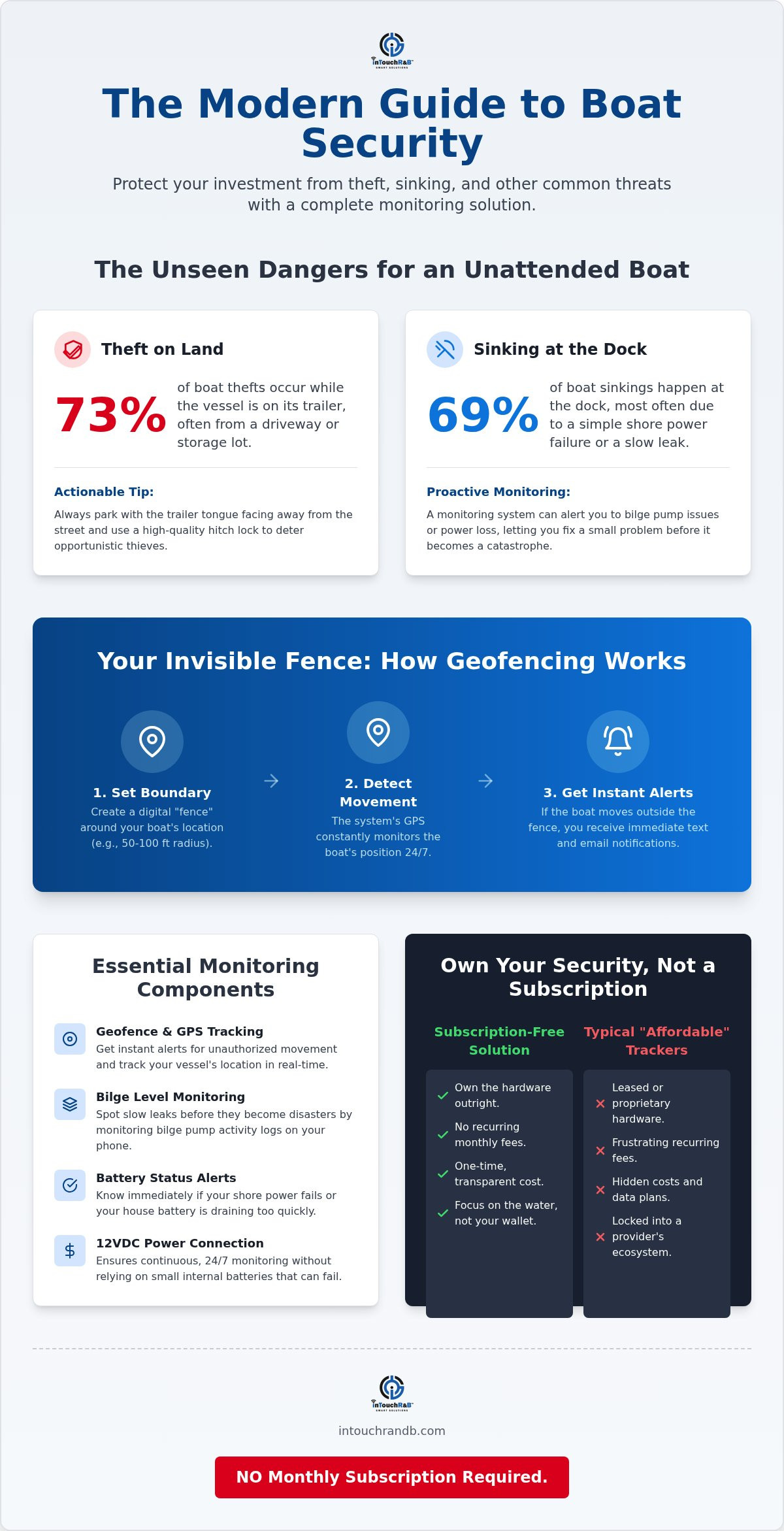
Data from 2026 shows that 73% of boat thefts occur while the vessel is on its trailer. These are crimes of opportunity where thieves can be miles away before you even realize the boat is gone. Beyond total theft, there's the constant risk of vandalism or "dock rash" caused by loose lines and failing anchors. This is where Vessel Monitoring Systems (VMS) technology proves its worth by providing constant oversight. A quick tip for trailer owners: always park with the tongue facing away from the street and use a high-quality hitch lock to slow down opportunistic thieves.
The Sinking Statistic Every Owner Should Know
Security isn't just about stopping criminals; it's about keeping the boat above the waterline. According to BoatU.S. data, 69% of boat sinkings happen while the vessel is docked. Most of these incidents start with a simple power failure or a slow leak that eventually overcomes the battery. If your shore power trips and your bilge pump drains the house battery, your boat is in immediate danger. By using a specialized tool like the Bilge Minder, you can see pump activity logs in real-time on your phone. This proactive approach lets you spot a pump that's running too often, signaling a leak before it becomes a disaster.
Moving from a reactive mindset to proactive monitoring means you don't have to wait for a phone call from the marina manager. By the time a neighbor notices your boat is sitting low in the water, it's often too late to save the electronics or the engine. A comprehensive anti-theft device for boats provides the relief of being informed, letting you take action the moment a sensor triggers. This total peace of mind ensures your asset is protected from every angle, 24 hours a day. NO Monthly Subscription Required.
How Modern Boat GPS Tracking and Geofencing Work in 2026
Geofencing is essentially a digital boundary created around your boat's specific coordinates. While the latest boat theft statistics show some fluctuations in crime rates, the risk to an unattended vessel remains a constant reality for every owner. An anti-theft device for boats uses GPS satellites to monitor your vessel's position with incredible precision. If the boat drifts or is towed outside this "invisible fence," the hardware triggers an immediate response. By connecting directly to your boat's 12VDC power supply, the system ensures 24/7 continuous tracking without the risk of a small internal battery dying at the worst possible moment.
Modern systems offer a "total vessel view" by integrating location data with environmental sensors. This means you aren't just seeing where the boat is; you're seeing how it's doing. Real-time location reporting provides constant updates during an event, while on-demand pings can be used for simple check-ins. This logical approach to monitoring ensures that you always have the most relevant information at your fingertips without unnecessary data usage.
Setting Geofence Boundaries for Anchor and Theft Alerts
Setting the right radius is a balance between security and practical movement. You want a custom boundary that allows for natural tide swings and wind shifts but triggers the moment unauthorized movement begins. If you set the geofence too tight, you might get "nuisance alerts" every time the tide changes or the boat swings on its anchor. A radius of 50 to 100 feet is usually sufficient for most slips or moorings. When the boat leaves this defined area, the system pushes text and email alerts to your smartphone or tablet instantly. This allows you to track the boat's path in real-time, which is the most effective way to help authorities recover your asset quickly.
The Technology Powering Your Alerts
Reliable alerts depend on stable connectivity. Most modern systems use 2.4GHz WiFi because it provides a longer range and better penetration through dock structures than higher frequency options. When a sensor is triggered, the data is sent to secure cloud servers. These servers act as a fail-safe, ensuring that "No Alert is ever lost" even if your phone is temporarily out of service or you're in a dead zone. One of the most effective security layers is the ability to send notifications to secondary contacts, such as a Marina Manager, simultaneously. This ensures that someone on-site can investigate the situation immediately while you're still processing the alert. For those looking to secure their vessel today, the GPS Tracking System offers a robust, easy-to-use solution that integrates seamlessly with your other onboard sensors. NO Monthly Subscription Required.
Evaluating Your Investment: Subscription-Free vs. Monthly Fees
Purchasing an anti-theft device for boats is a significant decision, but the initial sticker price is often a small part of the story. Many competitors offer hardware at a deep discount, knowing they'll make their profit through mandatory service plans that never end. This business model relies on "subscription fatigue," where owners eventually stop paying attention to the small monthly withdrawals even when the service isn't providing extra value. When you calculate the total cost of ownership (TCO) over five years, a "cheap" tracker with a monthly fee can end up costing you three or four times more than a premium, subscription-free system.
The Trap of Monthly Service Plans
Boaters often ask if they really need a monthly plan for basic security. If you're planning an offshore passage where land-based signals don't reach, a satellite-based subscription is a necessary safety tool. However, for vessels docked at a marina or stored on a trailer, these fees are usually an unnecessary burden. The biggest risk with subscription-heavy systems is the "kill switch" effect. If a credit card expires or a payment is missed, the proprietary app might stop functioning entirely, leaving your vessel unprotected at the exact moment you need it most. WiFi-based hubs provide a logical alternative by using existing dockside networks to send notifications.
Actionable Tip: Before committing to a hardware purchase, always ask if the device will still send basic alerts if the subscription is cancelled. If the answer is no, you don't own the security; you're just renting it.
Choosing the Smart Way to Protect Your Boat
The superior long-term value lies in owning both the hardware and the data it generates. A reliable system should act as a watchful guardian without requiring a monthly "ransom" for your own security alerts. Using secure cloud servers ensures that every notification is delivered to you and your secondary contacts (like a marina manager) simultaneously. You can Compare all inTouch R&B Minder models to find a solution that balances GPS tracking with environmental sensing. This approach treats your security as a one-time investment rather than a recurring liability.
By 2026, the gold standard for savvy boaters has shifted toward a premium anti-theft device for boats that provides total vessel visibility without the burden of a contract. This pragmatic reassurance allows you to focus on your next trip rather than your next bill. NO Monthly Subscription Required.
Essential Components of a Professional Boat Security Setup
A professional boat security setup is more than just a single GPS tracker; it's an integrated network of sensors that act as your eyes and ears. At the heart of this system is the Communication Hub. Think of this as the central "brain" that coordinates every piece of data from your vessel. This hub receives signals from various sensors and transmits them to secure cloud servers instantly. Without a reliable hub, even the most expensive sensors are just isolated gadgets. To keep this brain functioning 24/7, it should be wired directly into your boat's 12VDC power supply. This ensures the system never goes dark when you need it most.
While we often think of an anti-theft device for boats as a tool to catch criminals, the most critical security threat is often water ingress. High-water sensors are your last line of defense against dockside loss. These sensors trigger an immediate alert if the water level in your bilge reaches a dangerous height, giving you time to respond before your electronics are ruined. Battery voltage monitoring is equally essential here. If your house batteries drop below a certain threshold, your bilge pumps won't have the power to start. Monitoring these levels ensures your protective equipment is always ready for action.
The Critical Role of the Bilge Minder
Monitoring your pump's behavior is the best way to move from a reactive to a proactive maintenance schedule. You can Explore the Bilge Minder Monitoring System to see how activity logs help you spot small issues. For instance, if your pump starts running every 20 minutes instead of once a day, you likely have a failing seal. Actionable Tip: Manually lift your bilge pump's float switch once a month to verify that your monitoring hub sends an alert to your phone instantly.
Environmental Monitoring for Total Security
Your security setup should also protect the interior of your vessel. Intrusion sensors on cabin doors and hatch lids provide immediate notification of unauthorized entry. Meanwhile, shore power failure alerts prevent dead batteries or a defrosted refrigerator. You can also monitor humidity and temperature to stop mold growth before it damages your boat's value. To build your own custom setup, check out the full range of inTouch R&B monitoring solutions today. You can also Learn more about Asset Tracking Solutions for Boats and RVs. NO Monthly Subscription Required.
DIY Installation: Setting Up Your inTouch R&B System
Installing a professional anti-theft device for boats shouldn't be a daunting task that requires expensive specialized labor. We've engineered the inTouch R&B system to be accessible for any owner who can handle basic 12VDC wiring. Before you begin the physical mounting, run through a quick pre-installation checklist to ensure a smooth process. You'll need access to a steady 12VDC power source, your boat's name, and the SSID and password for your dock's 2.4GHz WiFi network. Having these details ready prevents the frustration of mid-setup delays and ensures your device can establish a secure connection immediately.
A key part of the setup is defining how often you want to hear from your boat. You can customize the frequency of routine status pings or ensure that critical alerts, like high-water detection, are sent instantly to both you and your marina manager. Naming your locations, such as "Main Deck" or "Engine Room," makes your alerts immediately recognizable so you can react without confusion.
Configuring the Captive Portal (IP 192.168.4.1)
Once your device is powered up, it creates its own temporary WiFi network. Use your smartphone or tablet to join this network, then open any web browser and type in 192.168.4.1. This opens the browser-based Captive Portal, which is a dedicated setup page that lives on the device itself. From here, you'll enter your boat's configuration data and select your time zone. This interface allows for lightning-fast configuration without needing to download a separate app. After acknowledging the terms and conditions, the reporting firmware activates, and your vessel is officially under the watch of our secure cloud servers.
Maintenance and Updates
Your system stays current without any manual intervention through over-the-air (OTA) updates. These firmware improvements are delivered automatically to your device, ensuring you always have the latest security features and sensing capabilities. Understanding the status indicators on the hardware is also vital for long-term peace of mind. The Blue LED on the hub acts as a silent communicator. One long blink indicates a successful connection to the cloud, while two short blinks mean the device is still searching for its WiFi signal.
Actionable Tip: Once setup is complete, trigger a test alert by briefly activating a sensor to confirm the notification arrives on your phone within seconds. Regularly testing your sensors once a month ensures 24/7 protection and verifies that your anti-theft device for boats is functioning exactly as intended. NO Monthly Subscription Required.
Take Command of Your Vessel's Security
Protecting your boat in 2026 is about more than just a heavy lock or a basic tracker; it's about maintaining constant, protective vigilance. By combining GPS geofencing with active bilge and battery monitoring, you're effectively addressing the biggest risks to your vessel whether it's on a trailer or at the dock. Choosing a high-quality anti-theft device for boats ensures that you're the first to know about unauthorized movement or rising water levels. This proactive approach transforms your security from a reactive hope into a reliable, automated system that works around the clock to protect your investment.
Trusted by boat and RV owners nationwide, inTouch R&B provides 24/7 proactive monitoring with immediate text and email alerts sent directly to your smartphone or tablet. You can secure your vessel today with inTouch R&B Smart Security Solutions and finally experience the relief of being truly informed. It's time to stop worrying about your unattended boat and start enjoying your time away from the water, knowing your asset is safe and sound. NO Monthly Subscription Required.
Frequently Asked Questions
Do I really need a boat security system if I'm at a secure marina?
Yes, you definitely do. While marinas offer physical gates, they don't monitor what's happening inside your bilge or behind your cabin doors. Statistics show that 69% of sinkings occur while docked, often due to slow leaks or shore power failures that go unnoticed. An anti-theft device for boats provides the protective vigilance needed to catch these issues. It acts as an ever-present guardian that alerts you the moment something goes wrong.
Will an anti-theft GPS system drain my boat's battery over time?
Our system is engineered to be extremely efficient. It connects directly to your 12VDC supply but uses very little current during normal operation. A major benefit is that the system actually monitors your battery voltage in real-time. If your house batteries drop below a safe level, you'll receive an immediate notification. This proactive alert ensures you have plenty of power left to start your engines or keep your bilge pumps running.
What is the difference between a cellular and a WiFi boat monitor?
The primary difference lies in the connection method and cost. Cellular monitors usually require a signed contract and a monthly data plan to function. WiFi monitors use the 2.4GHz network available at most modern docks. This allows for stable, high-speed data transmission without the "subscription fatigue" associated with cellular plans. You get the same real-time alerts and GPS tracking capabilities while maintaining total control over your hardware and data.
Can I install the inTouch R&B system myself without a technician?
Absolutely. We designed this system specifically for DIY-friendly installation using standard 12VDC power. You won't need to hire a specialized technician or spend hours on complex wiring. By accessing our browser-based captive portal through your phone or tablet, you can configure your sensors and name your locations in minutes. It's a straightforward process that empowers you to take charge of your vessel’s security with confidence and ease.
What happens if my boat moves while the geofence is active?
If your vessel drifts or is towed outside your digital boundary, the system triggers a response instantly. You'll receive a text or email alert notifying you of the unauthorized movement. This allows you to track the boat's location in real-time using GPS data. Whether it's a thief taking your boat or an anchor dragging in a storm, you'll have the information you need to take immediate action and protect your asset.
How many people can receive alerts from my security system simultaneously?
You can configure the system to notify multiple people at once. We recommend sending alerts to yourself and a secondary contact, such as a marina manager or a local friend. This simultaneous notification ensures that someone near the boat can investigate the situation immediately while you're still reading the alert. It adds an extra layer of security, especially when you're traveling or far away from the marina.
Does the system work for trailered boats and RVs as well?
Yes, the system is highly versatile and works perfectly for both. In fact, 73% of boat thefts happen while the vessel is on its trailer, making an anti-theft device for boats essential for these owners. The same hardware provides 24/7 protection for RVs, monitoring for intrusion, power loss, and environmental changes. It’s a comprehensive safety solution designed to protect your mobile assets wherever they happen to be parked.
What is the most common reason for boat security system failure?
Most failures happen because of dead internal batteries or lost subscriptions. Many trackers rely on small batteries that eventually die without warning, or proprietary apps that stop working if a payment is missed. We solve this by using your boat's 12VDC power and secure cloud servers. This setup ensures that your connection stays live and no alert is ever lost. Regular monthly sensor testing is the best way to ensure total reliability.
NO Monthly Subscription Required.

Article by
Jimmy Nesbitt
Principle
Be the first to comment