

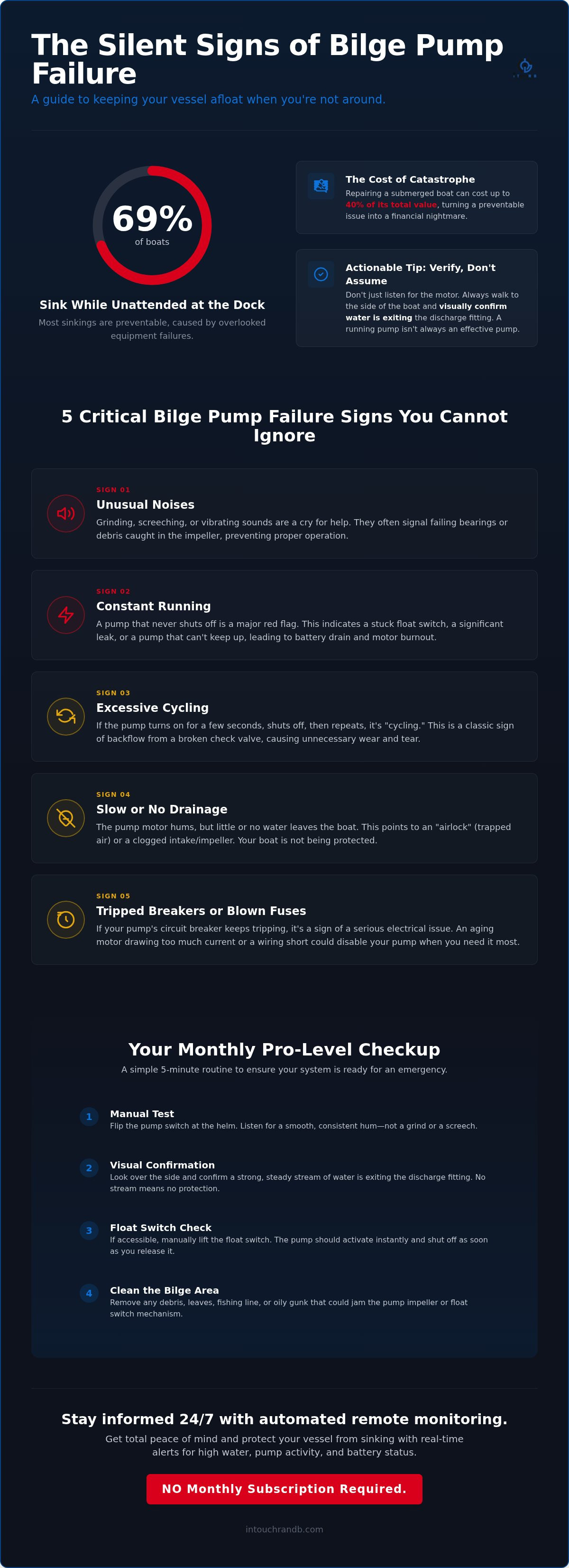
Did you know that for every boat that sinks while out on the water, four others sink while sitting quietly at the dock? According to BoatU.S. data, 69% of boat sinkings happen right at the slip, often because common bilge pump failure signs were overlooked until it was too late. It's a stressful reality for any owner, especially when you can't be there to keep a watchful eye on your vessel's health every single day.
We understand that nagging worry about whether your batteries are holding up or if your pump is cycling too often. While you might hear the motor kick on, a pump that's simply "running" doesn't always mean your boat is safe. Catching these mechanical red flags early is the only way to prevent a dead battery or a flooded cabin before the repair costs reach a financial nightmare. After all, the cost to fix a submerged boat can be up to 40% of its total value.
This article provides a clear checklist of what to look for during your next inspection and introduces how automated monitoring can act as your ever-present guardian. You'll discover the hidden warning signs of a failing pump and learn how to protect your vessel from sinking so you can have total peace of mind while you're away from the marina.
Key Takeaways
- Bust the common myth that a running pump automatically means your boat is safe and learn what your primary defense system actually needs to stay reliable.
- Identify the most critical bilge pump failure signs, including auditory clues and visual red flags, before they lead to a flooded cabin.
- Understand the hidden risks of leaving your boat unattended at the dock and how shore power issues can lead to unexpected pump failure.
- Follow a professional monthly testing routine that ensures your automatic sensors and electrical connections are ready for an emergency.
- Find out how to stay informed about your boat’s safety 24/7 with Bilge Minder, where there is NO Monthly Subscription Required.
Myth: If the Pump Runs, the Boat is Safe
Many boaters flip a switch at the helm, hear a reassuring hum, and assume their vessel is protected for the next month. It's a dangerous assumption to make. A Bilge pump is your boat's primary defense against water intrusion, but its operation is far more complex than just a spinning motor. Hearing the pump run during a quick dockside check is a good start, but it's not a guarantee of safety once you leave the marina.
What exactly is a Bilge? (Jargon Explained)
Think of the bilge as the "basement" of your vessel. It's the lowest point inside the hull where everything from stray rainwater to slow leaks from stuffing boxes, which are the seals around the propeller shaft, eventually collects. Just as a basement sump pump keeps a home dry during a heavy storm, the bilge pump is tasked with moving that unwanted water back overboard. Because water naturally flows to the lowest point, any leak, no matter how small, will end up here. In a marine environment, this area is often damp and dirty, which creates a harsh environment for mechanical parts.
The real danger lies in what we call "silent failures." You might perform a manual test on Saturday, but that doesn't account for the "Unattended Boat" problem. Most bilge pump failure signs occur when you aren't there to hear the pump struggling or notice the high water alarm. A float switch can easily get stuck behind a piece of debris, or a pump motor might burn out after running continuously for hours while you're at home. Recognizing these bilge pump failure signs early, such as a pump that cycles too frequently without a clear cause, can save your boat from a catastrophic event.
The difference between "On" and "Effective"
There's a significant difference between a pump being "on" and being "effective." Sometimes the motor spins perfectly, but no water leaves the hull. This often happens due to an "airlock," which is when a bubble of air gets trapped in the pump housing. This air bubble prevents the pump from "priming," which is the critical step where the pump clears out the air so it can start creating the suction needed to move water. Other times, the impeller, the spinning part that pushes water, might be jammed with hair, fishing line, or oily gunk that has settled in the bottom of the boat. In these cases, the pump sounds healthy, but the water level continues to rise.
Actionable Tip: Don't just listen for the motor. Next time you test your pump, walk to the side of the boat and visually confirm water is exiting the discharge thru-hull fitting, which is the specialized pipe and opening in the side of your boat where water is pushed out. If you hear the hum but don't see a steady stream of water, your pump is failing to protect your asset. For 24/7 vigilance, tools like the Bilge Minder can notify you the moment these issues arise, providing the relief of being informed even when you're miles away.
5 Signs of Bilge Pump Failure You Cannot Ignore
Most boat owners don't realize that a pump failure rarely happens all at once. It's usually a slow decline marked by specific mechanical protests. If you ignore these bilge pump failure signs, you risk a chain reaction where a small leak turns into a submerged engine or a ruined interior. Catching these indicators early is the best way to ensure your boat doesn't sink at the dock while you're away.
Sign 1 & 2: Unusual Noises and Constant Running
A healthy pump should have a steady, smooth hum. If you start hearing grinding, screeching, or vibrating sounds, it's a clear signal that the internal bearings are failing or a piece of debris is caught in the impeller. These sounds are the mechanical equivalent of a cry for help. Similarly, a pump that never seems to shut off is a major red flag. This usually points to a float switch that has become stuck in the "on" position or a leak that is outpacing the pump's capacity.
Actionable Tip: Timing is everything. If you notice your pump running for more than 15 minutes at a time, consider it a "serious problem" alert. You should immediately investigate the bilge for high water or mechanical hang-ups.
Sign 3 & 4: Excessive Cycling and Slow Drainage
You might notice your pump turning on for a few seconds, shutting off, and then repeating the process every few minutes. This is known as "cycling." Cycling is a primary indicator of backflow issues, where water remaining in the discharge hose flows back into the bilge because of a failing check valve. This creates a loop that wears out the motor and drains your battery. If the pump is running but the water level is dropping at a snail's pace, you likely have a clog in the intake strainer or a battery that's too weak to provide the necessary power.
Sign 5: The "Electrical Gremlin" and Battery Drain
Sometimes the sign isn't in the pump itself, but in your battery levels. A shorted bilge pump can act as a "vampire" load, mysteriously draining your batteries even when everything else is turned off. It's also vital to monitor your voltage, measured in VDC (Volts Direct Current), which is the electrical pressure your battery provides. If your battery drops below 11.37 VDC, the pump may struggle to start under the weight of the water. Recognizing these bilge pump failure signs before they drain your power reserves is critical for vessel safety.
Actionable Tip: If your pump acts erratically or your batteries are dying faster than usual, use a multimeter (a handheld tool used to measure electrical voltage and current) to check for "stray current." Stray current is electricity that is "leaking" out of your wiring and into the water or metal parts of the boat, which can cause rapid corrosion and drain your power. To make this process easier, the Bilge Minder can track these electrical fluctuations and pump cycles automatically, sending an alert to your phone before the damage is done. This kind of 24/7 vigilance is a simple way to maintain the relief of being informed about your boat's status.
Why 69% of Boats Sink at the Dock: The Unattended Risk
It is a sobering reality that 69% of boat sinkings occur while the vessel is supposedly safe at the dock. This statistic from BoatU.S. highlights the "Unattended Boat" problem, where small issues escalate because no one is there to intervene. When you're on board, you can hear a pump straining or notice water where it doesn't belong; when you're away, the boat relies entirely on its automated systems. If those systems are already showing bilge pump failure signs like slow drainage or excessive cycling, a single heavy rainstorm or an accumulating snow load can be the tipping point. You can find a deeper dive into these risks in our Common Causes of Boats Sinking at Dock checklist.
The Danger of the "Silent" Leak
A small drip from a packing gland, which is the seal around your propeller shaft, might seem minor at first. However, if your pump is struggling with low voltage or a clogged intake, that drip eventually wins the race. By the time water reaches the floorboards, the damage to your engines and electrical systems is often irreversible. Standing water also creates a breeding ground for mold and mildew, which are the "secondary" damages that can ruin a cabin's interior in just a few days of humid weather. By the time you physically see water over the floorboards during a weekend visit, the repair bill has already skyrocketed.
Shore Power Failures: The Hidden Catalyst
Shore power is often the only thing keeping your batteries charged and your pumps ready. Problems arise when a dock neighbor accidentally trips a shore power breaker or a power cable is bumped and disconnected. Once shore power is lost, your battery charger stops functioning. Your bilge pump now has a very finite lifespan based on the remaining charge in your batteries. While following U.S. Coast Guard boating requirements for onboard safety equipment is essential, those standards don't account for a dead battery while you're at work or home.
Environmental factors like ice or heavy rain can quickly overwhelm a single pump that is already compromised. If you've been overlooking subtle bilge pump failure signs, you might not realize your pump is drawing too much current or cycling because of a backflow issue. This "Shore Power Ripple Effect" turns a simple electrical trip into a sunken vessel because the primary defense system ran out of juice.
Actionable Tip: Don't rely solely on the dock's power pedestal. Check your shore power cord for a secure, locked connection every time you leave. For true peace of mind, you should have a backup plan that includes a remote notification system. This ensures you're the first to know if your boat loses power or if the water level begins to rise unexpectedly.
Proactive Maintenance: How to Test Your System Like a Pro
Many boaters rely on the "Helm Switch Test" to verify their safety. You flip the switch, hear the motor hum, and think you're good to go. However, this test is fundamentally insufficient. The manual switch usually bypasses the float switch, which is the sensor responsible for turning the pump on when you aren't there. If that float switch is jammed or broken, the pump won't activate during a leak, regardless of how healthy the motor sounds when you trigger it manually. To truly protect your vessel, you need to simulate a real-world scenario by following The Ultimate Guide to Bilge Pump Monitoring and testing the system under load.
The Bucket Test and Float Switch Check
A true test involves more than just electricity; it requires water. Follow these three steps at least once a month to ensure your primary defense is ready for action:
- Step 1: Pour enough water into the bilge to lift the float switch. This confirms the mechanical arm or sensor actually triggers the pump without human intervention.
- Step 2: Watch the thru-hull discharge. You're looking for a strong, steady stream. If it's a weak trickle, you might have an airlock or an obstruction in the line.
- Step 3: Clean the debris screen. Reach down and clear any hair, wood chips, or gunk from the pump's intake. This prevents clogs that lead to those bilge pump failure signs we discussed earlier, like grinding noises or slow drainage.
Moving from Reactive to Proactive Monitoring
Relying on a "Home Watch" service or a quick walk-by from a marina manager is a reactive strategy. These checks only capture a single moment in time. If a hose bursts ten minutes after they leave, your boat is at risk for the next 24 hours. We believe in a proactive philosophy where technology acts as your ever-present guardian. This shift from waiting for a problem to actively monitoring for bilge pump failure signs is what keeps vessels afloat when the owner is away.
Actionable Tip: When setting up your remote alerts, add a secondary contact like a trusted dock neighbor or your marina's service desk. A faster response time can be the difference between a simple fix and a salvage operation. To start monitoring your boat's health with professional precision, consider installing a Bilge Minder today.
Remote Monitoring: Your 24/7 Watchman with Bilge Minder
"Dock anxiety" is a common feeling for any boat owner who lives miles away from their slip. While manual checks and monthly "bucket tests" are necessary, they don't provide the continuous oversight required to prevent a disaster. The Bilge Minder acts as a watchful, ever-present guardian for your vessel, bridging the gap between your weekend visits. By monitoring for bilge pump failure signs around the clock, it transforms uncertainty into the relief of being informed.
This system goes beyond simple water detection by looking at the health of your entire electrical defense. If your pump begins to run continuously because of a jammed float switch or a massive leak, the technology recognizes the pattern and notifies you immediately. It also tracks battery voltage (the lifeblood of your pump) to ensure you have the power needed to handle an emergency. You can compare how our monitoring solutions stack up against other options by viewing our Comparison Matrix.
Real-Time Alerts for Critical Faults
The core benefit of remote monitoring is the speed of notification. When a sensor detects high water, it triggers an immediate response through a text message or email sent directly to your phone. These notifications are clear and descriptive, providing specific data like "High Water Detected" or "Low Battery: 11.2V." This level of detail allows you to prioritize your response, whether that means calling a dock neighbor or heading to the marina yourself.
Security is maintained through cloud-based reporting, which ensures that no alert is ever lost. Even if your phone is temporarily out of service, the data is logged and accessible as soon as you reconnect. The system also monitors for over-temperature conditions, which can be an early indicator of a motor that is working too hard or a pump that is failing to prime correctly.
Simple Installation for Every Boat
You don't need to be a marine electrician to secure your boat. The system is designed for ease of use, offering both wired and wireless sensors that can be placed exactly where they are needed most. This flexibility makes it an ideal solution for boats kept in slips, on mooring balls, or even on trailers in storage. It is a pragmatic way to apply modern technology to the age-old problem of keeping water out of your hull.
Actionable Tip: Before you install your monitoring system, check the WiFi signal strength at your specific dock or storage spot using your smartphone. If the signal is weak, you might need a simple range extender to ensure your alerts always reach the cloud without delay. By taking this small step, you ensure your boat remains protected 24/7.
Protecting your investment shouldn't come with a recurring financial burden. We believe in providing high-quality, reliable monitoring that stays accessible to every boat owner. That is why our systems are designed with one clear promise: NO Monthly Subscription Required.
Securing Your Vessel for the Long Haul
Staying ahead of potential disasters doesn't have to be a source of constant stress. By learning to identify bilge pump failure signs like unusual cycling or slow drainage, you've already taken the most important step toward protecting your investment. Remember that a healthy boat requires more than just a working motor; it needs a reliable float switch and a clear path for water to exit the hull every time you're away from the dock.
You can transition from reactive worry to proactive peace of mind by letting technology handle the watch. The Bilge Minder offers 24/7 vigilance by monitoring pump activity, high water levels, and battery health, all while sending real-time alerts to multiple recipients. It's a simple, professional way to ensure you're never the last to know when your boat needs help. Protect your vessel with the Bilge Minder today!
We're here to help you enjoy your time on the water with the confidence that your boat is safe and secure. NO Monthly Subscription Required.
Frequently Asked Questions
How do I know if my bilge pump is bad?
You can identify a failing pump by listening for unusual grinding or screeching noises, which suggest the internal bearings are worn out. Other common bilge pump failure signs include a motor that hums without moving any water or a float switch that gets stuck and keeps the pump running until the battery dies. If you notice any of these red flags during your inspection, it's time to replace the unit before your next trip.
Why is my bilge pump running but not pumping water?
This issue is typically caused by an airlock, which is when a bubble of air gets trapped in the pump housing and prevents it from pulling water. It can also happen if the intake screen is clogged with debris like wood chips or if the discharge hose has a kink. In some cases, a weak battery might provide enough power to spin the motor but not enough torque to actually move the water out of the boat.
How long should a bilge pump last?
Most high quality pumps are designed to last between 5 and 10 years, but their actual lifespan depends heavily on the environment inside your hull. Saltwater, oil, and floating debris can significantly shorten this timeframe by corroding electrical contacts or jamming the spinning impeller. Because these components live in a harsh, damp area, regular monthly testing and remote monitoring are the only ways to ensure they remain reliable.
Can a bilge pump drain a boat battery?
Yes, a faulty bilge pump can drain a battery bank in just a few days, especially if the boat is disconnected from shore power. This usually happens if the pump is "cycling" too frequently because of a failing check valve or if there is an internal electrical short. Monitoring your battery voltage remotely is a great way to catch this problem before the pump loses the power it needs to keep you afloat.
Is it normal to have water in the bilge?
While "bone dry" is always the ideal goal, it's common to find small amounts of water from condensation or slow drips from the stuffing boxes. These are the seals that prevent water from entering where the propeller shaft passes through the hull. However, you should investigate any sudden increase in water levels immediately, as it often points to a failing hose or a new leak that your bilge pump failure signs might be masking.
What is a float switch and how does it fail?
A float switch is a buoyant device that acts as the automatic "on" switch for your pump whenever the water level rises. These devices often fail when they become physically stuck by debris like fishing line, or when the internal electrical contacts corrode from constant moisture. It's the most common failure point in a bilge system, which is why testing it manually with water is a vital part of boat maintenance.
Do I need a high water alarm if I have a bilge pump?
Absolutely. A high water alarm serves as a critical secondary defense that alerts you if the water rises past the point where your primary pump should have handled it. It provides an essential backup for when a pump fails or becomes overwhelmed by a major leak. Having this extra layer of protection ensures you have time to react before the water reaches your expensive engine components or electrical systems.
NO Monthly Subscription Required.

Article by
Jimmy Nesbitt
Principle
Be the first to comment