

A small amount of water in the wrong place can stop an air conditioner before a clogged drain line causes a larger leak. An HVAC drain line overflow sensor detects rising condensate or moisture and signals the system to shut down, helping limit water damage. Depending on how it is installed and wired, the switch may stop the air handler or other parts of the cooling system.
If your air conditioner produces water as it cools, it’s reasonable to wonder where that water goes and what happens when it can’t drain. A condensate switch adds a practical safeguard: when water reaches its trigger point, it signals the system to stop rather than continuing to run during a backup.
This article explains how float and moisture-sensing switches detect overflow, where they can be installed, and how they interrupt HVAC operation. You’ll also learn why the air handler’s location matters, what a shutdown may indicate, and how drain-line monitoring fits into a broader approach to protecting your home.
Key Takeaways
- Understand how condensate switches respond when water rises or moisture signals a possible drain problem.
- Learn how an air handler’s location and orientation affect switch placement.
- See how a float switch detects rising water and signals the cooling system to shut down.
- Find out how a switch in a secondary drain pan can help detect overflow from the primary pan.
- Explore how HVAC Minder fits into a broader approach to monitoring HVAC equipment.
What Is A Condensate Switch and How Does It Work?
Cooling from an air conditioner or heat pump produces condensate, which drains by gravity or through a condensate pump. If water rises or moisture signals a backup, a switch can interrupt cooling before water spills from the drain pan.
For a clear visual overview, watch “HVAC Condensate Safety Switch Training! 6 Types, Operation, Installation, Wiring, Testing!” from AC Service Tech LLC.
Overflow Prevention and Switch Operation
A condensate overflow switch detects water or moisture and signals the cooling system to shut down. This matters because it stops the system from continuing to produce condensate while a clog prevents proper drainage. Depending on its wiring, the switch may stop the air handler, outdoor compressor, condenser fan, or supply fan. It responds to a trigger, but does not clear the blockage.
Clogs in Condensate Pans and Lines
The drain pan catches water formed during cooling, while the drain line carries it away. Debris or buildup can block the line, causing water to rise in the pan; a cracked pan can also let condensate escape. Water may spill onto an attic, basement, or utility-closet floor. During maintenance, have the pan and line checked for clogs or cracks.
Comparing HVAC Overflow Switch Types
An HVAC drain line overflow sensor is a broad term for a device that detects a potential backup. A drain-pan float switch uses a float that rises with the water, while a condensate pump safety switch responds to a problem at the pump, which moves condensate when gravity drainage isn’t used. Their purpose is to interrupt cooling, but their trigger points differ. There is no blanket U.S. requirement established here. Building codes and insurance terms are separate considerations, so don’t treat one as proof of the other.
Testing, Resetting, and Switch Failures
To test or reset a switch, follow the equipment and switch manufacturer’s instructions, and avoid handling exposed wiring. Once the drain problem is cleared, use the specified reset procedure. Some systems resume when the water falls, while others need a manual reset. False alarms or failures can involve a float that doesn’t move freely, moisture at the sensor, or a connection problem. A switch that repeatedly trips needs attention, not bypassing. Installation cost depends on the switch type, placement, wiring, and access, so there isn’t one reliable price for every system.
Depending on the system’s location, air-conditioning condensation may drain by gravity to an outside drain line, an inside drain, or a condensate pump. A condensate sensor switch turns off the air-conditioning system when it detects moisture that may result from a leak or clog.
During routine HVAC maintenance, a technician can check the condensate drain line and pan for clogs or cracks and replace parts as needed.
Drain line switch installation
An HVAC condensate overflow switch is positioned where rising water or moisture can signal a drainage problem. Depending on the air handler’s location and orientation, it may sit in the primary drain pan, secondary drain pan, or condensate line. The right position lets the switch detect a backup before water reaches nearby floors, ceilings, or stored belongings.
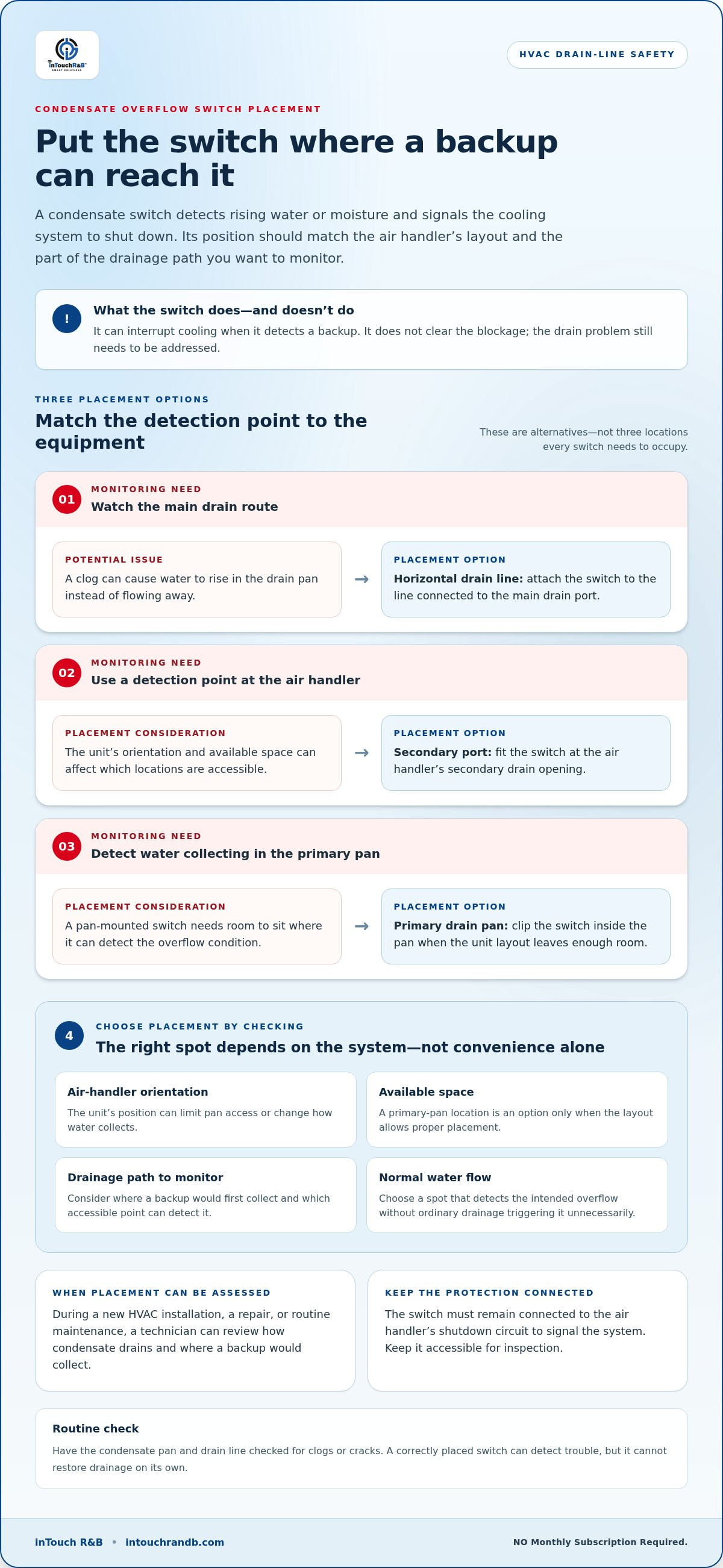
Where should an HVAC condensate overflow sensor be installed? Common locations include the horizontal drain line connected to the main drain port, the air handler’s secondary port, or the primary drain pan. The best option depends on the unit’s orientation, available space, and which part of the drainage path needs monitoring.
For a primary-pan setup, a technician may use one of these placements:
- Horizontal drain line: The switch attaches to the line from the main port, where backed-up water can trigger it.
- Secondary port: The switch fits at the air handler’s secondary drain opening, providing another detection point.
- Primary pan: A switch can clip inside the pan when the unit’s layout leaves room for proper placement.
These options aren’t interchangeable in every installation. An air handler’s orientation, for example, may limit access to the primary pan or change how water collects. A sensor can be installed inside or outside a condensate pan, but its position must let it detect the overflow condition it is intended to catch. Choose placement to suit the equipment layout, not simply the nearest convenient surface.
Installation can take place during a new HVAC system installation, a repair, or routine maintenance. At each visit, a technician can assess how condensate drains, where a backup would first collect, and which accessible location provides a useful trigger point. This also helps avoid placing a sensor where ordinary drainage could trigger it unnecessarily.
After installation, the switch needs to remain connected to the air handler’s shutdown circuit so it can signal the system when it detects overflow. A float switch itself may not need power to move, but disconnecting it from the air handler removes its ability to stop cooling during a backup. Keep the switch and wiring accessible for inspection, and include the drain pan and line in routine maintenance checks for clogs or cracks. A correctly placed switch can detect trouble, but the blockage still needs to be cleared to restore normal drainage.
For a primary drain pan condensate switch, the installation point can be the horizontal drain line leading from the main port, the air handler’s secondary port, or a position clipped into the primary pan if space permits. These are alternative placements, not steps that all need to be completed for one switch. The pan placement depends on available room; the line and secondary-port placements are also options. A single switch does not need to occupy all three locations.
A drain pan overflow switch can be fitted during a new HVAC installation, a repair, or a maintenance visit. Those occasions provide different opportunities to include the switch in the work being done, but each is a valid time for installation. The appropriate occasion can depend on when the HVAC work is scheduled; the listed options do not require installation to occur only during a new system installation.
Float switch operation
HVAC drain line overflow sensors include float switches, which respond to rising water, and wet switches, which detect moisture. The type fitted to an air conditioner determines what triggers the shutdown signal.
How HVAC Float Switches Operate
A float switch uses a movable float that rises as water collects, then changes an electrical signal to stop cooling. In a common arrangement, the switch stays closed while the drain is dry and opens when water backs up. That break in the circuit tells the air-conditioning system to shut down, helping prevent it from continuing to operate as water rises in the pan.
The float itself may not need power, but its connection to the air handler matters: disconnecting it removes its ability to signal a shutdown. Once the clog is cleared and water drops, some switches return to their normal position. If the system stays off, it may have a manual reset or another fault, so identify the switch type before trying to restart the equipment.
Float Switches and Wet Sensors
A float switch reacts to a set water level, while a wet sensor reacts to moisture on its sensing point. Both can signal the cooling system to stop, but they detect different conditions. A float usually needs water to rise enough to move its mechanism; a moisture switch can respond when water reaches its sensing surface.
That difference explains why a wet sensor may trip before the drain pan visibly fills. A few drops reaching its sensing area, for example, can trigger a shutdown. The actual response depends on the switch design and placement, so follow the installed device’s instructions for its trigger and reset behavior.
In either design, the switch is a warning and shutdown control, not a drain cleaner. If a float rises or a wet sensor detects water, the system stops operating to limit further condensate production. The obstruction or leak still needs attention before normal drainage can resume.
During a backup, a float switch provides a visible clue through the water level, while a wet sensor may trip with little water in view. A shutdown alone doesn’t identify the exact cause. Check for water around the air handler and whether the pan is filling. If water remains or the switch trips again, arrange attention for the drain path.
Never bypass a float or wet switch to keep cooling running. It is connected to the air-conditioning system to provide a shutdown response, and disconnecting it removes that protection. If a switch appears stuck, resets repeatedly, or fails to stop the system during a clear backup, have it and its connection inspected along with the drain pan and line.
Secondary drain pan switch applications
Condensate switches can monitor a primary pan, a secondary pan, or a drain line. The best location depends on where water would collect first if normal drainage stopped.
Moisture Sensor Switch Operation
A moisture sensor switch detects water at its sensing point and signals the HVAC system to shut down. In a primary pan, it can respond when condensate reaches the sensor rather than waiting for water to spill onto the floor. Placement matters: the sensor must sit where backed-up water can reach it, while remaining clear of normal drainage.
For example, a sensor mounted inside the primary pan monitors water there directly. One mounted outside the pan can detect water escaping from it. These positions monitor different events, so the equipment layout and likely overflow path guide the choice.
Water-Sensing Overflow Switches
A water-sensing overflow switch detects water at a set location and interrupts HVAC operation. Unlike a float switch, which responds to a rising movable part, a moisture sensor responds when water reaches its sensing area. This helps explain why a moisture-based switch may trip before the pan appears full.
A trip identifies water at the sensor, not its cause. A blocked drain line, an overflowing pan, or water reaching the sensor by another route can trigger it. Consider the sensor’s position relative to the pan and drain path to understand what it monitors.
A secondary drain pan sits beneath the primary pan and collects condensate that escapes when the primary pan cannot contain it. This backup matters when a clog or drain backup makes water rise beyond the primary pan. A switch in the secondary pan can detect that overflow and signal the system to stop.
Secondary-pan monitoring differs from sensing water inside the primary pan. A primary-pan switch can detect a developing issue at its source; a secondary-pan switch detects water that has already reached the backup pan. The system’s layout helps determine whether one location, or more than one, provides useful coverage.
Switches may also be placed along the condensate drain line. This location can detect water backing up in the line, while a pan-mounted switch responds to water collecting in the pan. For example, an air handler with an accessible primary pan may use a pan sensor, while a line-mounted switch monitors the drain route.
During HVAC maintenance, have the drain line and both pans checked for clogs or cracks. Confirm that a pan-mounted sensor remains where water can reach it, and keep the switch connected to its shutdown circuit. A sensor cannot clear a blockage, so restore drainage after it trips rather than treating the shutdown as the repair.
Air-handler shutdown during overflow detection
When an overflow switch detects water, it signals the HVAC system to stop operating. Depending on its wiring, the shutdown can stop the air handler’s supply fan, outdoor compressor, and condenser fan. A drain problem can therefore stop more than a fan: the cooling system may shut down to limit continued condensate production.
The response starts at the sensor. A float rises with water, or a moisture sensor detects water at its sensing point. The switch then changes the control signal connected to the air-conditioning equipment. A float switch may be normally closed while the drain is dry, then open during a backup and interrupt the system’s operation.
That sequence can look like an unexpected equipment failure. For example, the thermostat may call for cooling, yet the air handler or outdoor unit stays off because the overflow control has interrupted operation. Treat a sudden shutdown alongside water in a drain pan or around the air handler as a possible drainage warning, not proof that the switch itself has failed.
Depending on the installation, the switch can stop different components:
- Air handler: The indoor unit may stop moving supply air through the ducts.
- Outdoor compressor: The part that performs the cooling cycle may be disabled.
- Condenser fan: The outdoor fan may stop along with the compressor.
The response depends on how the switch is connected, so one system may not behave exactly like another. A shutdown also doesn’t clear a clog or repair a cracked pan. It pauses operation while the drainage issue remains; restarting the equipment without addressing standing water can allow the same condition to return.
If cooling stops, note which equipment is still running and look for visible water near the air handler or drain pan. Don’t disconnect or bypass the switch to force operation. Have the drain path, pan, sensor position, and electrical connection inspected; a blocked line, water at the sensor, or a switch connection issue can produce similar symptoms. Once drainage is restored, the switch can return to its normal state or require its specified reset.
For an attic air handler, a shutdown may help limit water reaching the ceiling below, but it doesn’t guarantee that no leak has occurred. Check nearby surfaces for dampness and have the source addressed before treating the interruption as resolved. The switch provides a protective response; clearing the drain and confirming proper operation completes the repair.
If you want to explore HVAC equipment monitoring as part of your water-damage prevention plan, learn about HVAC monitoring options.
InTouch R&B: Bilge Minder
inTouch R&B offers Bilge Minder for monitoring bilge pumps, and HVAC Minder for remote monitoring of HVAC equipment. A local condensate switch responds to water at the pan or drain, while remote equipment monitoring can complement that safeguard by helping you stay informed about HVAC operation. Consider the HVAC Minder when you want remote monitoring and alerts for your HVAC equipment. It complements, rather than replaces, a condensate overflow switch or clearing a blocked drain line. To explore the option, visit inTouch R&B or contact the team. NO Monthly Subscription Required.
Make Equipment Monitoring Part of Your Next Step
Think through how you’ll respond if your HVAC system stops unexpectedly. An HVAC drain line overflow sensor is one part of a broader protection plan; consider what information would help you recognize an issue and decide what to do next. A simple response plan can make it easier to act calmly when equipment needs attention.
If you’d like to discuss your monitoring needs, contact inTouch R&B. A thoughtful plan can help you feel more prepared to protect your home. NO Monthly Subscription Required.
Frequently Asked Questions
What is an HVAC condensate drain line overflow sensor and how does it work?
It’s a protective control connected to HVAC equipment that responds to a condensate drainage problem. The exact trigger and recovery behavior depend on the switch type and system controls. For practical reference, note the sensor’s model and keep its installation information with your HVAC records. This helps a technician identify the right switch and understand its intended operation during future service.
How do you install and wire an HVAC drain line float switch safely?
Have an HVAC technician install and connect the switch using the equipment and switch instructions. Before the appointment, record the air handler’s model, the existing switch type, and any recent shutdown symptoms. Ask the technician to document the connection and explain how to recognize a normal reset. Keep those notes with the system paperwork so the next service visit can start with accurate information, without your opening the control compartment.
What are the risks of not having an HVAC condensate overflow sensor?
Without an overflow sensor, a developing drain problem may go unnoticed while the HVAC system continues running, giving water more opportunity to escape. The risk deserves attention if equipment is unattended or sits above finished rooms, stored belongings, or ceilings. Add a visual check of accessible areas around the unit and the ceiling below to routine home maintenance. Investigate new damp spots or water marks promptly rather than waiting for the next scheduled check.

Be the first to comment