

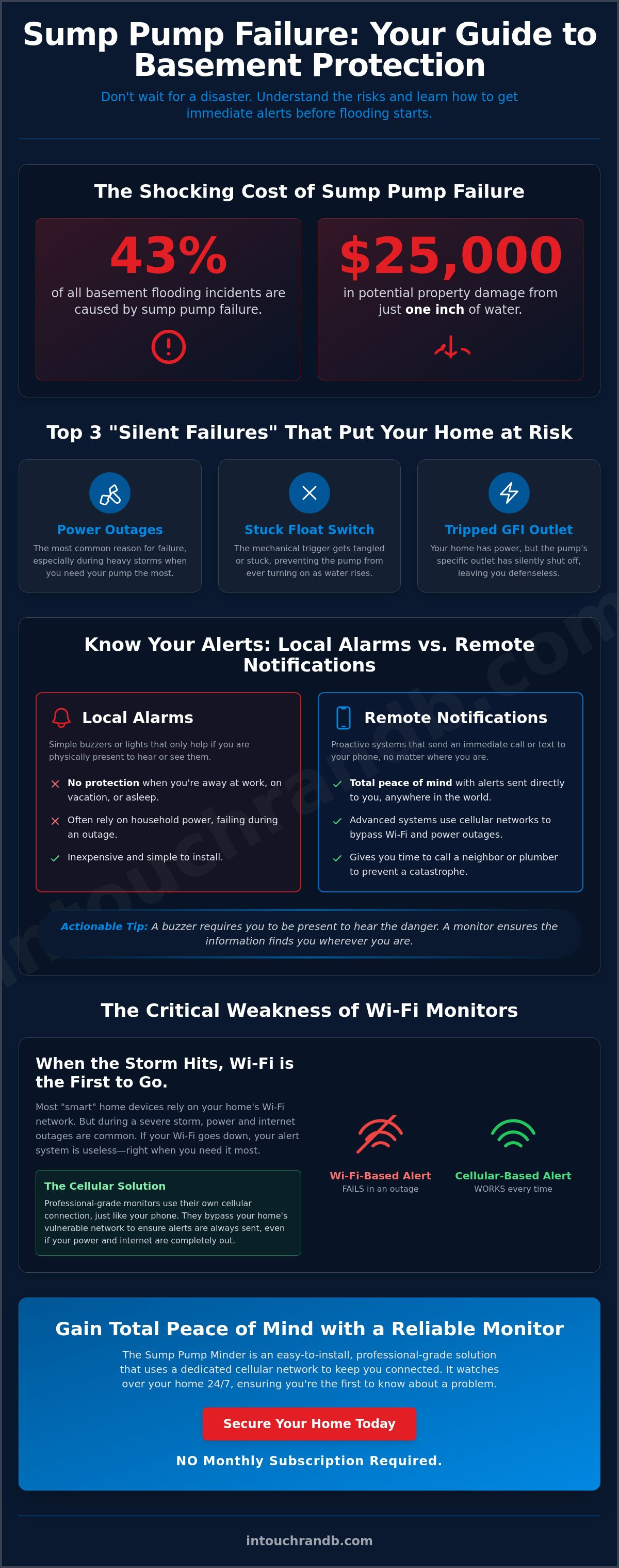
Did you know that sump pump failure is responsible for 43% of all basement flooding incidents in the United States? It's a staggering figure from industry research, especially when you realize that just one inch of standing water can cause up to $25,000 in property damage. Most homeowners spend stormy nights worrying about their basement, wondering if their equipment is actually running or if they'll wake up to a costly disaster. If you've been searching for how to get notified if sump pump fails, you're likely looking for a way to replace that lingering anxiety with total certainty.
We believe you should feel like a watchful guardian is always looking over your home. This guide will teach you how to set up a reliable notification system that sends an immediate call or text to your phone the moment your pump stops working. We'll explore simple installation processes and systems that remain active even during power outages (when you need them most) by bypassing the common weaknesses of standard Wi-Fi. You'll learn how to secure your home with technology that provides pragmatic reassurance without the need for complex smart home configurations or technical expertise with inTouchRandB.com using Sump Pump Minder.
Key Takeaways
- Understand the common causes of mechanical failure in older pumps and why an independent monitoring system is your best defense against water damage.
- Discover how to get notified if sump pump fails using high-water float switches that provide immediate phone alerts instead of just local floor buzzers.
- Identify the critical weaknesses of Wi-Fi-based monitors and learn how to ensure your alerts get through even during power outages or server downtime.
- Follow our five-step guide to correctly position your sensors for early warning detection and learn how to test your system without getting your feet wet.
- Explore how the Sump Pump Minder provides a professional-grade, easy-to-install solution that keeps you connected to your home's safety at all times.
Table of Contents
-
Understanding the Risks: Why Sump Pump Notification is Your Best Defense
-
Comparing Your Options: Local Buzzers vs. Remote Phone Alerts
-
Solving the Wi-Fi Problem: Ensuring Alerts Get Through During Power Outages
Understanding the Risks: Why Sump Pump Notification is Your Best Defense with inTouch R&B
Most homeowners understand what a sump pump is and why it sits in the lowest part of their home. It's the primary line of defense against rising groundwater, yet many people treat it like a "set it and forget it" appliance. In reality, a sump pump notification system acts as an independent guardian for your basement. It's a separate layer of security that stands watch even when you're asleep or away from home, ensuring that if the mechanical parts fail, you aren't the last person to find out.
These pumps are mechanical workhorses, but they have a limited lifespan. Most units only last between 7 and 10 years before the motor or seals begin to degrade. You might face a "silent failure" where the pump looks perfectly fine sitting in the pit, but a clogged impeller or a worn-out motor prevents it from moving water during a sudden surge. This is exactly why learning how to get notified if sump pump fails is so critical for modern homeowners. Industry data shows that 43% of basement floods are caused by pump failure, and the financial toll is heavy. While professional remediation averages around $6,965, the total damage from just one inch of standing water can skyrocket to $25,000 according to research from insurance groups.
To better understand how to check your system's health and ensure it's ready for the next storm, watch this helpful video: inTouchRandB.com using Sump Pump Minder.
Common Reasons for Sump Pump Failure
Power outages are the most frequent cause of failure during heavy storms. When the grid goes down, your primary pump stops unless you have a robust backup. Another common issue involves the float switch. This is the mechanical trigger that floats upward as water rises; if it gets stuck against the side of the basin or tangled in wires, the pump won't turn on. Finally, GFI (Ground Fault Interrupter) outlets can trip due to moisture or minor electrical spikes. This is particularly frustrating because your home may still have power, but the specific outlet for your pump has cut off, leaving your basement completely vulnerable without you realizing it.
The Difference Between an Alarm and a Notification
A local alarm is a simple buzzer that sounds when water hits a certain level. It's a helpful tool if you're currently in the house, but it provides zero protection if you're at the office or on vacation. Remote notifications bridge this gap by using cellular or internet-linked technology to send an alert directly to your smartphone. When you use a professional-grade tool like inTouchRandB.com using Sump Pump Minder. you're investing in a system that communicates through the cloud to reach you anywhere in the world. This ensures you can call a neighbor or a plumber the moment a problem is detected, rather than discovering the mess hours later.
Actionable Tip: Always remember that a buzzer is not a monitor; a buzzer requires you to be present to hear the danger, while a monitor ensures the information finds you wherever you are.
Comparing Your Options: Local Buzzers vs. Remote Phone Alerts with inTouchR&B
Choosing the right hardware is often where homeowners feel the most confusion. If you're researching how to get notified if sump pump fails, you will encounter everything from five-dollar plastic buzzers to industrial-grade monitoring stations. Many people start with a simple moisture sensor that sits directly on the concrete floor. While these are inexpensive, they are purely reactive. They only trigger once the basin has already overflowed and water is touching your foundation. This approach doesn't address the underlying causes of basement water problems, such as a pump that has quietly seized while the water is still safely inside the pit.
High-water float switches are the gold standard for early detection. These sensors hang inside the pit, positioned just above the normal operating level of your pump. They act as a proactive warning system. If the water rises past the sensor, it means your pump hasn't activated when it should have. This gives you a critical window of time to act before the first drop ever hits your floor. While some people try to integrate these into smart home hubs like Alexa or Google Home, these consumer-grade setups often lack the rugged reliability required for flood prevention.
Wi-Fi Based Sump Alarms
Smart monitors that connect to your home router are a popular DIY choice. They're easy to set up and usually come with a sleek smartphone app. However, they have a major drawback. During a severe thunderstorm, the very event that might cause your pump to fail is also the most likely time for your power or internet to go out. If your router loses power, your "smart" alarm cannot send an alert to the cloud. These systems are only truly effective in homes with a robust, battery-backed internet setup that stays live during a total grid failure.
Cellular and Dedicated Line Notification
Professional-grade systems often utilize cellular signals or dedicated phone lines to communicate. These units talk directly to cell towers, meaning they don't rely on your home's Wi-Fi network or router to function. This independence provides a level of security that Wi-Fi units simply cannot match. If you want a system that works when the lights go out, inTouchRandB.com using Sump Pump Minder. is a dedicated solution built for this exact purpose. It ensures that the notification reaches your phone even if your home's internal network is completely dark.
Actionable Tip: Test your current setup by briefly unplugging your router. If your alarm system doesn't send a "connection lost" notification to your phone within a few minutes, it isn't providing the protection you need for a major storm.
For a deeper look at how these different technologies stack up against each other, you can explore our comparison matrix of monitoring options to find the right fit for your home.
How to Set Up a Reliable Sump Pump Alert System in 5 Steps
Setting up your monitoring equipment correctly is the difference between a minor inconvenience and a total basement remodel. While the technology behind these systems is advanced, the actual installation is designed to be straightforward for any homeowner. If you're wondering how to get notified if sump pump fails, the process starts with the strategic placement of your sensors to ensure you receive an "early warning" rather than an "emergency" alert when the water is already at your ankles.
Your monitoring device needs a dedicated power source that is independent of the pump itself. This is a critical detail because if a tripped breaker kills power to your pump, you don't want it killing your alert system too. Most professional units include a battery backup to bridge this gap. Once powered, you'll need to establish your contact list. We recommend setting up the system to alert you first, followed by a trusted neighbor or a local plumber who has a key to your home. This multi-person approach ensures that even if you're in a meeting or on a plane, someone can take action immediately.
Step-by-Step Installation Guide
The most important part of the setup is mounting the float switch. You should secure this sensor roughly 2 to 3 inches above your pump's normal "on" level. This specific height ensures the alarm only triggers if the pump has failed to do its job. Next, connect your inTouchRandB.com using Sump Pump Minder. to your communication line, whether that's a cellular connection or a dedicated phone line. Finally, configure your preferences through the system interface. You can usually choose between a text message, an automated voice call, or both. A voice call is often better for nighttime alerts as it's more likely to wake you up than a simple text notification.
Maintenance Checklist for Your Notification System
A notification system is only useful if it's actually functional when a storm hits. To maintain peak reliability, we suggest performing a "bucket test" every three months. Simply pour a few gallons of water into your sump pit to raise the level manually and confirm that the system triggers an alert on your phone. This simple test verifies the entire communication chain from the pit to your pocket.
-
Check backup batteries: Every six months, test the internal battery of your monitor to ensure it can still hold a charge during a power outage.
-
Clean the sensor: Mineral buildup or debris can sometimes weigh down a float switch; wipe it clean twice a year to ensure it moves freely.
-
Update contact info: If you change your phone number or your emergency contact moves away, update the system immediately.
Actionable Tip: Treat your quarterly bucket test like a fire drill; it only takes 60 seconds but provides the pragmatic reassurance that your home's guardian is still on duty.
Solving the Wi-Fi Problem: Ensuring Alerts Get Through During Power Outages
The biggest mistake homeowners make is assuming their Wi-Fi is invincible. When the sky turns black and the winds pick up, the power grid is often the first thing to go. If your router loses its connection to the wall outlet, your smart monitor becomes a silent observer that can't tell you anything. This creates a dangerous blind spot during the exact moments when your basement is most at risk. If you truly want to know how to get notified if sump pump fails, you have to choose a system that doesn't share a power circuit with your toaster or your TV.
Beyond local power issues, there is the vulnerability of the "Cloud." Many modern monitors rely on the manufacturer's servers to process and send alerts. If that company's server goes down or their app has a glitch, your notification might never arrive. A reliable system needs a battery backup strategy that keeps the monitoring hardware alive for hours or even days during a prolonged outage. This ensures that the sensor in your pit can still talk to the world even when the rest of your house is dark and quiet.
Actionable Tip: Look for a system that uses a "Minder" approach to watch the watcher, ensuring the device itself reports its status regularly so you know the connection is still active.
Redundancy: The Secret to a Dry Basement
True protection comes from layers of defense. While a backup battery pump is a great mechanical addition, a remote notification system is often more vital because it tells you exactly when those backups have been pressed into service. Combining these two creates a redundant shield for your home. A notification system is significantly less expensive than a secondary pump, yet it provides the immediate data you need to prevent a disaster. You can see how different systems handle these challenges by reviewing our Comparison Matrix to see which level of monitoring fits your specific needs.
If you're ready to move beyond fragile Wi-Fi connections and secure your property with a professional-grade solution, you can protect your home today with our dedicated monitoring hardware.
Peace of Mind Protection with the Sump Pump Minder
When you're looking for a definitive answer on how to get notified if sump pump fails, you deserve a solution that doesn't quit when the weather gets rough. The Sump Pump Minder. was designed to be that ever-present guardian for your basement. By combining robust hardware with a simplified installation process, we've created a system that provides immediate phone notifications the moment water levels rise too high. You won't have to wonder if your equipment is working; our technology is built to provide pragmatic reassurance through constant, reliable monitoring.
The core of our "Always On" philosophy is the belief that safety shouldn't be complicated. Our sensors are engineered to withstand the damp, harsh environment of a sump pit without corroding or failing. This level of protective vigilance is why thousands of homeowners trust our Minder technology to watch over their most valuable assets. This same need for reliable oversight extends to the business sector, where Mytech Partners provides the IT support and strategic consulting required to keep a company's technology infrastructure secure. We understand that your home is more than just a building. It's a collection of memories and investments that deserve professional-grade security that works exactly as promised when a crisis occurs.
Why Choose inTouch R&B?
Our team at inTouch R&B didn't start in the consumer electronics world. We brought our extensive background in marine and HVAC monitoring to the home environment. If you can trust a system to monitor a boat's bilge in the middle of the ocean or critical cooling systems in industrial buildings, you can trust it in your basement. We specialize in "critical failure" environments where there is no room for error. As a US-based small business, we take your security personally. When you have a question about your setup, you're getting support from specialists who are deeply invested in your property's safety.
The Financial Benefit: No Monthly Subscription Fees
One of the most frustrating aspects of modern smart home gadgets is the hidden cost of ownership. Many competitors offer a low entry price but then require you to pay for expensive monthly monitoring fees just to receive alerts on your phone. Over five or ten years, those subscriptions can cost you hundreds of dollars more than the hardware itself. We believe that once you buy the equipment, the protection should be yours to keep without a recurring bill. This makes our system a much smarter long-term investment for your household budget.
Actionable Tip: Once your monitor is installed, call your homeowners insurance agent. Many providers offer "water backup" or "loss prevention" discounts for homes equipped with active monitoring systems, which can help pay for the device over time.
Practical protection shouldn't come with a catch. We offer a professional-grade solution that keeps you informed and your basement dry. NO Monthly Subscription Required.
Protect Your Home with Professional Confidence
You now have the tools and knowledge to transform your basement from a source of anxiety into a space of security. We've explored why traditional Wi-Fi alarms often fall short during the worst storms and how a dedicated cellular or landline connection provides a much stronger safety net. By following the installation and maintenance steps we've discussed, you've learned how to get notified if sump pump fails before water ever touches your floor.
Our team brings over 10 years of remote monitoring expertise to your home, using technology originally developed for demanding marine and HVAC environments. We believe in providing pragmatic reassurance through hardware that simply works when you need it most. You don't have to be a tech expert to safeguard your property; you just need a system that watches the watcher for you. It's about having a reliable guardian that stays active even when the power goes out and the neighborhood goes dark. This same principle of reliable oversight is essential in the professional world, where TrackMyBusiness acts as a digital guardian for your company's internal processes and workflows.
Secure your basement today with the inTouchRandB.com using Sump Pump Minder. Take the first step toward a drier, safer future for your family and your home. NO Monthly Subscription Required.
Frequently Asked Questions
Do I need a special phone line for a sump pump alarm?
No, you don't need a dedicated phone line just for your alarm. Most systems are designed to share an existing landline or utilize a built-in cellular connection. Cellular options are particularly reliable because they don't rely on physical wires that might be knocked down by falling trees or heavy winds during a severe storm, keeping your home's guardian connected to the world at all times.
Will a Wi-Fi sump pump alarm work if the power goes out?
Yes, Generally, a Wi-Fi alarm will stop working during a power outage because your home router loses its power source. Unless you have invested in a backup battery for your modem and router, the alert cannot reach the internet to notify you. This is why many homeowners prefer cellular-based monitors; they provide consistent protection even when the rest of the neighborhood is dark and without power.
Where exactly should I place the high-water sensor in my sump pit?
You should mount the high-water sensor approximately 2 to 3 inches above the level where your pump normally turns on. This specific placement ensures the alarm only triggers if your primary pump has failed to activate as it should. It gives you a vital head start to address the issue or call for help before the water reaches your basement floor and causes damage.
Can a sump pump alarm notify multiple people at once?
Yes, professional-grade systems are designed to contact several people in a specific order that you choose. You can program the monitor to send alerts to your phone, your partner, or even a trusted neighbor with a key. Having multiple people on the notification list ensures that an emergency won't go unnoticed if you happen to be busy, sleeping, or out of cell range.
How often should I test my sump pump notification system?
It is best to test your system every three months using a simple bucket test. Pour enough water into the pit to raise the float and trigger an alert manually. This quarterly check confirms that the sensor moves freely and the notification successfully reaches your phone. It's a quick process that provides pragmatic reassurance that your basement's defense system is ready for the next rainy season.
What is the difference between a water leak sensor and a sump pump monitor?
A water leak sensor is a reactive tool that sits on the floor and tells you when a flood has already started. A sump pump monitor is a proactive guardian that lives inside the pit. It tracks the water level to warn you of a mechanical failure before any water escapes the basin. This gives you time to react before your furniture and drywall get wet.
Is it possible to get a text message if my sump pump fails?
Yes, receiving a text or a phone call is exactly how to get notified if sump pump fails while you are away from home. Many systems offer both options for your convenience. While a text is easy to read, an automated voice call is often more effective at waking you up if a pump failure occurs in the middle of a loud, nighttime storm.
Do these systems require a professional plumber to install?
You don't need a plumber or an electrician to install most modern notification systems. They are designed for a simple DIY setup that usually takes about 30 minutes of your time. You just need to secure the sensor in the pit and plug the monitor into a standard outlet. It is an accessible project that allows any homeowner to add a professional layer of security.
NO Monthly Subscription Required.

Article by
Jimmy Nesbitt
Principle
Be the first to comment