

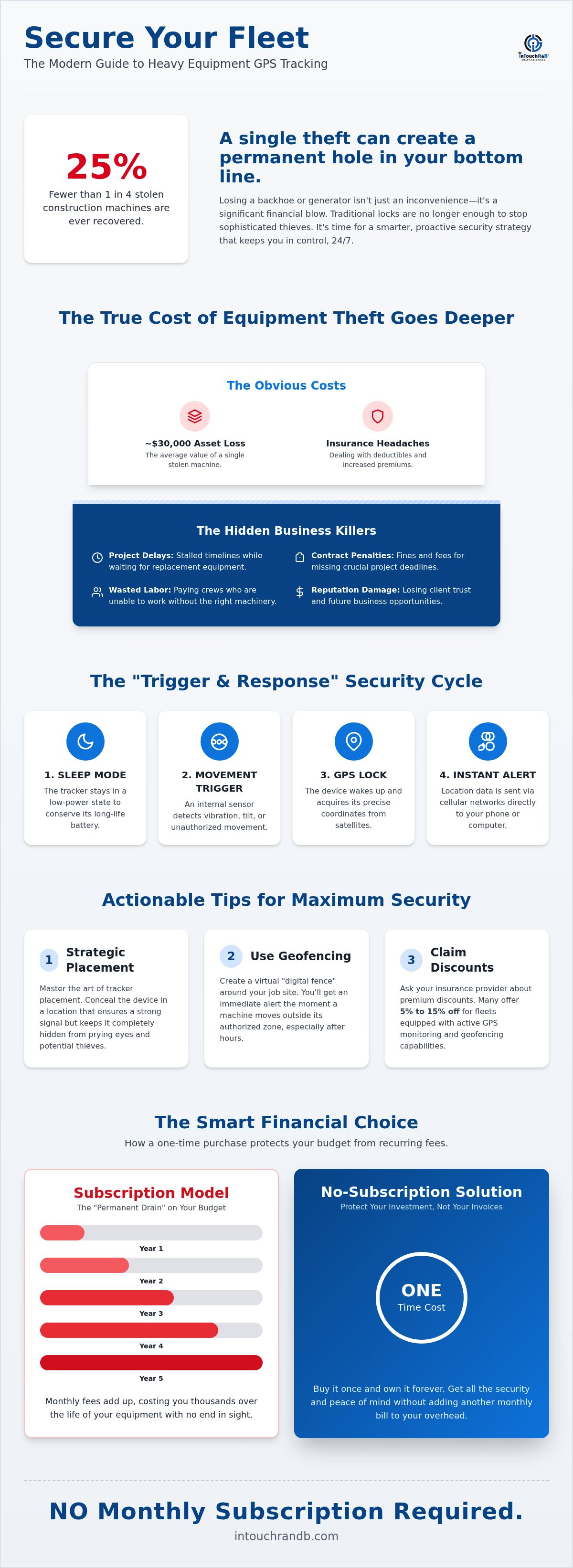
With fewer than 25% of stolen construction machines ever being recovered, losing a single backhoe often results in a permanent $30,000 hole in your bottom line. It's a heavy price to pay for a moment of vulnerability on a busy job site. You probably already know that keeping a watchful eye on your fleet is essential, yet the thought of adding another dozen monthly subscriptions to your overhead is enough to make any owner hesitate. Finding a reliable gps for heavy equipment should feel like gaining a partner in security, not signing up for a permanent financial drain.
We understand that you need a pragmatic way to protect your investments without the complexity of professional wiring or the sting of recurring fees. In this 2026 guide, you'll learn how to deploy a "set it and forget it" tracking strategy that offers the relief of being informed around the clock. We'll walk through how modern systems use geofencing, which creates a virtual digital fence around your equipment, to trigger immediate alerts if a machine moves outside its authorized zone. By the end of this article, you'll have a clear path to securing your machinery with a solution that values both your safety and your budget.
Key Takeaways
- Identify the high-risk zones on your job site and understand why traditional locks are no longer enough to stop modern equipment thieves.
- Learn how a reliable gps for heavy equipment uses a "trigger and response" system to send immediate alerts the moment unauthorized movement is detected.
- Calculate the true five-year cost of your security to see how much you can save by avoiding recurring monthly subscription fees.
- Master the art of tracker placement to ensure a strong signal while keeping the device completely hidden from prying eyes.
- Explore how to build a complete security ecosystem that protects your unattended assets from both theft and environmental damage.
Why GPS for Heavy Equipment is No Longer Optional in 2026
Leaving a multi-million dollar fleet on a remote job site overnight often feels like a gamble. In 2026, the stakes are higher than ever because organized theft rings have become more sophisticated, frequently using cordless tools and signal jammers to bypass traditional security. Relying on physical locks alone is a reactive strategy that only works until the lock is cut. A dedicated gps for heavy equipment acts as a digital sentry, providing a layer of protection that physical obstacles simply can't match. This technology transforms your machinery from a sitting duck into an active participant in its own security, offering a watchful eye even when your crew is miles away.
There's a specific kind of stress that comes with managing high-value assets in high-theft states like Texas or Georgia. You might find yourself worrying about site security after every shift or mentally rehearsing the recovery process. Implementing a robust GPS Tracking System replaces that anxiety with the relief of being informed. It's the difference between hoping your gear is safe and knowing exactly where it's located at 3:00 AM. This peace of mind allows business owners to focus on growth rather than constant risk mitigation.
The True Cost of Equipment Theft
When a piece of equipment goes missing, the $30,000 average financial loss per theft is just the starting point. You also face the immediate burden of insurance deductibles and the long-term sting of increased premiums. However, the indirect costs often hurt more. Project timelines stall, man-hours are wasted while crews wait for replacements, and missed contract deadlines can lead to heavy penalties or damaged reputations. Even minor issues with support vehicles, such as putting the wrong fuel in car North East, can cause unexpected downtime that impacts the entire site's productivity. An unattended asset is any piece of machinery, such as an excavator or generator, left on-site without active human supervision. These assets become primary targets for criminals who track site schedules and strike during the quiet hours of the night.
How Modern GPS Technology Has Evolved
Asset tracking technology has moved far beyond the bulky, power-hungry boxes of the past. Modern sensors are discreet, battery-powered devices that can be tucked into small crevices, making them nearly impossible for a thief to find and disable quickly. We've seen a massive shift from old 3G networks to LTE-M and 5G IoT (Internet of Things) networks. These modern networks offer much deeper signal penetration through thick metal and in remote terrain where standard cell service might struggle. Real-time notifications have replaced the old "after-the-fact" discovery process. Instead of arriving Monday morning to find an empty spot on the lot, you get an alert the moment a vibration sensor is triggered or a geofence is breached.
Actionable Tip: Review your current insurance policy today. Many providers now offer premium discounts of 5% to 15% if you can demonstrate that your fleet is equipped with active GPS monitoring and geofencing capabilities.
How Equipment GPS Trackers Actually Work
Understanding how a gps for heavy equipment functions helps you trust the system when your assets are out of sight. Most modern trackers operate on a "Trigger and Response" cycle. While the machine is stationary, the device remains in a low-power sleep mode to conserve battery. The moment an internal accelerometer (a sensor that detects vibration or tilt) feels movement, the device wakes up and begins its security protocol. This proactive detection ensures that the device is only active when it needs to be, which is the secret to its long-term reliability.
To be effective, your tracker uses two distinct technologies. First, the GPS receiver connects with satellites to determine the exact coordinates of your machinery. Second, a cellular module (frequently using LTE-M or 5G IoT networks) sends that location data to a secure cloud server. Without the cellular component, the device would know where it is, but it wouldn't be able to tell you. Beyond just security, these systems can help managers Optimize Construction Equipment Efficiency by providing data on engine hours and usage patterns. If you're looking for a reliable GPS Tracking System that keeps you in the loop without the hassle, choosing a device with high-quality components is essential.
Battery management is another area where smart engineering shines. Instead of draining power by constantly "pinging" a tower, the tracker stays in a deep sleep state. It only consumes significant power during an active alert or a scheduled daily check-in. This allows the unit to stay alive for months or even years on a single charge or a simple battery set. It's a "set it and forget it" approach that ensures the device is ready to act the moment a thief tries to move your gear.
Geofencing: Your Digital Perimeter
Think of geofencing as an invisible, digital fence that you draw around your job site on a map. When the gps for heavy equipment crosses this virtual boundary, the system triggers an immediate notification. You can customize these alert zones for every unique project, ensuring that your security matches the specific layout of the land. Actionable Tip: Set your geofence boundary roughly 50 to 100 feet larger than the actual site perimeter. This small buffer prevents "false alarms" caused by minor GPS drift or a driver simply repositioning a machine near the gate.
The Communication Hub and Cloud Reporting
Once an alert is triggered, the information travels to a cloud server that acts as a 24/7 command center. This hub ensures that "No Alert is ever lost" by retrying the notification until it successfully reaches your phone via text or email. You can also set up the system to alert multiple recipients simultaneously. This means your site manager, your lead technician, and your head of security all get the same information at the same time. This shared awareness allows your team to coordinate a response quickly, significantly increasing the chances of a successful recovery.
Subscription vs. No-Subscription: Finding the Best Value
Most providers in the tracking industry rely on a recurring revenue model that turns your security into a permanent overhead cost. While a small monthly fee might seem manageable for a single excavator, it quickly becomes a significant burden when you scale it across a full fleet. This is often referred to as the "Subscription Trap." You buy the hardware, but you never truly own the service. If a credit card expires or a payment is missed, your gps for heavy equipment could be deactivated at the very moment a thief decides to strike. We believe that security should be a one-time investment that offers the relief of being informed, not a permanent tax on your operations.
When you look at the math of ownership over five years, the difference is staggering. Verified industry data shows that business fleet plans typically range from $10 to $35 per asset every month, with some specialized services reaching $50 or more. For a company with ten machines, even a modest $20 monthly fee results in $12,000 in total costs over five years, not including the initial hardware purchase. By choosing a no-subscription model, you are securing a value you cannot ignore. You pay for the technology once, and it continues to act as a watchful guardian without asking for another dime from your cash flow.
The Hidden Costs of Monthly Fees
Beyond the direct financial hit, monthly fees create unnecessary administrative friction for your office staff. Managing dozens of individual subscriptions and keeping track of renewal dates is a time-consuming task that distracts from your core business goals. There is also the risk of "silent failure," where a device stops reporting because of a billing issue, leaving your machinery unprotected without your knowledge. You can check our comparison matrix of all Minders to see how a streamlined, no-fee approach simplifies your oversight while maintaining the highest security standards.
Reliability Without the Recurring Bill
A common myth suggests that no-fee systems are somehow less reliable than their subscription-heavy counterparts. In reality, the quality of protection depends on the hardware components and the network it uses, not the frequency of your payments. inTouch R&B provides 24/7 protection by utilizing the same robust LTE-M and 5G IoT networks as the major providers. Owning your device and your data means you aren't beholden to a third party's service terms or price hikes. You get the same "trigger and response" reliability and instant notifications that project owners demand, all while keeping your long-term costs at zero. Actionable Tip: When comparing trackers, always ask if the "no-fee" period is for the lifetime of the hardware or just for the first year. Knowing exactly when a service might expire helps you avoid surprise costs down the road.
NO Monthly Subscription Required.
Actionable Tips for Installing GPS on Heavy Machinery
Installing a gps for heavy equipment is a tactical exercise that requires you to step into the mindset of a potential thief. A tracker is only an effective guardian if it remains undiscovered during those first critical minutes of a theft. When you approach a machine, look for "dead spaces" that aren't subject to frequent maintenance or daily inspections. The goal is to find a location that offers a clear view of the sky through non-metallic materials while remaining completely invisible to a casual observer. This careful placement ensures that if a machine is moved, the "trigger and response" mechanism can work exactly as intended without interference.
Where to Hide Your Tracker
Every piece of machinery offers unique hiding spots that can baffle even experienced criminals. For excavators and backhoes, consider mounting the device inside the boom assembly or behind non-metal access panels near the cab. These areas are rarely checked by thieves looking for a quick score. Skid steers are more compact, making the space under the cab or inside the plastic light housing an ideal choice. If you are securing a fleet of trailers, try hiding the unit inside the frame rails or within the tongue box. For more specialized advice, you can see our specific tips for the best GPS tracker for trailers to ensure your haulers are just as protected as your power equipment.
Avoiding Common Installation Mistakes
The most frequent error we see is the "metal cage" effect. GPS signals are relatively weak and struggle to pass through thick steel plates. If you place your tracker directly under a heavy engine hood or inside a fully enclosed steel toolbox, the device may fail to find a satellite lock. Actionable Tip: Always mount the unit with the internal antenna facing toward a plastic, fiberglass, or glass surface. Before you leave the site, test your alert sequences by manually triggering a small movement. This confirms the device is within range of a stable cellular signal and that your notifications are reaching the intended recipients. If you want to protect your fleet with a professional-grade GPS Tracking System, focus on hidden placement and clear signal paths.
Durability is another factor that shouldn't be overlooked. Heavy machinery lives in an environment of extreme vibration, mud, and pressure washing. Ensure your sensors are rated for high-impact use and are securely fastened with industrial-strength adhesive or mechanical mounts. A loose tracker can eventually fall off or suffer internal damage from constant rattling. Create a simple monthly maintenance checklist to check the physical security of the device and verify battery levels. This proactive approach ensures your watchful guardian is always ready to act the moment it's needed.
NO Monthly Subscription Required.
Beyond Tracking: Building a Holistic Security Ecosystem
While knowing the location of your machinery is vital, a truly effective security strategy looks at every threat that could sideline your fleet. Theft is a significant risk, but environmental factors and mechanical failures can be just as costly. A gps for heavy equipment provides the foundation for this protection, but it becomes even more powerful when integrated into a broader ecosystem of sensors. For operations in specialized sectors like oil and gas, incorporating safety solutions from PetroHab LLC alongside your tracking system ensures a truly comprehensive approach. By monitoring water levels, power status, and battery health, you transition from a reactive posture to a proactive one, ensuring your equipment is always ready for the next shift.
One often overlooked aspect of site security is the health of the monitoring system itself. A "set it and forget it" solution still requires a basic level of oversight. Modern systems provide automated alerts when a device’s internal battery drops below a certain threshold. This ensures you never have a gap in coverage because a sensor went dark. Actionable Tip: Designate a specific "Security Review" time every Monday morning to check the status of all your active alerts and battery levels in your dashboard. This five-minute habit prevents most system failures before they happen.
Protecting Your Support Equipment
Many job sites rely on more than just rolling stock. You might have site pumps, generators, or even marine assets that are equally vulnerable to damage or theft. For example, using a Bilge Minder allows you to monitor for rising water in unattended pumps or vessels, preventing a small leak from becoming a catastrophic loss. Similarly, you can monitor power loss on-site with the AC Minder. If a circuit breaker trips or a thief cuts the power to your site lights or charging station, you receive an instant notification. Having a single dashboard for all these critical points simplifies your management and ensures that no alert is ever lost.
The inTouch R&B Advantage
Choosing inTouch R&B means you are investing in 24/7 protection and control for your boat, RV, or heavy equipment. Our systems are designed to bridge the gap between simple location tracking and comprehensive asset monitoring. We focus on the "relief of being informed," providing you with simple, easy-to-read alerts that tell you exactly what is happening the moment it happens. This approach moves you away from the frustration of discovering a problem days after it occurred.
The most significant benefit remains the financial freedom our model provides. You get professional-grade security that works as a watchful guardian for years without the burden of a recurring bill. By eliminating the "Subscription Trap," we help you protect your high-value assets while keeping your long-term operating costs as low as possible.
NO Monthly Subscription Required.
Take Control of Your Fleet's Security Today
Protecting your high-value machinery is about more than just finding a lost asset; it's about maintaining the continuity of your business and avoiding the steep costs of project delays. By prioritizing strategic placement and choosing a reliable gps for heavy equipment that operates on modern IoT networks, you ensure that your gear remains a hard target for thieves. You don't have to settle for the hidden costs of recurring bills to get professional-grade protection. With 24/7 proactive monitoring and notifications sent to multiple recipients, you can finally enjoy the relief of being informed without the administrative headache of monthly payments.
Building a holistic security ecosystem allows you to watch over every unattended asset on your site, from site pumps to heavy excavators. It's time to move away from reactive tracking and embrace a solution that works as hard as you do. Take the first step toward a more secure job site and better cash flow today.
Secure Your Heavy Equipment Today with inTouch R&B
NO Monthly Subscription Required.
Frequently Asked Questions
Do I really need a GPS tracker if my equipment is insured?
Insurance is a vital safety net, but it's rarely a complete solution for recovery. With fewer than 25% of stolen machines ever returned to their owners, a claim often results in lost productivity and higher future premiums. A gps for heavy equipment provides the real-time coordinates necessary for local law enforcement to act quickly, often recovering the asset before it's stripped for parts or moved across state lines.
How long does the battery last on a heavy equipment GPS tracker?
Battery life depends on your reporting settings, but modern trackers are designed to be extremely efficient. By staying in a low-power sleep mode when the machine is stationary, the device can remain active for several months or even years on a single charge. You'll receive a proactive notification the moment the battery level drops below a certain threshold, ensuring your watchful guardian never goes dark without your knowledge.
Can thieves use GPS jammers to bypass my security system?
Some professional thieves use signal blockers, but modern trackers utilizing LTE-M and 5G IoT networks are much more resilient than older models. These systems are engineered to provide deep signal penetration even in challenging environments. Actionable Tip: Mount your tracker in a location that is difficult to access quickly, as this forces thieves to spend more time on-site, increasing the likelihood that your initial movement alert will lead to their capture.
Is there a monthly fee for inTouch R&B GPS tracking systems?
No, our GPS Tracking System is a one-time purchase that eliminates the ongoing burden of recurring bills. We believe you should own your security hardware and the data it produces without being trapped in a permanent subscription. This approach protects your cash flow and ensures that your equipment remains monitored even if a credit card expires or a billing cycle is missed during a busy season.
What is the difference between a GPS tracker and a Bluetooth tag like an AirTag?
A dedicated gps for heavy equipment uses satellites and cellular towers to provide independent, long-range tracking anywhere there is a signal. Bluetooth tags, such as AirTags, rely on a nearby network of other people's smartphones to report a location. On a remote job site or in a rural storage yard where foot traffic is non-existent, a Bluetooth tag will fail to update, whereas a GPS tracker remains fully operational.
How accurate is the location data for heavy machinery?
The location data is highly precise, typically pinpointing your machine's position within 10 to 15 feet in clear outdoor conditions. This level of accuracy allows recovery teams to identify exactly which trailer or warehouse a machine is being held in. You can monitor this data through a secure cloud dashboard, giving you a clear, bird's-eye view of your entire fleet at any time of day or night.
Can I monitor multiple pieces of equipment from one app?
Yes, you can manage your entire fleet through a single, unified dashboard. Whether you're tracking one backhoe or twenty different unattended assets, the system organizes all your notifications in one place. This allows you to set custom geofences for different job sites and ensure that alerts are sent to multiple recipients, such as site managers and security personnel, simultaneously for a coordinated response.
What happens if my equipment is moved outside of working hours?
The moment your equipment moves or vibrates outside of its authorized hours, the system triggers an immediate alert. This "trigger and response" mechanism ensures that you're notified via text or email the second a theft is in progress. Because the system is active 24/7, you can rest easy knowing that your gear is being watched by a guardian that never sleeps, providing the relief of being informed at all times.
NO Monthly Subscription Required.

Article by
Jimmy Nesbitt
Principle
Be the first to comment