

What if your boat moves from its berth while you’re away, or starts taking on water without any visible sign from shore? A boat security system with gps can help you monitor a vessel’s location, but location tracking alone can’t explain what’s happening onboard.
It’s understandable to want a clear picture of your boat’s safety, especially when it’s unattended at a dock or on a trailer. GPS tracking can show its location, and geofencing can alert you if it moves beyond an area you’ve set. Separate onboard sensors can report conditions such as bilge activity, water level, battery voltage, intrusion, and power status. These capabilities provide different kinds of information, so using them together can give you a fuller view than either type of monitoring alone.
In this guide, you’ll learn what movement alerts can and can’t tell you, how standalone tracking compares with broader boat monitoring, and which features may fit your vessel. You’ll also find practical steps for planning alerts and choosing a secondary recipient who can help respond when you’re unavailable.
Key Takeaways
- Choose alerts based on what you need to know, such as unexpected movement or a change in an onboard condition.
- A boat security system with gps can help you track location, while separate monitoring capabilities can provide insight into what’s happening aboard.
- Compare location tracking, movement boundaries, and onboard condition monitoring by the events each can detect and what those alerts can’t prove.
- Before setting up protection, identify where your boat is kept and decide who should receive an alert if you’re unavailable.
- inTouch R&B’s GPS Tracking System and boat-monitoring capabilities address different needs and can be considered as parts of a practical response plan.
What Does a Boat Security System with GPS Actually Protect?
A boat security system with GPS combines awareness of a vessel’s location with relevant security alerts. GPS tracking helps you see where your boat is. If the system includes geofencing, it can also notify you when the boat moves beyond a defined area. Separate onboard sensors can report conditions such as bilge activity, water level, battery voltage, intrusion, or power status. The distinction matters: a location on a map doesn’t reveal whether water is rising in the bilge, a battery is losing charge, or equipment has lost power.
That broader view can help with common unattended-boat concerns, from unexpected movement and unauthorized access to water intrusion or power loss. These are different events, and they call for different monitoring features. Knowing where your boat is can be useful, but it isn’t the same as knowing its condition.
GPS tracking and boat security are related, but not identical
GPS tracking uses location information to help an owner monitor a vessel’s position. If a system includes geofencing, it can notify you when the boat moves beyond a defined area. A geofence is a virtual boundary set around a real-world place; learn more about how geofencing works.
Security monitoring can go further by using onboard sensors to detect specific conditions. For example, a sensor might report bilge activity, water level, battery voltage, intrusion, or power status. These capabilities are not interchangeable, and not every GPS tracker includes sensors. Compare the specific events each feature is designed to detect before choosing a system.
Why unattended boats need more than a location check
Picture a boat still sitting in its usual berth. Its location appears unchanged, but that alone can’t tell you whether water is entering the hull, the power supply has been interrupted, or someone has accessed the vessel. A location alert and an onboard condition alert answer different questions, and both may matter when you’re away.
GPS can report where a boat is; it can’t diagnose what’s happening aboard. When considering a boat security system with gps, think through the concerns you want alerts to address:
- Movement: Would notice of a boat leaving a defined area help you respond to unexpected movement?
- Water: Do you want an alert about bilge activity or a change in water level?
- Power and battery: Would knowing about a change in power status or battery voltage be useful?
- Access: Do you want monitoring for possible intrusion?
Start with the events that matter most for your boat and how it’s kept. Then distinguish location tracking from sensors that report onboard conditions. This simple comparison sets realistic expectations and helps you choose protection that answers more than “Where is it?”
How GPS, Geofencing, and Boat Sensors Work Together
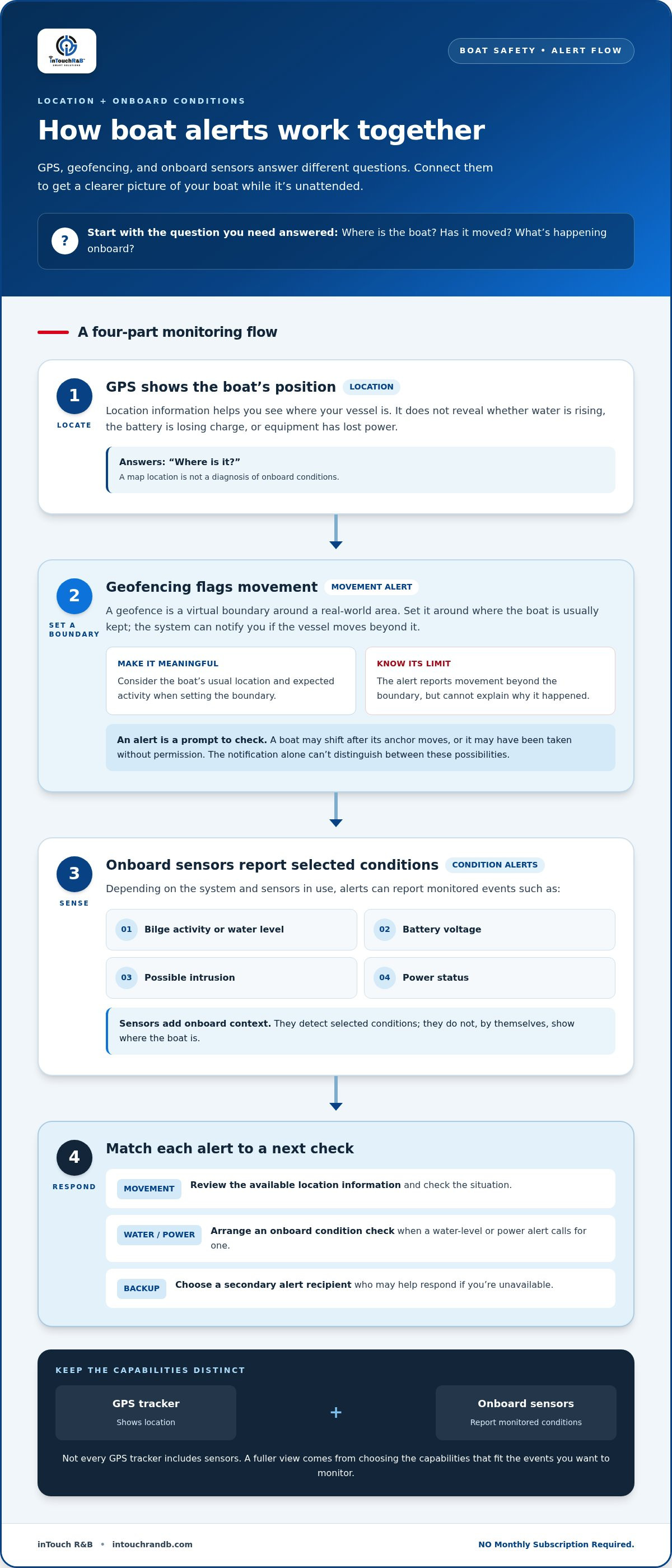
A boat security system with gps can bring several kinds of information into your monitoring plan, but each capability answers a different question. Location information shows where the boat is. A geofence can flag movement beyond a defined area. Onboard sensors detect selected conditions, and the system sends a notification when a monitored event occurs.
A geofence is an alert boundary set around an area, such as the place where a boat is usually kept. If the vessel moves outside that boundary, the system can notify you. The alert reports movement beyond the set area; it doesn’t explain why the boat moved. For a general explanation of virtual geographic boundaries, see How geofencing works.
What a GPS movement alert can tell you
An out-of-boundary alert can draw your attention to movement you weren’t expecting. A boat may shift from its usual position after its anchor moves, or it may have been taken without permission. The notification alone can’t distinguish between those possibilities. Treat it as a prompt to review the available location information and check the situation, not as proof of a specific cause.
Before setting a boundary, consider where the boat normally stays and which movements should prompt a check. A boundary based on its usual location and expected activity makes an alert more meaningful than one set without considering normal movement.
What onboard sensors can add to the picture
Onboard sensors monitor conditions separately from GPS location. Depending on the system and sensors in use, an alert may report unusual bilge pump activity or a water-level concern. Other sensor alerts may relate to battery voltage, power status, or possible intrusion. These signals can help identify an issue that a map location can’t reveal.
A movement alert tells you the boat has crossed a boundary; a sensor alert tells you a monitored onboard condition has been detected. They complement each other, but they aren’t interchangeable. A GPS tracker doesn’t necessarily include onboard sensors, and sensors don’t by themselves show where the boat is.
To make alerts useful, decide what each one should prompt you to do. An unexpected movement notice may mean reviewing the vessel’s location, while a water-level or power alert may call for someone to check its onboard condition. Boat-focused monitoring can also send alerts to an owner and a secondary recipient, which may help if you’re unavailable. Explore bilge and boat monitoring as one way to consider location tracking alongside condition alerts, with each capability serving a distinct role.
GPS Tracker vs. Boat Security Monitoring: Which Fits Your Needs?
The right setup depends on what you most need to know about your boat. A trailered-boat owner may focus on location and unexpected movement, while someone leaving a vessel at a dock may also want alerts about onboard conditions. Use this comparison to match each capability to the information it can provide.
| Capability | What it can detect | Possible notification | What it can’t establish |
|---|---|---|---|
| Location tracking | The vessel’s reported location | A location update or change in position | Why the boat moved, or whether anything onboard is wrong |
| Movement boundary (geofence) | Movement beyond a defined area | An alert that the boat has crossed the boundary | Whether the cause is theft, normal activity, or another event |
| Onboard condition monitoring | Conditions monitored by connected sensors, such as bilge activity, battery voltage, intrusion, or power status | An alert when a monitored condition is detected | The boat’s location or the full cause of the condition |
When a GPS-focused system may address the main concern
If your main question is “Where is my boat?” location tracking may be the priority. For a boat kept on a trailer, location awareness and a movement boundary can help draw your attention to an unexpected change. For a docked vessel, a geofence can alert you if it moves beyond the area you set. Neither feature prevents theft or guarantees recovery; an alert gives you information to investigate.
For broader context on tracking boats and other mobile assets, explore the available inTouch R&B monitoring solutions.
When broader boat monitoring may be useful
If you’re concerned about what could happen while the boat is unattended, location data may not be enough. Bilge activity, battery voltage, power status, and intrusion are separate conditions that require relevant onboard monitoring. For example, a docked boat may stay in the same place while a sensor reports a change in water level or power.
Think through the response as well as the alert. If you can’t check a notification promptly, a secondary recipient may help ensure someone else knows attention is needed. For a closer look at bilge-focused monitoring, see Bilge Minder. A boat security system with gps can bring location awareness into the picture, while onboard monitoring provides a different kind of information. Choose based on the events you need to notice and what you or a designated recipient could do when an alert arrives.
How to Choose and Set Up a Boat Security System with GPS
Start with the situations you want to notice, then choose the tracking or monitoring features that can report them. A boat security system with gps is most useful when its alerts match how you keep your vessel and what you’d do if a notification arrives. A simple plan can help you avoid configuring alerts you don’t need while ensuring important events have a clear response.
Decide what you want to know about the boat
First, consider where your boat is kept and what concerns you most. A trailered boat may call for location and unexpected-movement awareness. A docked vessel may also need monitoring for bilge activity, water level, battery voltage, power status, or intrusion. Separate alerts that need prompt attention from routine status updates so you can prioritize when notifications arrive.
Before configuring a system, use this checklist:
- Identify the priority: Is your main concern location, movement, water, battery, power, or unauthorized access?
- Match the feature to the concern: Choose location tracking or a movement boundary for location changes; consider relevant onboard sensors for condition alerts.
- Set the alert purpose: Decide which events should trigger a prompt response and which information is useful as a routine check.
- Name a backup recipient: Choose a trusted secondary recipient, such as a marina manager or service technician, who can respond if appropriate.
- Understand the setup: Review the system’s instructions for power, connectivity, and configuration. Plan installation around where the boat is kept and how the system communicates.
Plan alert boundaries and response steps
If movement alerts matter, set a geofence that reflects the area where you intend the boat to remain. Think through normal movements before settling on a boundary, so expected activity is less likely to cause confusion. The alert should prompt a check, not a conclusion about why the boat moved.
Next, decide what happens after each alert. For an unexpected location change, identify who will review the location information and follow up. For a water, battery, power, or intrusion notification, assign someone to check the relevant onboard condition. Share the plan with your secondary recipient, including which alerts they may receive and what follow-up you expect. That way, the notification has a clear next step even if you’re unavailable.
With these priorities in mind, explore inTouch R&B GPS tracking and boat monitoring as complementary ways to stay informed about location and onboard conditions.
How inTouch R&B Supports GPS Boat Security and Remote Monitoring
Location tracking and onboard monitoring answer different questions. inTouch R&B’s GPS Tracking System helps owners monitor a boat’s real-time location and security. Geofencing can provide an alert if the boat moves beyond a defined area, helping bring unexpected movement to your attention. This gives you useful information about where your vessel is without treating a location alert as proof of what caused the movement.
A boat-focused approach to location and alerts
The GPS Tracking System is designed for boats and other mobile assets. That can be useful for owners who want location monitoring for more than one asset. For an overview of the monitoring options, see the inTouch R&B monitoring solutions comparison.
Location tracking is distinct from onboard condition monitoring. Separate boat-monitoring sensors can report conditions such as bilge activity, water level, battery voltage, intrusion, and power status. These capabilities complement GPS by adding information about what may be happening aboard, but they are separate functions. Broader monitoring can also support alerts to both the owner and a secondary recipient, giving someone else a chance to follow up if the owner is unavailable.
Choose a practical next step for your vessel
Start with one question: do you mainly need to know where the boat is, or do you also want alerts about onboard conditions? If location and unexpected movement are the priority, GPS tracking and geofencing address those concerns. If water, battery, power, or intrusion also matter, consider how onboard monitoring could complement location awareness. Then decide who should receive alerts and what each person should do next.
Compare inTouch R&B’s boat-monitoring options by the information they provide and the events you want to know about. Clear priorities and a simple alert plan can help you stay informed while your boat is unattended.
Choose the Right Alerts for Your Boat
A boat security system with gps can help you stay aware of where your vessel is and alert you when it moves beyond a defined area. But location tracking and onboard monitoring do different jobs: GPS reports location, while separate sensors can alert you to conditions such as bilge activity, battery voltage, power status, or intrusion.
Start by deciding which changes you most need to know about, then match alerts to those concerns. Consider who should receive a notification and what they can do next. A secondary recipient can help keep a response plan moving if you’re unavailable.
inTouch R&B’s GPS Tracking System supports location monitoring for boats and other mobile assets, with geofencing for movement alerts. Broader boat monitoring adds sensor-based information, so you can consider the capabilities together while keeping their roles clear.
Use the inTouch R&B website to explore boat security and GPS monitoring solutions and choose a practical next step for staying informed about your vessel.
Frequently Asked Questions
Can GPS track a boat in real time?
Yes. A GPS tracking system can provide real-time location monitoring, allowing an owner to view a boat’s reported position. The timing and detail of updates depend on the particular system and its ability to communicate, so don’t assume every tracker updates in the same way. GPS location helps answer, “Where is the boat?” It doesn’t report bilge, battery, or other onboard conditions unless separate monitoring is included.
What is geofencing on a boat GPS tracker?
Geofencing lets you set a virtual boundary around an area where you expect your boat to remain. If the boat moves beyond that boundary, the system can send an alert. For example, a movement notification may draw your attention to a boat leaving its usual area. The alert doesn’t explain why it moved, so review the location and circumstances before deciding what happened.
Can a GPS tracker prevent boat theft?
A GPS tracker can’t guarantee that a boat won’t be stolen. It can help you monitor the vessel’s location, and a geofence may alert you if it moves outside an area you’ve defined. That information can help you notice unexpected movement and follow up. Tracking by itself doesn’t identify the cause of movement or guarantee that a stolen boat will be recovered.
What is the difference between a boat GPS tracker and a boat security system?
A boat GPS tracker focuses on location, helping you see where the vessel is and, if geofencing is available, receive notice when it moves beyond a defined area. A broader boat security system may also use separate onboard sensors to report conditions such as bilge activity, battery voltage, power status, or intrusion. Features vary, so a GPS tracker doesn’t automatically include condition monitoring.
Can a boat security system alert me if my boat moves?
Yes, if the system includes movement alerts or geofencing and that feature is set up. A geofence is a virtual boundary around an area; crossing it can trigger a notification. The alert tells you the boat moved beyond that boundary, not whether the cause was ordinary activity, anchor movement, or theft. Decide who should receive the alert and how they’ll check the situation.
Can a boat GPS system also monitor the bilge and battery?
GPS location tracking alone doesn’t tell you about bilge activity or battery voltage. Those conditions require relevant onboard sensors and monitoring. A broader boat-monitoring setup can provide sensor-based alerts for bilge activity, battery voltage, water level, intrusion, and power status. Think of these as complementary capabilities: GPS helps locate the boat, while sensors report selected conditions aboard. Not every GPS tracker includes those sensors.
What should I do when I receive an unexpected boat movement alert?
First, review the boat’s reported location and consider whether the movement could be expected. If it remains unexplained, follow your response plan and notify your designated secondary recipient, such as a marina manager or service technician, if appropriate. Don’t treat the alert as proof of theft. Use it as a prompt to check the situation and decide on a sensible next step based on what you learn.
Explore inTouch R&B’s GPS Tracking System and boat-monitoring options to plan alerts around your vessel and the events you want to track. NO Monthly Subscription Required.

Article by
Jimmy Nesbitt
Principle
Be the first to comment