

What if power to important equipment failed while you were away, and nobody noticed until a small problem became a bigger one? An ac power failure alarm system detects power loss at a monitored point and sends an alert so you can respond sooner. It does not restore power or guarantee that equipment and property are protected.
When comparing options, check what the device monitors, how it sends alerts, and what happens if its communication path is interrupted. This guide explains how AC power detection works, what an alert can and can’t tell you, and what to check before choosing or installing a monitor. AC Minder, for example, includes a 120 VAC monitor that detects power presence or loss on a monitored HVAC circuit, with reports sent through a communication hub to secure cloud servers.
Key Takeaways
- An ac power failure alarm system reports a loss of power at the point it monitors. It does not restore power or repair equipment.
- Identify the equipment and circuit you want to watch so the monitoring point matches your needs.
- Compare local alarms, circuit-level monitors, and remote monitoring by their notification methods, connection requirements, and limitations.
- Test the setup by confirming normal status, alert recipients, and the communication connection.
- AC Minder may suit HVAC power monitoring. Its documented 120 VAC monitor detects power presence or loss on a monitored HVAC circuit.
What Does an AC Power Failure Alarm System Detect?
An AC power failure alarm system monitors a specific point for electrical power and reports when power is lost there. It detects whether the monitored AC circuit has power and sends an alert if its status changes from power present to power absent. The alert reports a condition. It does not restore electricity, restart equipment, or repair a fault.
This can be useful when a home, heating, ventilation, and air conditioning (HVAC) system, boat, or RV is unattended. If power to monitored equipment drops while you’re away, a remote alert can prompt you to check the situation. A power outage may affect an entire property or only part of its electrical system, depending on where the interruption occurs.
For a quick look at how a power issue may appear on an alarm panel, watch this video:
What counts as AC power loss?
AC means alternating current, the type of electricity used by many household systems. A monitor checks power at a defined point, such as a particular circuit connected to equipment. If that circuit loses power, the monitor may report the change even if other parts of the building still have electricity. The alert alone usually doesn’t explain why power stopped, so don’t treat it as a diagnosis.
Why can a power interruption matter?
When power to an HVAC circuit is interrupted, the connected system may stop operating. Indoor temperatures may change, and other concerns, such as water issues, may also need attention. An alert gives you a chance to check the equipment and decide what to do next, but it can’t prevent damage or confirm the property’s full condition.
For example, if an unattended home’s monitored HVAC circuit loses power, an alert can prompt you to check the system or contact someone who can assess it. A power-status monitor is most useful when it watches the circuit that matters to you, not an unrelated point. For HVAC circuit monitoring, AC Minder includes a 120 VAC monitor that detects power presence or loss on the monitored HVAC circuit.
How Does an AC Power Failure Alarm Detect and Report an Outage?
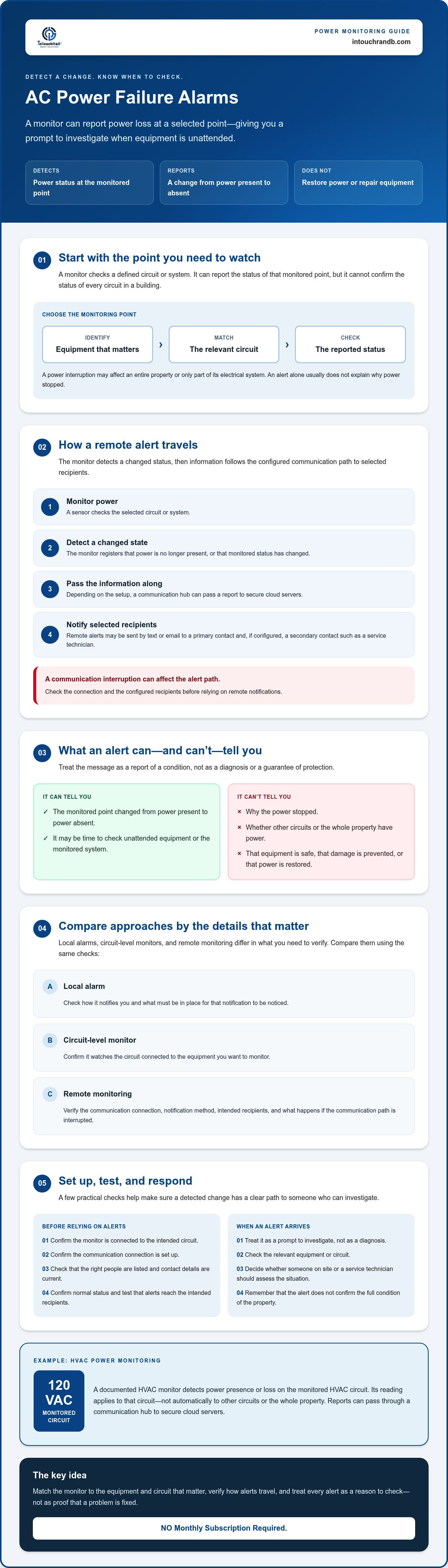
An ac power failure alarm system checks power at a selected point, recognizes a change, and passes that information to the people who need to know. The monitor must be connected to the relevant circuit or system. A device watching one circuit can’t confirm the status of every circuit in a building.
In short: the monitor checks power, detects a change, sends the status through its communication path, and notifies the selected recipients.
From AC voltage monitoring to an alert
Voltage is the electrical force that helps move current through a circuit. In this context, voltage monitoring checks whether power is present at the point being watched. If the status changes from power present to power absent, the system can report the change. The alert indicates a detected condition, not its cause.
For example, AC Minder includes a 120 VAC monitor that detects power presence or loss on a monitored HVAC circuit. That reading applies to the monitored circuit, not automatically to other circuits or the whole property. See the AC Minder power monitor for product details.
How remote notifications reach the right people
With remote monitoring, a reported status can pass through a communication hub to secure cloud servers, then reach recipients as a text or email alert. The system may also notify a secondary contact, such as a service technician. The exact route depends on the monitoring setup and its available connection.
Before relying on alerts, confirm that the monitor is connected to the intended circuit, the communication connection is set up, and the right people are listed to receive messages. Check that recipient contact details are current, too. These checks help ensure a detected change has a clear path to someone who can act.
- Monitor power: The sensor checks the selected circuit or system.
- Detect a changed state: It registers that power is no longer present or that the monitored status has changed.
- Send information: The system passes the reported condition through its communication hub and cloud service.
- Notify recipients: A text or email can alert the primary contact and, where configured, a secondary recipient.
An alert is a prompt to investigate, not a repair or a guarantee that equipment is safe. For broader household planning and safety steps, Ready.gov explains how to prepare for and respond to a power outage. Also check your monitor’s setup details, including supported connections and alert delivery options.
Which AC Power Failure Alarm Approach Fits Your Equipment?
The right choice depends on what you need to know and whether someone is nearby to hear an alert. A local alarm signals at the property, a circuit-level monitor watches a selected electrical point, and broader remote monitoring can combine power status with other sensor readings. An ac power failure alarm system is most useful when its monitoring point and notification method match the equipment you want to check.
| Approach | Monitoring point | Notification method | Connectivity needs | Limitations |
|---|---|---|---|---|
| Local alarm | The location or equipment where it’s installed | Sound or visual signal nearby | May operate locally. Check the specific device | May go unnoticed if nobody is within hearing or sight |
| Circuit-level monitor | A selected circuit or connected system | Local signal or remote alert, depending on the setup | Depends on the monitor and its alert method | Reports only the monitored point, not every circuit or the cause of power loss |
| Broader remote monitoring | Power status and, if supported, other sensor conditions | Remote notifications to configured recipients | Requires the system’s supported communication connection | Connectivity and supported sensors vary. An alert doesn’t fix the fault |
Local alarm or remote power notification?
A local alarm may suit a location where someone is usually on-site and can respond to its signal. If a property, boat, or RV is unattended, remote notification may be more useful because it can bring a reported change to an absent owner’s attention. Don’t assume every remote monitor will stay connected during a power or internet outage. Check its communication requirements and what happens if that connection is interrupted.
When is broader equipment monitoring useful?
A basic power alert answers one question: is power present at the monitored point? It doesn’t tell you the room temperature, whether water is present, or the condition of a battery unless the system also supports appropriate sensors. HVAC power monitoring paired with temperature or water sensing may provide more context if the system supports that setup. The HVAC Minder product information can help you assess an HVAC monitoring option.
On a boat, monitoring shore-power status may be useful while the vessel is unattended, but that status alone won’t describe every onboard condition. AC Minder is one example of HVAC circuit power monitoring: its documented 120 VAC monitor detects power presence or loss on the monitored HVAC circuit. For broader power-outage planning, the CDC outlines health and safety risks of power outages. Match each monitor to the condition you need to know about, then confirm its supported sensors and alert path.
How to Prepare for and Respond to an AC Power Failure Alert
Preparation makes an alert easier to act on. Before choosing or installing an ac power failure alarm system, identify what you want to monitor, confirm how the device communicates, and decide who should receive a notification. The monitor can report a change, but someone still needs to check what’s happening and choose the next step.
Before choosing or installing a monitor
Write down the appliance, equipment, or circuit whose power status matters. If you’re unsure which circuit supplies it, check the equipment documentation or ask a qualified professional rather than guessing. Then review the monitoring device’s documentation to confirm it supports the intended monitoring point and communication method.
- Name the equipment: Record which system or appliance you want to monitor.
- Confirm the monitoring point: Make sure the device can monitor the relevant circuit or system, not just a nearby outlet.
- Check the communication path: Confirm the connection method is supported and suitable for the location.
- Set up recipients: Verify the primary alert contact and add a secondary recipient if the system supports one.
- Learn normal status: Confirm how the system reports ordinary operation so a change is easier to recognize.
Follow the product’s installation and user instructions. Don’t rely on generic wiring advice or attempt electrical work unless you’re qualified to do it.
What to do when an alert arrives
First, check that the message refers to the equipment or circuit you intended to monitor. Then verify the reported condition using information available to you, such as another system status indicator or an on-site check. If power appears to be lost, consider which connected equipment may be affected. For electrical or HVAC work, contact an appropriate service professional rather than attempting a repair beyond your ability.
Checklist: An alert confirms that the monitor detected a change at its selected point. Identifying the cause, checking other equipment, and assessing the property still require verification or inspection.
For example, if you receive a power-loss alert for a monitored HVAC circuit, confirm it’s the expected circuit, then check the system’s condition if you can do so safely. A power-status alert doesn’t show whether the HVAC equipment has restarted or whether another issue is present.
For a wider look at monitoring needs across equipment, read this remote equipment monitoring guide. If you’re comparing power-monitoring options, explore AC power monitoring options and confirm the current product details, supported connections, and alert settings before choosing.
How AC Minder Fits into a Remote Power Monitoring Plan
AC Minder is an inTouch R&B product for monitoring AC power status on a selected HVAC circuit. Its documented 120 VAC monitor detects whether power is present or has been lost at that point. A report can prompt you to check the system or arrange an assessment. AC Minder doesn’t prevent an outage, supply backup power, or repair HVAC equipment.
AC Minder may be one part of a remote monitoring plan, rather than a complete solution for every property risk. A power-status alert tells you about the monitored HVAC circuit. Other concerns, such as water presence, temperature, or humidity, require the relevant sensors and a setup that supports them. Confirm current compatibility and alert details before making a product decision.
What AC Minder can contribute
For an unattended home or other property with HVAC equipment, knowing that power to the monitored circuit has been lost can give you a reason to investigate. The report doesn’t establish why power stopped or whether the HVAC system is otherwise operating as expected. Treat it as information that can guide your next check, not a diagnosis or a guarantee against damage.
Review the AC Minder product details for current information about the monitor and its setup. Check that the documented monitoring point matches the circuit you want to watch, and confirm the available communication and alert options for your needs.
Choosing a next step without overcomplicating the setup
Before comparing products, write down the equipment or circuit you need to monitor and who should receive a notification if its status changes. Then consider what other conditions matter at that location. Water or temperature information may add context to power status if the system supports the sensors needed to monitor those conditions.
If you’re comparing monitoring categories, the monitor comparison matrix can help you review related system options. Keep the goal specific: choose a monitoring point that fits your equipment, and confirm the alert route before relying on it. For a closer look at AC power monitoring, explore AC power monitoring options.
NO Monthly Subscription Required.
Choose a Monitor That Matches What You Need to Know
A useful ac power failure alarm system watches the right circuit and gives you clear information when its status changes. Before choosing one, confirm what it monitors, how alerts reach you, and who else should be notified. An alert is a prompt to investigate, not a backup power source or a repair—for those seeking proactive backup power solutions, resources from Nippon Energy explain how battery storage systems can keep power flowing during unexpected outages.
For HVAC circuit monitoring, AC Minder documentation specifies a 120 VAC monitor. Documented alerts can be sent by text or email, with a secondary recipient available so another designated contact can also be informed. Review current product details to confirm the setup fits your equipment and notification needs.
Frequently Asked Questions
What does an AC power failure alarm system do?
An AC power failure alarm system detects a loss of power at a selected monitoring point and reports the change. It might watch a particular HVAC circuit, for example, rather than the entire property. Depending on the setup, it can send an alert so you know to check the equipment. It doesn’t restore power, identify the cause of the interruption, or repair connected systems.
Can an AC power failure alarm send alerts when I am away?
Yes, a remote monitor can send alerts while you’re away if its communication connection and notification settings are working. Documented inTouch R&B alerts can be sent by text or email, and a secondary recipient can also be notified. Before relying on remote messages, confirm the intended contacts and connection method, and check what the system can report if its communication path is interrupted.
Will a power failure alarm tell me why the power went out?
No. A power-status alert reports what the monitor detected at its selected point, not the cause. The interruption could involve the monitored circuit or a wider power issue, but the notification alone won’t distinguish between them. Check the message and equipment status, then arrange an inspection if needed. Don’t assume that an alert identifies a fault or confirms the condition of other circuits.
Can one alarm monitor HVAC power and water leaks?
A monitoring setup may report both conditions if it supports the appropriate power monitor and water sensor. These are different measurements: a power monitor checks whether electricity is present at its selected point, while a water sensor detects water at its location. Before choosing a system, verify that it supports both sensor types and that each can be positioned to monitor the condition you care about.
Does AC Minder monitor an entire home’s electrical system?
No. AC Minder’s documented 120 VAC monitor detects power presence or loss on the monitored HVAC circuit. That reading doesn’t establish whether power is available on every circuit in the home. If you need to monitor a different circuit or system, check the product documentation to confirm what the monitor is designed to watch and whether it matches your intended monitoring point.
What should I check before installing an AC power failure alarm?
Identify the equipment and circuit you want monitored, then confirm the device supports that monitoring point and your preferred communication method. Decide who should receive alerts, verify their contact details, and learn what normal operating status looks like. Follow the product’s installation and user documentation. If identifying a circuit or connecting equipment requires electrical work, ask a qualified professional rather than guessing.
Can an AC power failure alarm prevent damage to my equipment?
No. An alarm detects and reports a condition; it doesn’t prevent an outage, restore electricity, or repair equipment. A timely notification may help you investigate sooner, but it can’t guarantee that damage won’t occur. Treat the alert as a prompt to check the reported circuit and affected equipment. If the issue needs electrical or HVAC work, contact an appropriate service professional.
To assess whether AC Minder fits your HVAC monitoring needs, review the product details and confirm the monitoring point and alert setup for your equipment.

Article by
Jimmy Nesbitt
Principle
Be the first to comment