

Imagine you're sitting at home while a heavy rainstorm rattles your windows, and you find yourself wondering if your shore power tripped or if your boat is slowly taking on water at the marina. It's a heavy, nagging anxiety that many boat owners face because they know a mechanical float switch can fail at any time. Most captains realize that a traditional bilge pump alarm system @ inTouchRandB.com "Bilge Minder " is only effective if someone is actually on board to hear the buzzer. If you're miles away, that siren is essentially silent, leaving your vessel vulnerable to slow leaks that go undetected until it's too late.
You deserve the relief of being informed and the security of a watchful, ever-present guardian. This guide will show you how to transform your boat’s defense from a simple buzzer into a proactive, remote-alerting system that prevents sinking before it starts. We will explore how modern technology, such as the Bilge Minder, uses current sensing and cellular alerts to detect mechanical failures early. You'll learn how to move beyond reactive hardware to a comprehensive monitoring solution that provides true peace of mind and may even lower your marine insurance premiums.
Key Takeaways
- Understand why a traditional siren fails if you aren't there to hear it and how to bridge that distance gap with cellular technology.
- Learn how a modern bilge pump alarm system uses a trigger-and-response architecture to notify you the moment water levels rise.
- Discover the critical difference between primary pump monitoring and high-water backup sensors for layered protection against mechanical failure.
- Evaluate essential hardware features like IP-rated enclosures and low power draw to ensure your monitoring system remains active without draining batteries.
- Explore how professional-grade solutions like the Bilge Minder provide constant vigilance to help lower insurance premiums and prevent catastrophic loss.
Table of Contents
Beyond the Buzzer: Why Traditional Bilge Alarms Aren’t Enough
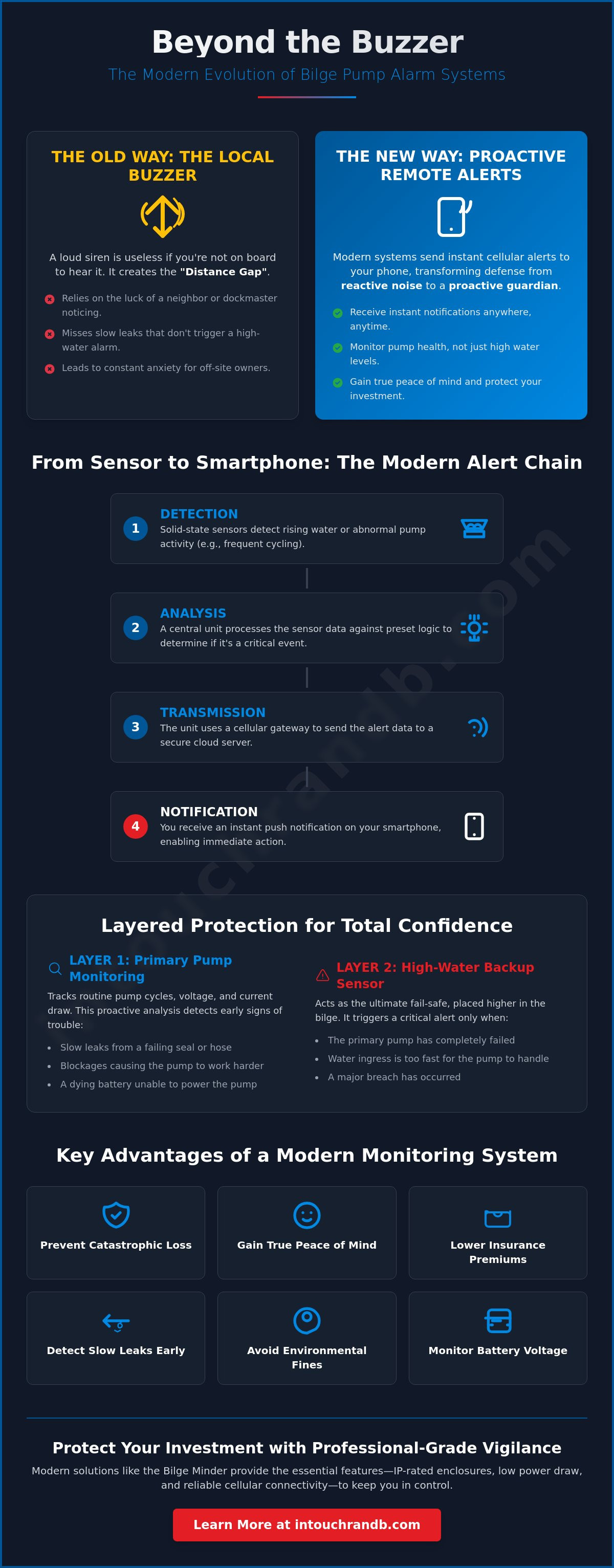
A reliable bilge pump alarm system @ inTouchRandB.com "Bilge Minder " serves as the critical link between a mechanical event and a human response. While the bilge pump itself is designed to remove water, the alarm system is what tells you that the pump is struggling to keep up or that a leak has exceeded normal parameters. For decades, the standard for boat protection was a simple float switch connected to a loud siren. If water lifted the float, the buzzer sounded. This reactive setup assumes that someone is always within earshot to intervene. In reality, most vessels spend the majority of their lives unattended at a dock, where a 100dB siren is nothing more than background noise to a passing seagull.
The siren is useless if you aren't there. This creates what we call the "Distance Gap." If you are at home, at work, or even just a few piers away at a marina restaurant, a traditional local alarm fails to protect your asset. By the time a neighbor notices the sound or the harbor master sees your boat sitting low in the water, the damage is often catastrophic. Beyond the risk of total hull loss, an unmonitored bilge can lead to severe environmental fines. If your pump activates and discharges oily water into the marina, you could face significant penalties under MARPOL regulations. A modern monitoring approach closes this gap by transforming a local noise into a remote notification, shifting your strategy from reactive equipment to proactive "Minder" systems.
The Problem with Local-Only Alarms
Local alarms rely heavily on the hope that a dockmaster or a helpful neighbor will hear the siren and know which boat it's coming from. Modern yachts are often built with heavy sound insulation, and marina environments are naturally noisy with wind, waves, and traffic. These factors can easily mask a buzzer. Additionally, many owners leave their pumps in "Auto" mode, which can hide a slow-growing leak. If a pump cycles every ten minutes to clear a weeping thru-hull fitting, it won't trigger a high-water alarm, but it will eventually burn out the motor or drain your batteries (leaving the boat defenseless when the real flood starts).
The Evolution of Marine Monitoring
Marine safety has evolved from basic mechanical float switches toward sophisticated solid-state sensors and cellular gateways. While older systems only cared if a switch was "on" or "off," modern technology monitors the health of the entire circuit. This shift toward real-time data allows you to track voltage, current draw, and cycle frequency. If a pump starts drawing more amps than usual, it's a sign of a blockage or a failing motor. Having this level of detail is becoming an essential part of modern marine insurance compliance, as many providers now offer lower premiums for vessels equipped with remote bilge pump alarm system technology that provides professional-grade vigilance. Just as modern vessels rely on sophisticated data monitoring for safety, global enterprises learn more about Computer Market Research to automate and streamline their complex distribution channels.
How a Modern Bilge Monitoring System Works
A modern bilge pump alarm system @ inTouchRandB.com "Bilge Minder " operates as a sophisticated communication chain rather than a simple electrical loop. The process begins with detection, where a sensor identifies the presence of water. This trigger sends a signal to a central processing unit, which then evaluates the data against pre-set logic parameters. If the system determines the event is abnormal, it transmits the data via a cellular gateway to a cloud server, which immediately pushes a notification to your smartphone. This entire sequence happens in seconds, ensuring you are the first to know about a potential issue even when you're miles from the dock.
Strategic sensor placement is vital for this architecture to work correctly. You should have a sensor monitoring the primary pump's activity and a separate high-water sensor placed slightly higher in the bilge. While the primary sensor tracks routine operation, the high-water backup acts as an emergency fail-safe. Following Federal regulations for bilge pumps ensures your vessel meets baseline safety standards, but a smart system goes further by analyzing pump cycle frequency. If your pump cycles three times in an hour during a dry spell, the system identifies this as a slow leak (even if the water never reaches the high-water mark). This early warning allows you to address a failing packing gland or a loose hose clamp before it becomes a crisis.
Detection: Sensors and Switches
Reliability starts with the hardware. Traditional mechanical float switches are prone to sticking due to debris or corrosion. Solid-state electronic sensors are often preferred because they have no moving parts to fail. For those seeking maximum protection, some sensors can even detect the presence of oil or fuel. This is a critical feature for environmental compliance, as it prevents the pump from accidentally discharging contaminants overboard and incurring heavy fines. Redundancy is non-negotiable; having multiple detection points ensures that a single component failure won't leave your vessel unprotected.
Notification: The Cellular Advantage
Once a trigger is detected, the method of notification determines the system's effectiveness. While some systems rely on marina Wi-Fi, cellular monitoring is far more robust because it doesn't depend on a local router that might lose power or signal. A high-quality system uses a "Heartbeat" signal (a periodic check-in between the boat and the server) to confirm the monitor is still online. If the heartbeat stops, you receive an alert immediately. This layer of security ensures that your remote vessel protection remains active regardless of local network stability. You can also customize alert tiers, receiving a gentle reminder for a low battery but a high-priority emergency alert if the water level rises rapidly.
Local vs. Remote Monitoring: Choosing Your Protection Level
Selecting the right bilge pump alarm system @ inTouchRandB.com "Bilge Minder " involves balancing your specific boating habits with the inherent risks of your marina environment. For some, a simple audible buzzer is the first line of defense, but its utility is strictly limited to periods when someone is physically on the vessel. If a hose bursts while you're sleeping in the v-berth, the siren does its job. If that same hose fails while you're at work, the siren is useless. To choose the right level of protection, you must evaluate the hardware requirements against the potential for catastrophic loss.
The total cost of ownership for these systems shouldn't be measured only by the initial purchase price. Instead, consider the value of the asset being protected and the potential for environmental cleanup costs. A basic local system is inexpensive but has a critical failure point: it requires a human listener. Advanced hybrid systems, which combine local sirens with cellular notifications, remove this vulnerability. These systems provide a layer of protective vigilance that remains active even during the off-season. Regular bilge pump maintenance and testing is still required, but a remote monitor acts as a 24/7 digital dockmaster for your vessel.
Feature Comparison Framework
-
Local Buzzers: These are best suited for dayboats or vessels that are rarely left unattended. They provide immediate feedback for those on board but offer zero protection once the cabin is locked.
-
Remote Alerts: These systems use cellular gateways to send text or app notifications. They are essential for any boat kept in a slip, as they bridge the "distance gap" discussed earlier.
-
Hybrid Systems: This is the gold standard. It combines a loud local alarm to alert anyone nearby with an immediate remote notification to the owner. This ensures that even if you miss the text, a neighbor or dockmaster might still intervene.
The Hidden Value of Cycle Counting
One of the most significant advantages of an advanced bilge pump alarm system @ inTouchRandB.com "Bilge Minder " is the ability to track pump cycles over time. Most owners only care if the pump is running "now," but historical data is far more revealing. If your data logs show that your pump is cycling ten times a day when it used to cycle twice, you have a clear indication of a failing through-hull fitting or a weeping seal. This predictive data allows you to schedule repairs before a mechanical failure occurs. The Bilge Minder approach prioritizes this historical logging, giving you a chronological record of your pump's health. By monitoring run-time data, you can predict pump motor burnout and replace the equipment on your own terms rather than during an emergency.
Key Features to Evaluate Before You Buy
Choosing a bilge pump alarm system @ inTouchRandB.com "Bilge Minder " requires a careful look at the hardware's resilience and the intelligence of its software. While many systems promise protection, the difference lies in the details of how they handle the harsh marine environment and how they communicate with you during a crisis. You want a system that acts as a silent guardian, working in the background without becoming a burden on your vessel's limited resources. Reliability is the most important factor, as a monitor that fails when the power goes out is no monitor at all.
Installation complexity is another factor to consider. Some systems require a professional technician to integrate with complex NMEA 2000 networks, while others are designed for a straightforward DIY setup. If you prefer a hands-on approach, look for a system that offers clear wiring diagrams and accessible support. Beyond installation, the way alerts are delivered matters. A high-quality system should provide multiple delivery methods, including SMS, email, and push notifications, ensuring that a single network failure doesn't prevent you from receiving a critical update about your boat's status.
Battery and Power Resilience
A dependable alarm must have its own power backup or utilize extremely low-draw circuitry to ensure it doesn't drain your house batteries while the boat is sitting. If the shore power fails, the system should immediately notify you of the change in status, as this is often the first step toward a bilge failure. By monitoring the voltage threshold of your batteries, the system can send an alert before the voltage drops too low to turn over the engine or run the pumps. This proactive approach prevents deep-cycle battery damage and ensures that your vessel remains protected even during extended periods of vacancy. Maintaining your vessel's integrity through constant monitoring is also a key factor in preserving its market value, a point often emphasized by marine professionals at btrship.com when assisting clients with the sale or purchase of high-quality boats.
Reliability in Harsh Environments
The bilge is a hostile environment filled with salt air, high humidity, and various chemicals like fuel or oil. Your monitor needs an IP-rated enclosure and stainless steel components to resist corrosion over time. Non-clogging sensor designs are also essential; a sensor that gets stuck by a bit of debris is a liability. Marine-grade circuitry protection means the internal components are coated or sealed to prevent moisture from causing short circuits or premature failure. To ensure your vessel is equipped with this level of professional-grade hardware, you can browse our selection of bilge monitoring solutions @ inTouchRandB.com "Bilge Minder " designed for long-term durability.
The Bilge Minder Solution: Professional-Grade Vigilance
The Bilge Minder @ inTouchRandB.com represents the pinnacle of our commitment to vessel safety and protective vigilance. It isn't just a sensor; it's a dedicated monitoring platform designed to act as the ultimate guardian for your investment. At inTouch R&B, we combine years of technical expertise with a pragmatic, solution-oriented approach to boat security. We understand that boat owners don't need more noise; they need accurate, actionable information delivered directly to their fingertips. By integrating the Bilge Minder into your boat's existing electrical system, you transform a passive bilge pump into an active, intelligent defense network. This shift replaces the constant "what if" anxiety with the quiet relief of being truly informed about your vessel's status at all times.
Integrating a modern bilge pump alarm system @ inTouchRandB.com "Bilge Minder " into your boat doesn't have to be a complex or invasive process. Our hardware is designed to work seamlessly with your current pumps and float switches, acting as an intelligent overlay that monitors performance without interfering with basic operation. If a mechanical event occurs (such as a pump motor drawing excessive current due to a blockage), the system captures that data immediately. This trigger and response architecture ensures that you are notified of potential failures long before they result in a high-water emergency. It's a professional-grade solution that brings modern connectivity to even the most traditional engine rooms.
Why inTouch R&B is Different
Our "Minder" technology is built on the principle of watchful, ever-present protection. Unlike generic alarms that only scream when a flood is already underway, our systems are designed to watch when you can't. As a national monitoring specialist, inTouch R&B provides a level of focus that multi-purpose hardware manufacturers often lack. We prioritize precision to avoid alarmism; for example, you won't be bothered by a single normal pump cycle. However, if the frequency increases (indicating a potential mechanical failure or a new leak), our system identifies the trend and notifies you before the situation escalates. This dedication to accuracy ensures that every notification you receive is meaningful and requires your attention.
Taking the Next Step in Boat Security
Transitioning to a cellular-based bilge pump alarm system @ inTouchRandB.com "Bilge Minder " is a straightforward process that yields immediate benefits for your peace of mind. You can begin by assessing your current bilge setup for remote compatibility, looking for existing sensors or primary pumps that can be easily monitored. The Bilge Minder is designed to be DIY-friendly, though professional installation is always an option for complex multi-compartment vessels. Once the system is powered and the cellular connection is established (a process that typically takes only a few minutes), your boat is protected by a secure digital heartbeat. You can then rest easy knowing that your asset is under the care of a reliable, expert-grade monitoring service.
Protect your investment with a Bilge Minder alarm system today @ inTouchRandB.com "Bilge Minder"
Securing Your Peace of Mind at the Marina
Investing in a modern bilge pump alarm system @ inTouchRandB.com "Bilge Minder " is about more than just installing hardware; it's about gaining the freedom to walk away from the dock without worry. You've learned that traditional sirens fail when you aren't there to hear them and that proactive cycle counting can identify a slow leak before it becomes a sinking emergency. Since 2014, inTouch R&B has leveraged over a decade of monitoring expertise to provide boat owners with specialized cellular alerts that work reliably in marine environments where Wi-Fi often fails. These systems act as a watchful, ever-present guardian for your vessel.
Our technology is trusted by boat owners nationwide for the protection of critical equipment, ensuring that every notification you receive is accurate and actionable. By choosing professional-grade vigilance, you ensure that your vessel remains secure against mechanical failures and environmental risks. We invite you to Shop the Bilge Minder and Remote Monitoring Collection to take the next step in vessel protection. Your boat is your sanctuary, and with the right guardian in place, you can finally enjoy the relief of being truly informed. You deserve the confidence that comes with professional monitoring.
Frequently Asked Questions
Does a bilge pump alarm system work if my boat loses shore power?
Yes, most systems are designed to operate directly on your vessel's 12V or 24V DC battery bank. This ensures that the monitor remains active even when the AC shore power fails or the battery charger stops functioning. In fact, a high-quality system will send you an immediate notification the moment it detects a loss of shore power, giving you a critical head start to investigate the cause before your batteries drain.
Can I install a remote bilge monitor myself, or do I need a marine electrician?
You can typically install these systems yourself if you have a basic understanding of 12V marine electrical systems. The process generally involves mounting the control unit and connecting a few wires to your existing pump or float switch circuits. If your vessel has a complex multi-compartment layout or integrated digital switching, you might prefer to hire a certified marine electrician to ensure the installation is seamless and complies with all safety standards.
What is the difference between a high water alarm and a bilge pump monitor?
A high water alarm is a reactive device that only triggers a siren when water has already reached a dangerous level. A comprehensive bilge pump alarm system with monitoring capabilities is proactive because it tracks the actual activity of your pumps. By counting pump cycles and measuring run times, the monitor identifies a weeping hose or a failing seal long before the water ever reaches the high-water fail-safe (allowing you to fix the problem on your own schedule).
How much data does a cellular bilge alarm use per month?
Cellular monitors use an incredibly small amount of data because they primarily transmit short bursts of text-based telemetry. These systems don't stream video or large files; they only send data when a trigger occurs or during a scheduled "heartbeat" check-in. This efficiency ensures that the system remains responsive and reliable without requiring a high-bandwidth data plan, making it a practical choice for long-term vessel protection.
Can one alarm system monitor multiple bilge compartments?
Yes, many professional-grade systems are expandable and can monitor several different compartments simultaneously. By putting seperate Bilge Compartment in-series you can install individual sensors in the forward, mid, and aft bilges and wire them back to a single central processing unit. This configuration allows the system to send you specific alerts, so you'll know exactly which area of the boat requires your attention when a notification arrives on your phone.
Will a bilge alarm lower my boat insurance premiums?
Many marine insurance providers recognize the value of remote monitoring and offer premium discounts for vessels equipped with a **bilge pump alarm system **@ inTouchRandB.com "Bilge Minder ". Because these systems act as a 24/7 guardian that can prevent a total loss from sinking, they significantly reduce the risk for the insurer. It's always a good idea to provide your insurance agent with the technical specifications of your monitoring system to see if you qualify for a rate reduction.
What happens if the cellular signal is weak at my marina?
If you encounter a weak signal at your slip, you can usually resolve the issue by adding an external high-gain antenna to the system. Most modern monitors are designed to handle varying signal strengths and use a "heartbeat" signal to maintain a constant connection with the cloud server. If the system stays offline for a certain period, the server identifies the lack of response and sends you an alert (notifying you that the connection has been lost).
Can I get alerts on more than one phone or email address?
Yes, you can easily configure your monitoring account to send notifications to multiple recipients at the same time. This is a helpful feature for owners who want their spouse, a trusted dock neighbor, or a local yacht manager to be informed during an emergency. You can often customize these settings so that certain people only receive high-priority flood alerts while you receive all routine status and battery updates.

Article by
Jimmy Nesbitt
Principle
Be the first to comment